Rodrigo Duterte camp asks ICC to reject ex-Davao City cop's prior recorded testimony
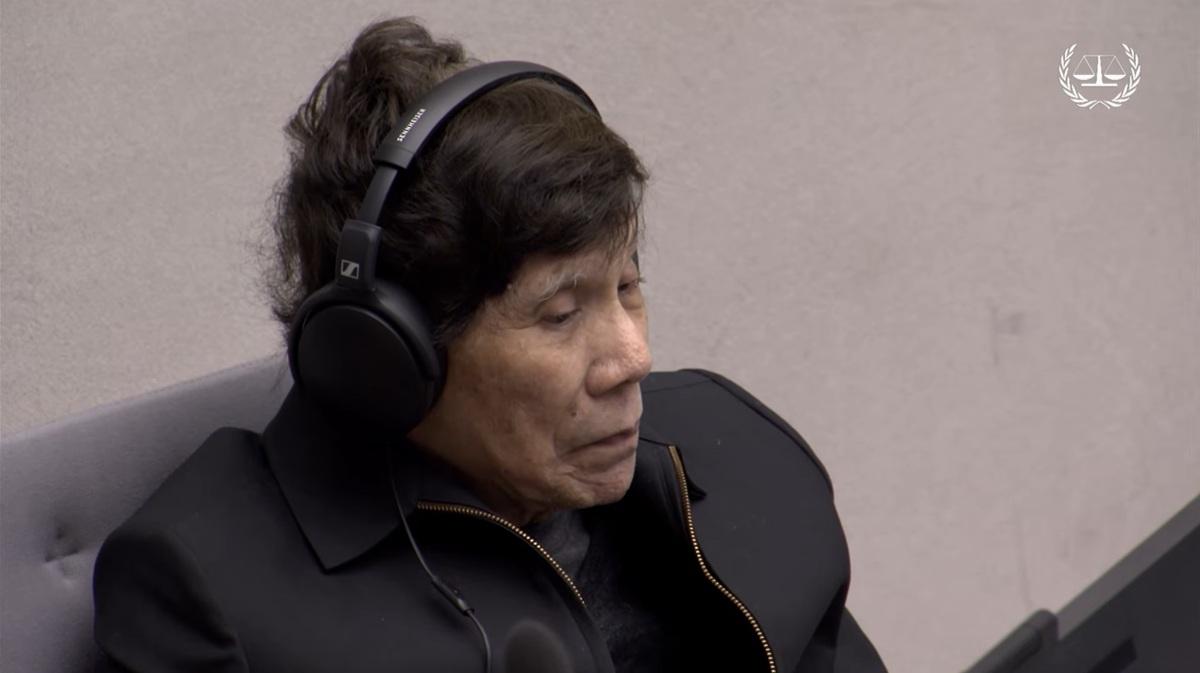
PRAGUE, Czech Republic – For former President Rodrigo Duterte’s defense team, the testimony of the ex-Davao City police officer sought by International Criminal Court (ICC) prosecutors to be admitted in court has “serious deficiencies” and must be rejected by Trial Chamber III.
Duterte’s counsel Peter Haynes contests the admission of P-0002’s evidence, saying the articles invoked by the Office of the Prosecutor to collect and preserve it require proof that a witness can no longer testify orally.
“Absent such proof, the prior recorded testimony cannot be admitted and the witness must be called to give his evidence viva voce,” Haynes said in a public redacted filing released on November 18.
Haynes’ legal challenge comes roughly ten days before the ICC’s trial of the former president opens, with information still unclear about which witness testimony and evidence will be admitted in court.
Haynes described P-0002 as a “central Prosecution witness” and said his testimony is the most heavily cited in the prosecution’s trial brief.
Prosecutors seek to admit P-0002’s preserved testimony under Article 69(4), following what they described as a “unique opportunity” to interview him and obtain evidence that “may not be subsequently available.”
The prosecution also informed the chamber that P-0002 is “no longer available” to testify before the court. The filing conceals the details of that significant risk, as well as the reason for P-0002’s expected absence.
The Common Legal Representatives of the Victims (CLRV) support the admission of P-0002’s evidence, which they described as having “particular importance” due to his “position and first-hand knowledge”, which makes his testimony “particularly significant” in the former president’s case.
Defense, prosecution clash over evidence
Duterte’s lawyers dispute how the prosecution obtained P-0002’s evidence, questioning whether it has adequately established its unavailability.
Aside from arguing that the prosecution has no documentary evidence to support P-0002’s evidence, Haynes also questioned the reliability of the former policeman’s account.
He pointed to alleged inconsistencies concerning charged Incident 1, including differences over the year of the incident, the number of victims, the perpetrators, and the circumstances of the killings.
In the Prosecution’s Trial Brief, Incident 1 refers to the killing of three unidentified alleged drug pushers by Davao Death Squad members in or around 2013 in San Rafael, Davao City. Prosecutors said then-Davao City Mayor Rodrigo Duterte “instructed police DDS members that there was a job to be done against three alleged drug pushers.”
The filing also said P-0002’s statement appears to be the sole source for several allegations concerning Duterte’s conduct.
These include prosecution allegations that Duterte created a police “Death Squad”, told police DDS members they were being tasked as hitmen, ordered co-perpetrator Vicente Danao “to kill three or four men”, gave financial rewards to DDS handlers, and financed weapons and ammunition through this intelligence fund.
These allegations were raised in the prosecution’s case and were not established as findings by Trial Chamber III.
Aside from this, Haynes pointed to another redacted individual or entity that he referred to as the “sole source”, which has “not provided a sworn statement” about the circumstances of P-0002 and his situation, which remains concealed.
Much of Haynes’ allegation over that “sole source” is redacted, but he cited obscure statements that he said “reveal an intention to steer the proceedings”.
“Taken together, these shortcomings undermine P-0002’s descriptions of Mr. Duterte’s alleged actions,” Haynes argued.
“Given the Prosecution’s submission that P-0002 is [REDACTED] and in the absence of any supporting documentation, the only appropriate remedy is the exclusion of his evidence.”
Corroborations in P-0002’s evidence
Among the 62,000 items of evidence prosecutors disclosed to the defense, Haynes said they found no material corroborating claims about P-0002.
The defense also said the former policeman’s statement and associate materials “portray a witness deeply hostile towards Mr. Duterte and paint a picture of an individual who is emotionally unstable.”
Describing the materials, including handwritten notes whose contents are redacted, Haynes said P-0002’s evidence “reveals a paranoia” and “leads him to exaggerate” information.
“This aligns with P-0002’s erratic conduct,” Haynes argued.
The other batches of associated material, including two handwritten notes, an unsigned and undated typed affidavit, and a Philippine National Police personal data sheet, “were not used or commented on P-0002” and had no verification or authentication.
The defense also questioned how the interview was conducted, stating that a counsel appointed by Pre-Trial Chamber I at the time represented the defense “as an observer."
Calling it a “significant error”, Haynes said the previous counsel’s involvement was “negligible” and that their presence “was a formality” that gave “no substantive protection to a future defendant’s rights”.
Criminal records of witnesses, victims sought
In a separate filing, Duterte’s lawyers asked judges to order prosecutors to seek and disclose criminal history information concerning witnesses and victims identified in the prosecution’s updated Trial Brief.
The defense wants records of arrests, convictions, sentences, non-judicial dispositions, arrest warrants and Interpol notices.
It argued that such information may be relevant to witness credibility and may also be “potentially exculpatory.”
The defense singled out P-1302, whom it identified as the first prosecution witness expected to testify.
It said open-source material indicates that P-1302 has been the subject of a redacted number of legal cases in the Philippines, but no corresponding judicial records have been disclosed.
Duterte’s lawyers also said the criminal records of alleged victims could be relevant to testing the prosecution’s case theory on police claims of self-defense.
They argued that records showing an alleged victim had an arrest warrant or faced proceedings for an offense such as illegal possession of firearms could support the legitimacy of a particular police operation.
The defense asked the Chamber to order the prosecution to immediately seek and obtain requested information.
For witnesses expected to testify before January 1, 2027, it asked that the materials be disclosed no later than November 30.
Trial Chamber III has yet to rule on either request.
Duterte’s crimes against humanity trial is scheduled to open on November 30. —VBL, GMA News
KioskNews shows a cleaned-up reading view extracted from the publisher’s page — the original always lives on their site, not ours.