Ministry recognizes heat management as priority
PREPARING FOR HIGHS: The ministry has been preparing for heat-related risks since 2024, and is planning for a 40?C global warming scenario, it said
By Esme Yeh / Staff reporter


Heat management is the priority in climate adaptation globally, Deputy Minister of Environment Hsieh Yein-rui (謝燕儒) said yesterday, adding that the Ministry of Environment would assist other central agencies in identifying heat adaptation issues.
Hsieh made the remarks at a public hearing on the draft of the fourth-phase National Climate Change Adaptation Action Plan.
Hsieh said that the nation’s hottest 11 years occurred from 2015 to last year.
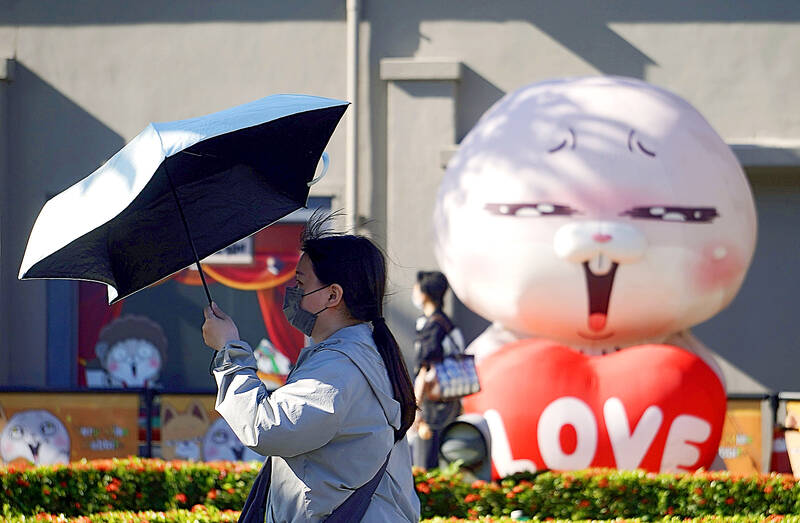
A pedestrian holds an umbrella as protection from the sun in Kaohsiung on June 22.
Photo: CNA
Taiwan has been preparing for heat-related compound disaster risks since 2024, with a focus on medical care, social safety nets, power supply and transportation, he said.
The nation’s current heat adaptation plans were made according to 1.5°C and 2°C global warming scenarios, he said, adding that the ministry expects to plan toward the 40°C scenario.
Heat management has become the priority issue for climate adaptation in many countries, including Singapore, Japan, South Korea and European countries, Hsieh said.
The ministry has focused on examining existing heat management efforts by ministries under the action plan’s previous phases, he said.
International heat adaptation experiences were introduced to help the ministries identify their heat-related issues and countermeasures, Hsieh said.
National Science and Technology Center for Disaster Reduction official Chen Yung-ming (陳永明) said that the action plan was formulated based on the projected warming scenarios proposed in the Intergovernmental Panel on Climate Change’s sixth assessment report.
The report said that a 1.5°C or 2°C rise in global warming is inevitable from 2020 to 2060, whether global carbon reduction efforts are successful or not, he said.
Taiwan’s national heat adaptation scenarios were defined according to the temperature rise, Chen said.
However, the World Meteorological Organization updated the projections months ago, announcing that the likelihood of global warming by 1.5°C over the next five years has reached 75 percent, he said.
The National Science and Technology Council would plan for 3°C and 4°C warming scenarios, while the ministries would still focus on preparing for a 1.5°C rise by 2040 and a 2°C rise by 2060, Chen said.
Although the warming scenarios were not changed for the ministries, latest scientific data and more variables would be incorporated into the fourth-phase action plan, he said.
In accordance with Article 18 of the Climate Change Adaptation Act (氣候變遷因應法), the environment ministry last year promulgated the Regulations for Climate Change Risk Assessment (氣候變遷風險評估作業準則) to establish a consistent methodology for developing adaptation plans, Chen said.
According to the fourth-phase action plan, eight fields were identified as vulnerable to the impact of climate change: essential infrastructure, water resources, land use, marine and coastal areas, energy supply and industries, agricultural production, ecosystems, and public health.
The environment ministry has adopted a four-tier grading approach to assisting ministries in planning toward heat adaptation across the eight fields.
The four tiers include: Update existing risk assessment results or adaptation strategies; complete ongoing risk assessments and identify adaptation gaps; define the scope and identify the link between ministerial work and climate risk; and other tasks unrelated to risk assessments.
Chen said that 104 adaptation measures have been established and more than half of them involve risk assessments.
KioskNews shows a cleaned-up reading view extracted from the publisher’s page — the original always lives on their site, not ours.