‘Club Kid’ Breakout Saturn Risin9 on Auditioning Weeks After Facial Feminization Surgery and a New Era for Queer Cinema: ‘Straight People Want to See Things They Don’t Know About’
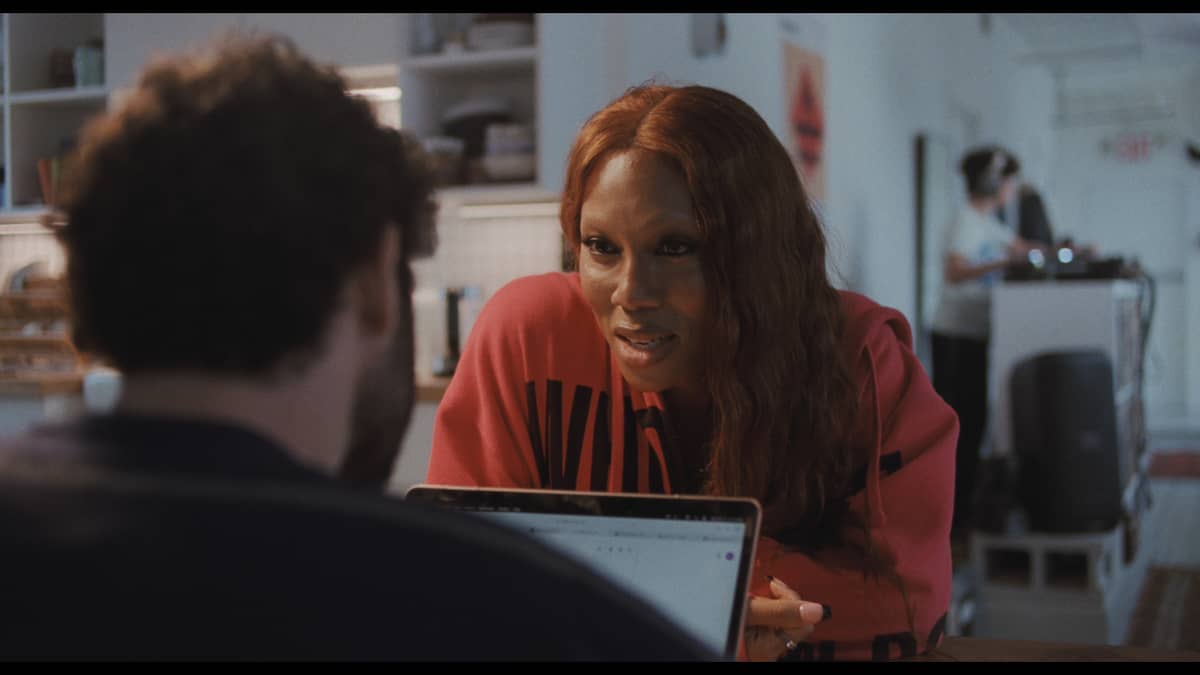
When Saturn Risin9 auditioned for Jordan Firstman’s “Club Kid,” her face was still swollen from facial feminization surgery. The musician, DJ and nightlife fixture, who had undergone the procedure a month earlier in April 2025, hadn’t even attempted to put on a wig since her surgery. Unable to bring herself to let anyone into her apartment, she played all three characters in her self-tape.
“I think they were just like, ‘Who is this crazy lady?’” Risin9 recalls with a laugh.
Firstman, a longtime friend from the nightlife circuit, had told Risin9 at a party two years earlier that he was writing a role for her. But the audition request came just weeks after her gender-affirming surgery. For Risin9, the timing felt like an affirmation — “I thought it was so aligned, at the moment that I was so authentic with myself, that the world opened up to me,” she says.
Now, Risin9 is one of the breakout stars of Firstman’s A24 comedy-drama, which follows a New York City party promoter whose life is upended by the arrival of a son he never knew he had. As Saffron, a DJ with a protective streak and diva sensibilities, Risin9 brings to the film two decades of experience navigating underground nightlife.

The Bay Area native grew up performing in theater productions and wrote her first play at 11, but turned her attention to music in her 20s after finding that the acting roles available to her didn’t align with her identity. She built a career as an independent recording artist, DJ and performer, touring internationally before relocating to Los Angeles in 2017.
Perhaps most gratifying to Risin9 has been the film’s reception among audiences far removed from the world it depicts. After a screening at Telluride Film Festival, she was approached by a father who was crying in the arms of his daughter. “I was like, ‘Are you okay?,'” she recalls. “And he was like, ‘Your movie was just so beautiful.'”
Even Risin9’s mother, who has historically been less comfortable watching queer intimacy on screen, (“She likes to pretend that she can’t watch people make out and I’m like, ‘I think you just don’t want to see gay stuff’) came away a fan.
The film’s success also comes at a particularly exciting moment for queer cinema. In addition to “Club Kid,” stories centered on gay men — such as “Elsinore,” “La Bola Negra” and “Artificial” — dominate awards season buzz this year. “These films exist in a post-‘Heated Rivalry’ moment during which audiences seem newly open to queer stories,” Variety’s Dan D’Addario wrote last month, posing the question: is this the gayest Oscar season ever? “These films launch into surprising directions, showing many different sides of the gay experience.”
Risin9 similarly describes this era as the “de-‘Will & Grace’-ification of queer art,” in which LGBTQ stories are increasingly afforded the complexity, specificity and messiness that Hollywood has long granted their heterosexual counterparts. “Straight people want to see more things that they don’t know about,” she says. “We all want to learn. We don’t want to stagnate.”
Below, Risin9 talks about her audition process, her evolving relationship with nightlife and teaching her young co-star Reggie Absolom to DJ:
You just attended the Governor’s Awards for the first time. Did anyone exciting come up to you to talk about “Club Kid”?
Léa Seydoux told me that she loved me in “Club Kid.” She just comes up to me and goes “I love you in the movie,” and I was like, “You saw ‘Club Kid’?” She was like, “I loved it,” and we actually walked the red carpet for “Gentle Monster” in Cannes. So it was kind of a kismet moment.
She had that knowingness that she was giving me something. You know what I mean? Like, “I have to tell you this, and you’re gonna live for it.” It was so cute.

What’s so special about “Club Kid” is its authenticity to queer culture. What was the process like with the script? How much of it was improv and bringing your real-world experience into it?
I didn’t want to be too aware of what was happening because something that I love about acting is letting go and finding that space where you know the rhythm of it and you know what your cues are, but you’re also allowing for the character to be thinking and to be human instead of just waiting to perform.
The first scene that we shot was the one where we go to Peter’s [Firstman’s] house and find out that he has Arlo, and we’re all busting in the house. I was supposed to say a few words about convincing him to do this party — and I was saying it so big, and Jordan just goes, “Just say it.” And I was like, “Oh, okay.”
That was what Jordan’s direction always was. It was a lot of trust, but also the encouragement to be comfortable in it and not to be so showy.
How did you get involved in “Club Kid”?
Jordan and I were very friendly party friends. We’ve always had a really good rapport, and we hung out once in Atlanta. I brought my little cousin with me and I’m very protective of my family. I’m the disciplinarian. So I think he got to see that outside of the “most fun girl at the party,” I’m also this maternal, super supportive figure. And I think his wheels started to turn.
I saw him about two years later at a party, and he was like, “Hey, I wrote this movie and I wrote a role for you. Would you be in my movie?” It’s like 5 a.m. So I’m like, “Yeah, girl, whatever.” You know how many people stop me at the end of the night and say, “Oh my God, it would be so cool if we did this?”
What was the audition process like?
I showed up in a fully laced bodysuit, thinking that they wanted to see a club diva. So I’m in this lace bodysuit at 10 a.m. in Hollywood. And I thought they wanted one of those nasty girls. I was reading it kind of cunty.
And then at the end, Carmen Cuba, our casting director, was like, “Can you do it more empathetic?” And I was like, “Okay, that’s me! Let’s talk. Let’s go.”

What was your experience working so closely with Reggie?
There’s a line in the movie where it’s like, “When’s the last time you saw a kid?” And I was like, really, actually, when was the last time I saw a kid? Because I also didn’t know if he knew trans people. I was in my head. The last time I saw a kid, the kid was bullying me. So I was like, “Whoa!” Kids can be scary. And he could be a bro who just randomly got cast in this queer movie.
So I was just so surprised at how well-adjusted and kind and really cool he is. We were going over these vinyl and I’m like, “Do you like this one?” He’s like, “No, I like heavy metal.” And I was like, “Oh!”
I really did teach him how to DJ because Twitter is a scary place, and I’d hate for someone to zoom in on the movie and be like, “Why are you turning those knobs?” Now we’ve done DJ sets together and he actually knows what he’s doing.
Queer cinema is already garnering a lot of buzz this awards season. What are your thoughts on the current state of queer representation in fillm?
I think this might be the first year where I’m not seeing the shortcomings. I’m seeing incredibly different stories. I love that “Club Kid” is like the de-“Will & Grace”-ification of queer art because that was that safety that they were selling in the ’90s and it kind of kept going for so long. Like, “Oh, we’re just kind of quirky, normal people who like to shop,” or something. And it’s just so much realer than that.
And even “La Bola Negra” being this Odyssey-level film. It’s incredible that there are so many different avenues of our lives and our fantasies being shown in the way that everything else is shown in the world because it’s normal. Life is normal for the people that are living it, and many people live many different lives.
KioskNews shows a cleaned-up reading view extracted from the publisher’s page — the original always lives on their site, not ours.