Notes from Central Taiwan: The environmental cost of a war over Taiwan
Attacks on industrial sites could leave lasting damage to land, water and wildlife, raising questions about Taiwan’s ability to respond and recover in the event of a cross-strait contingency
By Michael Turton / Contributing reporter


Off the coast of Taichung lies the well known Gaomei Wetlands (高美濕地), a popular nature preserve. On weekends, especially in the evenings, the site’s walkways are crowded with sunset watchers, its mudflats filled with people wading and taking pictures of the local wildlife. Birds, amphibious fish, crabs and other organisms flourish.
A few hundred meters to the south Berth number 8 of the Port of Taichung juts inland, surrounded by chemical plants, cement factories, chemical storage sites, warehouses and wind turbines. This infrastructure, critical to the running of a major industrial economy, will be targeted in wartime. Though they do not know it, the nearby creatures of Gaomei and elsewhere are going to be among the first casualties of strikes by the People’s Republic of China (PRC).
CHEMICAL DISASTER
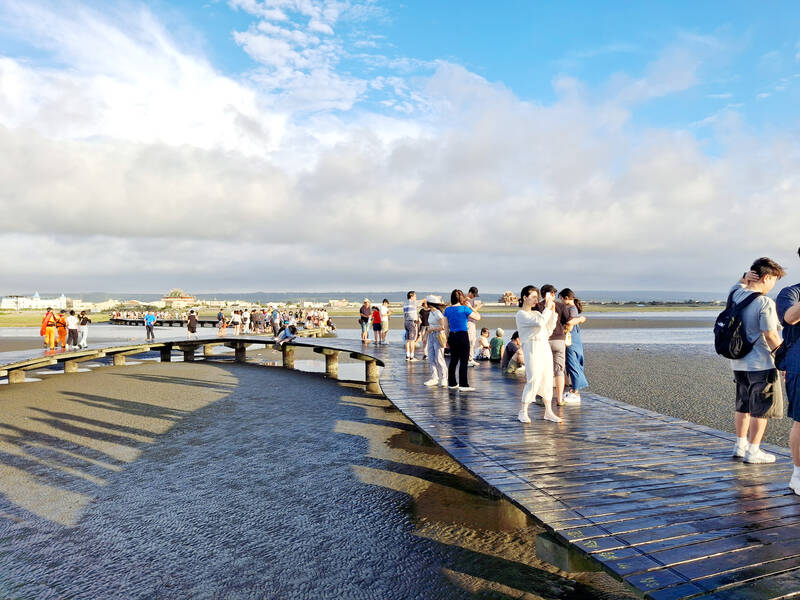
Boardwalks at Gaomei Wetlands in Taichung are crowded with tourists at sunset.
Photo: Michael Turton
Observers often comment on Taiwan’s power plants and its nuclear plants, but chemical and physical disasters will also result from PRC strikes on chemical plants and storage sites. These strikes will almost certainly have catastrophic effects on nearby wildlife. The PRC need not deliberately target wildlife, near misses and accidents will take a terrible toll, as will the diversion of resources from environmental care-taking to warfighting. The same thing will happen as Taiwan attacks PRC ports and near-shore facilities with its own missiles. A cross-strait war will be an environmental disaster.
Many have written on a cross-strait war and occupation. Few have considered the environment and clean-up. History shows it will be long. The aftermath of the US’ failed adventure in Vietnam left Laos, Cambodia and Vietnam covered in mines and bombs, still killing after all these years.
Russia’s invasions of Chechnya have left 30 percent of that nation unable to “meet environmental conditions for life,” according to research by the Central Asia-Caucasus Institute & Silk Road Studies Program. Soils become laden with toxic metals after war, the layers underneath the surface compacted by explosions, altering water flows and reshaping local ecologies. Some areas of France still cannot be farmed, the legacy of two invasions by Germany.
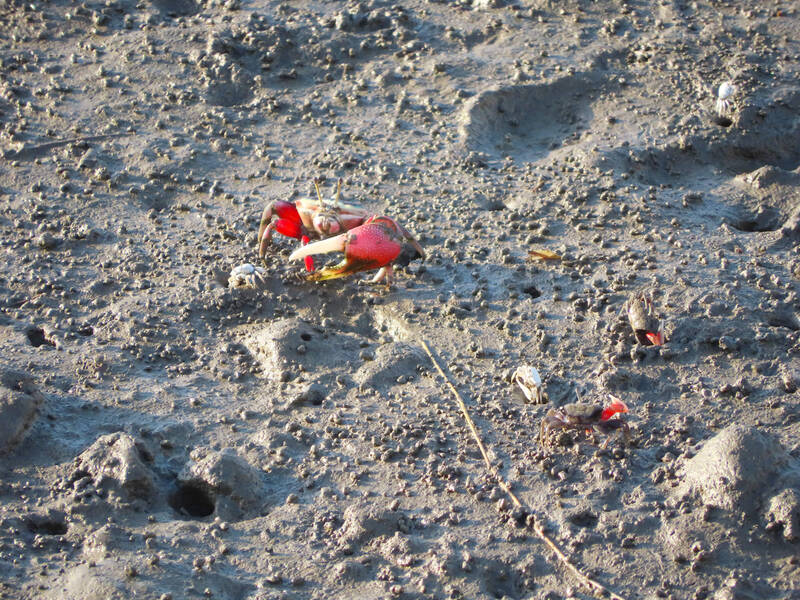
Crabs seen from the boardwalk at Gaomei Wetlands in Taichung.
Photo: Michael Turton
Occupation is expensive, and the population of Taiwan likely to be restive. Anyone out there think the PRC is going to be sparing occupation funds for expensive remediation of the nation’s soils after impregnating them with every kind of poison during a bombardment and invasion?
Industrial waste handling has been remiss, to say the least. One common method is to pave over a fishpond after filling it with waste, then build a pre-fabricated steel building on top. In other areas wastes are simply piled up and ignored. Illegal waste sites are still a chronic problem. Many of these sites are going to take damage in a bombardment. No one knows what is inside them.
Toxic chemicals, already a problem for the nation’s water tables, are going to dramatically worsen. Not only will domestic chemical production and storage facilities be hit, but missile and rocket fuels, chemical explosives and toxic metals from munitions (almost all munitions contain large quantities of lead) will contaminate the water table as well. Rocket fuels often contain sulfur, which forms sulfuric acid in the presence of water, burning the land. PRC planners may well consider water facilities such as reservoirs fair game for missile attacks, further poisoning the water supply. The coastal regions of the PRC, alive with industry, will suffer in the same way, as Russia is under the growing bombardment by Ukraine.
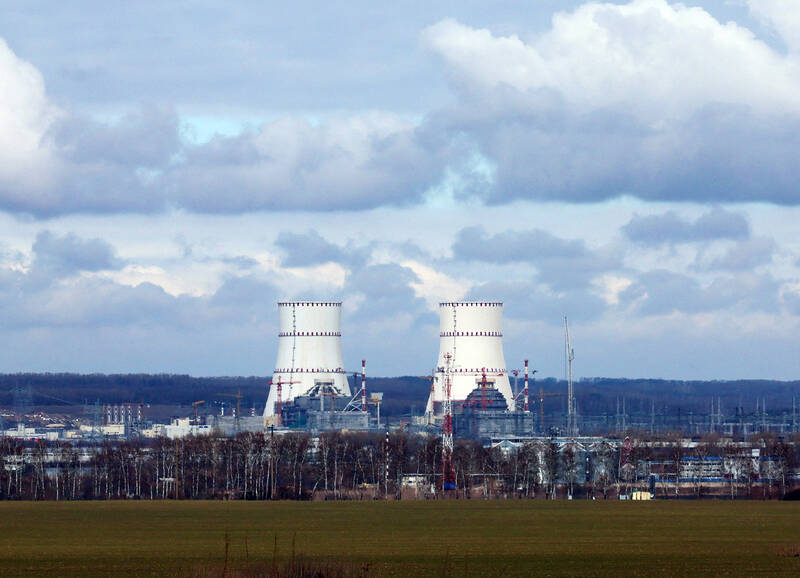
A view in March last year shows the Kursk Nuclear Power Plant in the course of Russia-Ukraine conflict, as seen from the town of Kurchatov in the Kursk region, Russia.
Photo: Reuters
FIRE HAZARDS
In Ukraine, forest fires created by the war are a problem. Nor can firefighters access them when they occur along the front lines or in areas planted with land mines or swept by hostile drones. Consider how many small fires set by locals clearing graves for Tombsweeping Day blossom into conflagrations requiring local fire departments to respond. PRC munitions will set hundreds of such fires on hillsides, in fields or in forests, which will burn out of control as firemen will be assigned to even more urgent fires at buildings and factories. Many of these fires generate toxic wastes and dust. Are Taiwan’s firefighters equipped to deal with them?
Taiwan’s petrochemical plants will not escape bombardment, since they produce war materials (the PRC will likely systematically destroy firms that compete with PRC companies). Under normal operating circumstances fires are a hazard (11 fire incidents in Taiwan’s petrochemical plants since 2009). In war it will be much worse, and the resulting toxic pollution vast. Taiwan’s chemical firms, which also produce war materials and compete with PRC firms, will be struck as well. The infamous industrial chemical disaster at Bhopal resulted in thousands of deaths and many more injuries, in part because local hospitals were ill-equipped to deal with chemical poisoning. Taiwan may not suffer injuries on that scale, but it will suffer large-scale injuries as chemical clouds, released by combat damage, expand over nearby built-up areas, especially in the north. Can local hospitals handle mass chemical casualties?
That waste won’t disappear when the war is over. Both the PRC and Taiwan will be stuck with enormous clean-up bills, degraded and useless urban and farm land and long-term medical bills for large numbers of people. The atmosphere and water will be polluted for months afterwards. Oil will leak from the bunkers of ships sunk in the sea around the island.
The horrors will not be confined to the west coast. Hualien will be under constant missile and drone attacks, and east coast ports will be targeted. The nation’s most important cement plant, the Asia Cement Corp (亞洲水泥) plant near Sincheng (新城) in Hualien, will be a major target. Pristine natural areas, archaeological sites, orchards and farms, would be impacted. Yet skilled workers to carry out clean up and remediation during wartime are few and far between on the east coast.
EVACUATIONS
One aspect of defense preparedness is going to be practicing for evacuations and remedial measures in the wake of all this destruction. Much attention has been given to military drills, perhaps in part to instill confidence in the public. What Taiwan needs is a far broader set of drills, along with investment in equipment and personnel development.
For example, precinct captains and neighborhood chiefs will need training in simple procedures like getting everyone in their neighborhood evacuated, and in handing orders and information up and down the chain of command. Individual Taiwanese will need to practice evacuating as well. These systems for evacuations, established with a conventional bombing in mind, will break down when the war begins if local residents do not practice.
A drone hit a cooling tower at the Kursk nuclear power plant in Russia last week. Barakah Nuclear Power Plant in the United Arab Emirates was attacked by three drones in May. One got through the defenses. Taiwan is moving to restart at least one of its nuclear power plants. It will almost certainly be a target in a PRC bombardment.
Is anyone prepared for a radiological disaster?
Notes from Central Taiwan is a column written by long-term resident Michael Turton, who provides incisive commentary informed by three decades of living in and writing about his adoptive country. The views expressed here are his own.
KioskNews shows a cleaned-up reading view extracted from the publisher’s page — the original always lives on their site, not ours.