‘My brother was its first body’: would you add your corpse to Birkenhead’s pyramid of dead people?
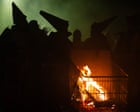
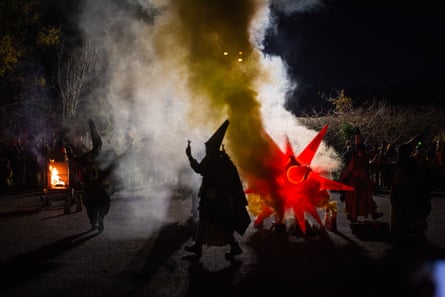
Hundreds of people wearing hi-vis clothing are on a death march through Birkenhead Park. A burning shopping trolley leads the way, smoke grenades clog the air, and people holding traffic signs chant: “The dead don’t stop – till they reach the top.” There’s a wave of curtain-twitching from residents who look on with fear and bemusement as what looks like a psychedelic building site gone rogue marches through their beautiful recreation space. Where could they be going? The answer might shock some of them. For this crowd are on their way to build a pyramid … made of dead people.
“My brother calls it my ‘anarchist death cult,’” laughs Steve Lowe, chief engineer of L-13 Light Industrial Workshop, who is involved in running Birkenhead Day of the Dead and the People’s Pyramid. It’s an event that has taken place every year (except 2020) since 2018 in a variety of locations and was announced by Jimmy Cauty and Bill Drummond of the KLF (AKA the Justified Ancients of Mu Mu AKA K2 Plant Hire Ltd), the seminal electronic duo and experimental art provocateurs, when they returned after 23 years in 2017.
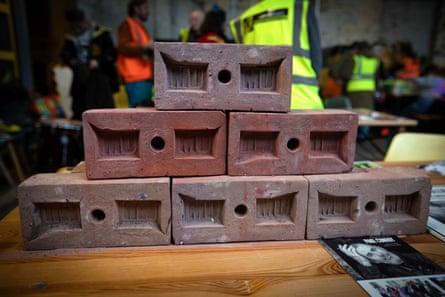
A solid brick monument is being built that will eventually contain 34,592 bricks, with each brick containing a small portion of a person’s cremated remains (23 grams of ashes are inserted and fired in a kiln until the remains become glaze). The process is called MuMufication, which people can sign up for – either for themselves or for lost loved ones – and this year 39 people are being added to the pyramid to create a total of 159. The pyramid lives in a shipping container and is removed each year for the ceremony but plans are being proposed to house it permanently in Birkenhead Park to coincide with its bid for 2028 Town of Culture. “Permanent site funding would be amazing,” says Lowe. “Because at the moment, all we do is sell tickets and merch and we lose money.”
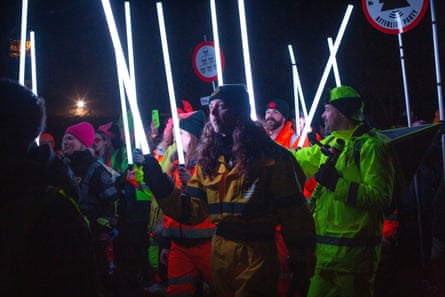
You can see why. The event is impressively high production. There’s a huge outdoor stage with visuals and a booming sound system. Rumbling ominous drones blare out as the death march approaches, and cement mixers churn through bags of cement as the pyramid is built one brick at a time. “The first year was literally on a bit of waste ground in Toxteth,” recalls Cauty. “It was done really guerrilla style but now it’s growing under its own steam. It’s probably the best thing I’ve been involved in.”
This was always a personal project for Cauty. “It’s got a ridiculous amount of meaning to me,” he says. “My brother was the first person to be in it.” Cauty’s brother died suddenly in 2016 and he was left feeling like more needed to be done to celebrate him. “His funeral was great but there was a part of me going, ‘It’s not really spectacular enough’,” he recalls. “We should have been processing through a forest and burning his car or something. Or just doing something that he would go, ‘Wow, that is really cool. Thanks for doing that’.”
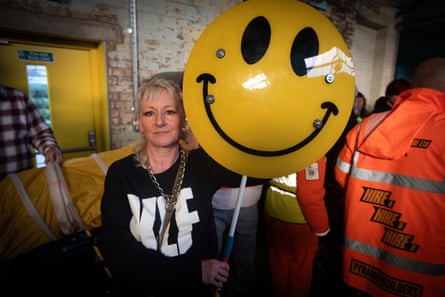
All ticket holders are assigned a role: everything from assembling signs to creating noise via marshalling and procuring a shopping trolley to be used as a fire basket. There’s a real buzz in the room. Quite literally, as one group are practising The Bee Gees’ Staying Alive via a chorus of kazoos as a drum bangs over it. Lisa Beanland and a team are busy building a giant Colin the Caterpillar in the style of a huge Chinese dragon puppet but with an acid house smiley face on. Also tied to it are reflective strips with the names of every single person who is in the pyramid handwritten on. “I’ve got two family members in the pyramid,” Beanland tells me. “There’s a really strong community of brick families. We meet every year and they’ve become our family.”
One person who has created an original poster for the day is Ed Bradbury, AKA Sheffield artist Kid Acne. “Once you come and experience this, it’s hard to not come back and want to contribute,” he says. Bradbury has been the last three years, after committing his father to the pyramid. Like Cauty, he felt like something was lacking after his death. “The funeral and the scattering of ashes weren’t the send-off I had in mind,” he says. “And this helped rewrite that.” Bradbury’s brother had held some ashes back in a matchbox and, remarkably, they weighed exactly 23 grams. And it’s since become a significant annual event. “It’s really hard finding the right tribute to someone that is not that conventional,” Bradbury says. “My dad was an outsider artist and eccentric and this feels like the perfect tribute. It’s a good anchor point. Like for anniversaries, what do you pick? Birthday? Death day? Father’s Day? So, it’s like, let’s just stick to the People’s Pyramid, and that’s a good annual event to collectively remember these people.”
Lisa Lovebucket works with the bereaved every year, running events such as death cafes, and collating biographical information on the people, who are all featured in an annual newspaper called the Pyramid Post. Lovebucket’s brother is in the pyramid and she will be one day too. “The whole context of the People’s Pyramid has changed from a big get-together party with my mates to something sacred and profound,” she tells me. “It’s the most meaningful and rewarding thing I’ve ever done, and I will be there looking after the bereaved every year until I die, and join the pyramid myself.”
At the entrance of the park at Pyramid Ground Zero, people have convened for some roadside magic, an imagined folk ritual by artist Libby Bove. Witches bless the ground and people give up offerings to be burned in the shopping trolley. Suddenly, the wonky sounds of ice-cream van music begin. It is from here, over the van tannoy, that the names of the dead are called and the brick bearers step forth to collect their bricks. We then carry on in communal silence to the brick laying ceremony. After that, people are invited to break the silence with a moment of noise, shouting the names of the dead for a minute, as people let rip lung-busting howls and screams. “You can’t really prepare yourself for a day like this,” says Bradbury. “It really is a rollercoaster. There is a moment for everything throughout the day, from very expressive, extrovert, hedonistic, party stuff, through to really introspective moments of reflection.”
Everywhere you turn there is a raw mixture of grief, sadness and tears, along with giddiness, smiles and joy. People sip from cans and bottles and they hug and cry and laugh and cheer. “Emotionally, it’s like being elated and solemn at the same time,” says Beanland. “It’s a really powerful thing.”
At the ceremony, a compilation of photographs of the dead is shown on a giant screen and, one by one, their names are called and the brick bearers step up to the stage to hand over their brick. The crowd screams as huge blasts of fog horns ring out over the PA to mark each person being added. People then file out, some heading to the Sports Banger after party at Future Yard where people will “rave in peace”, while others leave for home, wiped out from the emotional toil of the day.
Cauty is one of the people who will be calling it a night. “I’ve got two friends going in this year and it’s almost too much to handle,” he says. “Afterwards, you really have got to take a few days [to process].” It’s evolved into something beyond what most people expected and it’s really crucial to Cauty that this is an event for the people, by the people, that isn’t about him or his old band. “Mine and Bill’s history actually gets in the way of the pyramid,” he says. “We want to see that diminished. It isn’t a KLF thing. It’s its own thing.”
Lowe echoes this. “It’s growing and it will naturally evolve,” he says. “In 300 years’ time, the KLF part will just be this mythical origin story. One about these weird people who started a pyramid.”
KioskNews shows a cleaned-up reading view extracted from the publisher’s page — the original always lives on their site, not ours.