Japanese fighter aircraft took off from Indian soil this week. Here’s why it matters
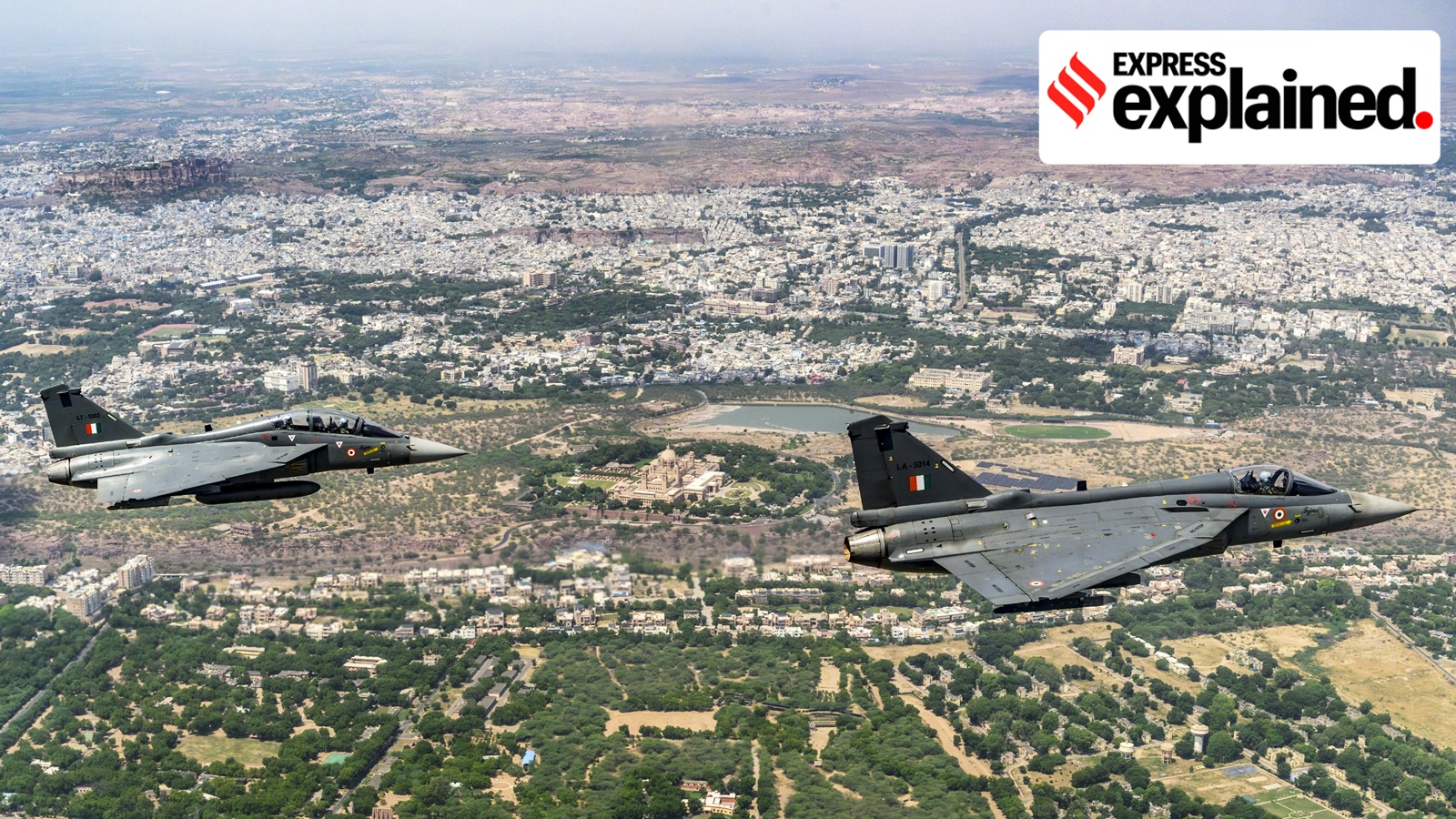
The Indian Air Force (IAF) and Japanese Air Self-Defence Forces (JASDF) conducted the bilateral air exercise, Veer Guardian, at the Air Force Station in Jodhpur earlier this month.
Held between September 9 and 22, the second edition of Veer Guardian notably saw the participation of JASDF’s Mitsubishi F-2A fighter aircraft — the first time Japanese fighter aircraft were deployed to India for such an exercise.
While India-Japan Joint Military Exercises (JME) are not limited to the aerial domain, the two editions of Veer Guardian point to a growing focus on interoperability between their air forces. The official press release stated that the exercise “served as a vital platform for enhancing interoperability and strengthening the strategic partnership between the two Air Forces.”
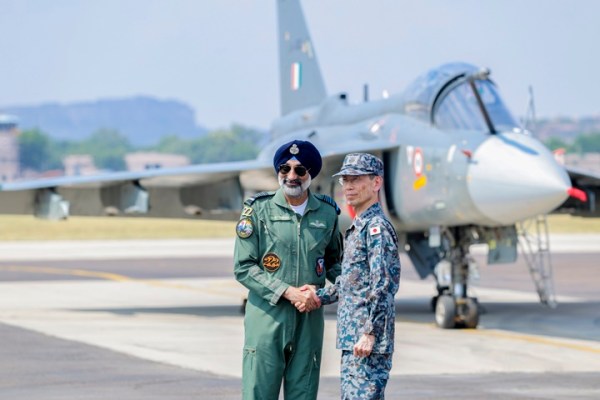 Chief of the Air Staff (CAS) Air Marshal AP Singh, left, with Japan Air Self-Defense Force (JASDF) Chief of Staff General Takehiro Morita during the joint air exercise ‘Veer Guardian 2026’, at Air Force Station, in Jodhpur, Sunday. (PTI photo)
What does Veer Guardian entail?
The two-week exercise was designed to let the two air forces train together in a range of scenarios. This includes joint mission planning, operational sorties and air combat manoeuvring (ACM).
Beyond flying operations, Veer Guardian also provides an opportunity for the two air forces to exchange best practices and build familiarity among personnel. Such interactions can help develop common operating practices and improve coordination over successive editions.
A key objective is to improve interoperability between the forces. In practical terms, this involves familiarising personnel with each other’s operating procedures and developing the ability to coordinate during complex air operations. This is particularly relevant when the two sides operate different aircraft, systems, and procedures.
Why is there such a focus on interoperability?
Story continues below this ad
Simply put, military interoperability is the capacity of different forces to work together cogently and efficiently to achieve strategic or operational objectives. This concept applies to both domestic cooperation between forces and transnational defence partnerships.
Increased interoperability has a host of benefits. Technical interoperability ensures that communications, equipment, and information systems can physically connect, while procedural interoperability relies on shared doctrines, standard operating procedures, and terminologies. Crucially, the human dimension cultivated during exercises like Veer Guardian reduces friction by building mutual trust, understanding, and linguistic familiarity through continuous joint training and exchanges.
Pushing for interoperability also serves security priorities by helping mitigate gaps in capability, while prioritising functions like command and control yields high payoff in increasing the overall efficacy of a combined force. This dimension was highlighted during Veer Guardian through joint mission planning and a symbolic formation sortie flown by JASDF Chief Takehiro Morita.
Story continues below this ad
Partner states can further leverage each other’s resources and reduce innovation costs with heightened interoperability. For India and Japan, the common concern of securing critical waterways in the Indian Ocean is aided by such efforts. The selection of compatible equipment ensures forces can share information and sustain joint operations over prolonged periods.
Conversely, the lack of interoperability has posed problems during operations. At the dawn of the Ukraine-Russia war, a patchwork of Western-donated artillery was used by Ukrainian troops, who found that functional interchangeability was missing in the weapons.
Procedural interoperability failed, too. NATO training programs assume a seamless ecosystem of Airborne Warning and Control System (AWACS) radar coverage and secure satellite links. But when thrust into a heavily contested airspace without those assets, Ukrainian aviators had to bypass standard NATO playbooks and instead opt for extreme low-altitude flights that severely limited the radar and missile range of the Western jets.
The broader India-Japan picture, eye on China
India-Japan defence cooperation now spans all three services — from Veer Guardian in the air to Dharma Guardian on land and JIMEX (Japan-India Maritime Exercise) at sea. These exercises are not isolated military drills. Over nearly two decades, India and Japan have consciously deepened their security and defence engagement vis-à-vis their overlapping regional interests.
Story continues below this ad
Today, the Indo-Pacific accounts for nearly two-thirds of the global GDP and handles approximately 60% of all maritime traffic. Around 55% of all Indian trade passes through this region, while Japan remains dependent on the Indian Ocean for much of its energy import transits. JASDF Chief Morita described the Veer Guardian exercise in the context of the two countries’ shared vision of a “free and open Indo-Pacific”.
Both nations have underlined the need for an inclusive Indo-Pacific where no regional power attempts to dominate, at a time when China has increasingly asserted itself. Japan’s 2022 National Security Strategy explicitly terms Chinese unilateral action as a “greatest strategic challenge” — a sentiment reiterated in its annual ‘Defence of Japan’ white papers.
Among the highlights of this turn was the Joint Declaration on Security Cooperation of 2008, making Japan only the third country with which India — historically choosing the path of non-alignment — formalised a bilateral security declaration. The agreement recognised shared maritime interests and kick-started joint military exercises.
Story continues below this ad
Since then, strategic alignment has been marked by the shared Japan-India Vision 2025, the 2+2 Foreign and Defence Ministerial Dialogue, and the Acquisition and Cross-Servicing Agreement (ACSA). The ACSA serves as an umbrella agreement enabling reciprocal logistical support, supply sharing, and refuelling. Together, these agreements provide the legal basis for information sharing, terms of equipment use, and the protection of shared sensitive information.
India and Japan will now also co-develop and co-produce defence equipment for the first time, having formalised an agreement for the Complex Radio Antenna (UNICORN) stealth system in July. Formally known as Nora-50, the antenna will be produced by Bharat Electronics Limited (BEL) alongside Japanese companies like Yokohama Rubber, NEC and Sampa Kogyo KK, a prominent defence manufacturer.
It has earlier been used in the Mogami-class frigates of the Japan Maritime Self-Defense Force (JMSDF). UNICORN physically integrates multiple antennas into a single horn-shaped structure. This lowers radar cross sections, which is a measure of how detectable an object is. Additionally, in April, the Japanese government revised the rules restricting defence exports to allow weapons transfers to partner nations, potentially opening up another area of mutual interest.
KioskNews shows a cleaned-up reading view extracted from the publisher’s page — the original always lives on their site, not ours.