Student protesters seek to unseat Serbia ruling party
HIGH HOPES: On top of the movement’s central theme of fighting corruption, it has promised measures such as improved heathcare and more affordable housing
After nearly two years of protests, student activist Masa Perepeliuc believes Serbia’s grassroots movement can end more than 14 years of rule by the governing party in elections tomorrow.
“I am sure we will win, and I am sure that on the 26th, we will wake up in a free Serbia,” the 21-year-old political science student said ahead of the snap vote.
For Perepeliuc and thousands of student activists, the election marks the culmination of a campaign against a government they accuse of deep-rooted corruption.
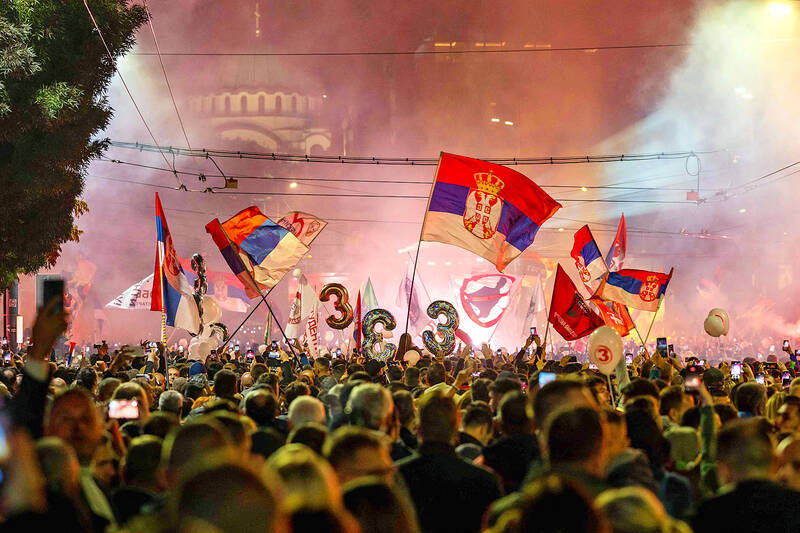
Supporters of Serbia’s student-led movement attend the final campaign rally of the student-backed election list in central Belgrade on Thursday, ahead of the country’s snap parliamentary elections tomorrow.
Photo: AFP
The movement emerged after 16 people were killed when a concrete canopy collapsed at Novi Sad’s newly renovated train station in November 2024.
The tragedy sparked some of Serbia’s largest protests since the fall of former Serbian president Slobodan Milosevic in 2000 and snowballed into a political challenge to former president Aleksandar Vucic and his right-wing populist Serbian Progressive Party (SNS), which has held power since 2012.
Most of the 250 candidates on the Student List have never held public office, with many coming from academia and professional circles rather than party politics.
The movement remains largely leaderless, with assemblies based around university faculties voting to select candidates.
Vucic, by contrast, has concentrated power and cultivated an image as an indispensable statesman, walking a diplomatic tightrope between the EU and Russia.
“We are not looking for a new leader around whom another cult of personality will be built,” the students’ Web site states.
Radomir Saicic, a candidate on the student list, said the movement offered an alternative to the “political games” of the past.
“This is a wave of popular discontent, hope and faith in victory that cannot be stopped,” the chemistry professor said.
The students have faced a formidable ruling-party machine backed by dozens of pro-government media outlets, including tabloids that regularly target opponents.
Saicic said activists had been wiretapped, followed, arrested or harassed.
Dozens of protesters have been detained, some accused of plotting to overthrow the constitutional order.
Cars have ploughed into demonstrations several times, while masked men have violently confronted protesters.
Earlier this year, digital rights group SHARE Foundation said the phones of people linked to the movement had been infected with sophisticated spyware, although authorities have denied any knowledge of it.
Vucic, who resigned last month to run for prime minister, has repeatedly called the movement a foreign-backed coup attempt, a claim widely echoed by supportive media.
Serbia lacks reliable independent polling, and surveys have produced widely differing results.
Right-leaning think tank New Serbian Political Thought published a poll this week putting the student list ahead of the SNS by 44.5 percent to 42.7 percent.
However a poll last month by Faktor Plus, seen as close to the authorities, put the SNS ahead at 48.6 percent and the students at 37.1 percent.
Political scientist Dusan Vucicevic nevertheless expects the students to win more than 40 percent of the vote, significantly better than most opposition groups under SNS rule.
He attributed their appeal to occupying the political center and largely sidestepping divisive foreign policy issues, particularly relations with Russia.
Students have organized some of Serbia’s biggest demonstrations in decades, including a rally last year in Belgrade that drew about 300,000 people, an independent count said.
As they marched across the country, residents in smaller towns greeted them with food, flags and fireworks.
“They saw with their own eyes that we were coming, knocking on their doors and passing by, and they came out to greet us,” organizational sciences student Neda Simonovic said.
The movement has promised measures ranging from improved healthcare to more affordable housing, but its central theme remains the fight against corruption.
Saicic said students and experts drafted a 1,200-page governing program, but it has yet to be published.
Critics have questioned the movement’s opposition to sanctions on Russia, while it has not fully clarified its position on Serbia’s bid to join the EU.
Vucicevic warned that even an election victory would leave the students facing immense challenges.
“They will certainly have a great deal of work ahead of them to turn Serbia into a well-governed and democratic state,” he said.
KioskNews shows a cleaned-up reading view extracted from the publisher’s page — the original always lives on their site, not ours.