Appliance repair focus of ministry voucher program
SUSTAINABILITY: A recycling official said that small appliances are often dumped when they stop working, as the cost of repair can make new ones more attractive
By Yang Yuan-ting and Esme Yeh / Staff reporters


The Ministry of Environment is planning to provide vouchers to encourage home appliance repair.
Most people replace small appliances — such as fans, rice cookers or blenders — when they stop working, as the cost at an official authorized repair service can approach the cost of a replacement. That has an environmental effect, including additional load on incinerators.
With the Resource Circulation Promotion Act (資源循環推動法) passing its third reading in the legislature in June, product lifecycle management — including design, manufacturing, consumption, recycling and reuse — has been written into law.
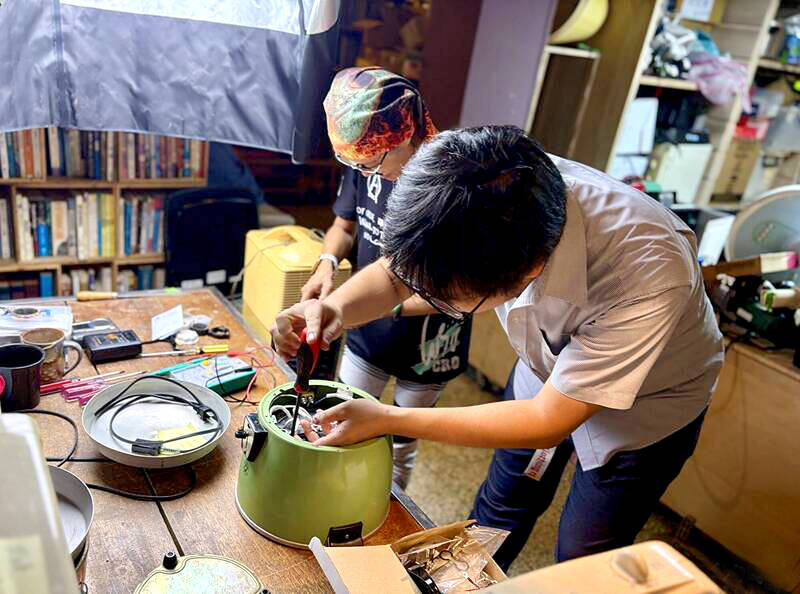
A person repairs a cooker in an undated photograph.
Photo: Huang Yi-ching, Taipei Times
The ministry since 2024 has encouraged local communities and civic groups to set up stations to repair and maintain appliances.
Minister of Environment Peng Chi-ming (彭?明) on Sunday said more than 800 repair sites have been catalogued nationwide.
The goal is to set up 1,000 such sites, making appliance repair and maintenance so accessible that it becomes part of people’s daily life, Peng said.
The ministry would soon launch a voucher mechanism to incentivize more people to use the services, he said.
The vouchers would be worth at least NT$100 each and be distributed on a registration basis in limited quantities, he said.
Chen Yen-nan (陳彥男), head of the Resource Circulation Administration’s Sustainable Consumption and Recycling Division, said that small appliances are most often dumped when they stop working, as the cost of repair can often make buying new more attractive.
However, the service life of small appliances can easily be extended by maintenance, Chen said.
Maintenance requires labor and knowledge to prevent risks such as electrical fires, he said, adding that training programs are available at local environmental protection bureaus or community colleges.
For appliances such as vacuum cleaners, including robot vacuums — which people often complain break shortly after their warranty expires — the “rent, don’t buy” approach might be appropriate, Chen said.
Many vendors have launched appliance renting services, he said, adding that the public should adopt the services to promote sustainable use of larger appliances.
Small Appliance Repair Workshop, a mobile repair and maintenance service group founded in 2016, has nearly 30 employees and volunteers who provide such services.
Tsai Yah-hsuan (蔡亞軒), a senior campaigner at the Circular Taiwan Network, does repairs and maintenance at the workshop.
The workshop was formed following the example of “repair cafes” in other countries, Tsai said.
Many staff at the workshop do not have backgrounds in electrical engineering, Tsai said.
They join the workshop out of interest and to learn repair knowledge through hands-on experience with experts, he said.
Half of the workshop’s staff are women, Tsai said.
The workshop last year published a report on small appliance repairs, he said.
Coffee machines and vacuum cleaners are the small appliances most repaired in Western countries, but in Taiwan it is mostly electric fans and rice cookers, he said.
More than 70 percent of the appliances brought to the workshop are fixed, he said, adding that the rate shows how effective the work is.
KioskNews shows a cleaned-up reading view extracted from the publisher’s page — the original always lives on their site, not ours.