Taiwan entrepreneurs optimistic about future: HSBC
By Crystal Hsu / Staff Reporter


Taiwanese entrepreneurs are among the world’s most optimistic about business prospects, with 98 percent confident about the outlook as the artificial intelligence (AI) boom and Taiwan’s pivotal role in global supply chains fuel business opportunities, HSBC Holdings PLC said in a report on Tuesday.
Yet their optimism about business expansion does not extend to personal wealth management, with many prioritizing capital preservation and protection against inflation over higher investment returns.
According to HSBC’s annual Global Entrepreneurial Wealth Report, the share of Taiwanese entrepreneurs optimistic about their business outlook exceeded the global average of 95 percent.
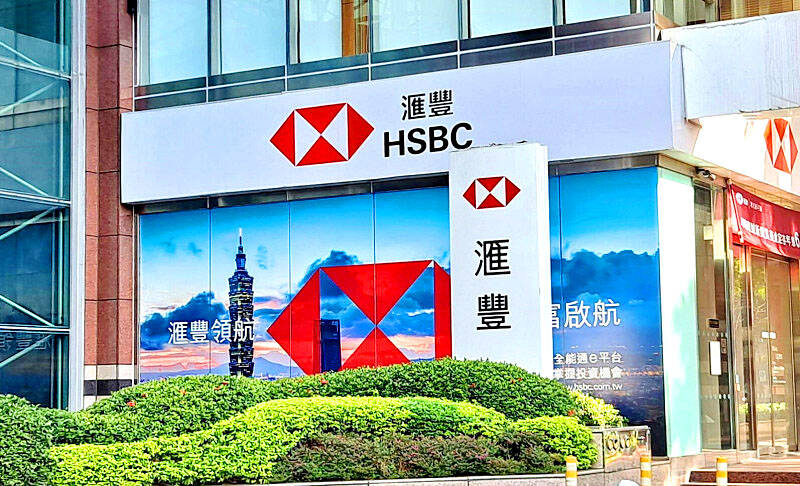
An HSBC Bank outlet in Taipei is pictured in an undated photograph.
Photo courtesy of HSBC Bank (Taiwan) Ltd
AI advances were cited as the leading source of optimism by 44 percent of respondents, followed by technological progress at 28 percent and business opportunities and performance at 25 percent.
Taiwan supplied 14 percent of global AI-related exports in the first quarter of this year, highlighting its importance to the AI supply chain. AI-related exports accounted for almost half of the nation’s GDP, the report said.
The confidence is translating into greater investment in emerging technologies, with almost 80 percent of Taiwanese entrepreneurs planning to increase AI spending over the next 12 months. Their approach remains measured, with many intending to allocate 11 to 30 percent of business revenue to AI-related initiatives.
Their approach to personal wealth is considerably more conservative. The report found that 75 percent of Taiwanese respondents came from multigenerational family businesses, placing Taiwan among the markets with the highest concentrations of family-owned enterprises in the survey.
This background appears to influence their investment priorities. Protecting wealth against inflation was cited as a key investment objective by 41 percent of respondents, while 34 percent prioritized protecting their assets against losses. By comparison, only 28 percent aimed to achieve returns above market benchmarks.
The contrast reflects a so-called “barbell strategy,” in which entrepreneurs pursue growth through their operating businesses while adopting a more defensive approach to personal investments, the report said.
Taiwan’s relatively high concentration of family businesses means entrepreneurs’ personal wealth is often closely intertwined with their business assets, it said.
Business owners tend to pursue expansion and higher returns through their companies, where they have greater control over operations and can leverage their competitive advantages. They keep personal investment portfolios focused on capital preservation, lower volatility and liquidity, it said.
Personal wealth serves as a financial buffer for their businesses, allowing entrepreneurs to respond quickly to external market changes or unexpected funding needs, the report added.
KioskNews shows a cleaned-up reading view extracted from the publisher’s page — the original always lives on their site, not ours.