Honoring Anwar Sadat: The weight of a historic medal and a lesson in loyalty
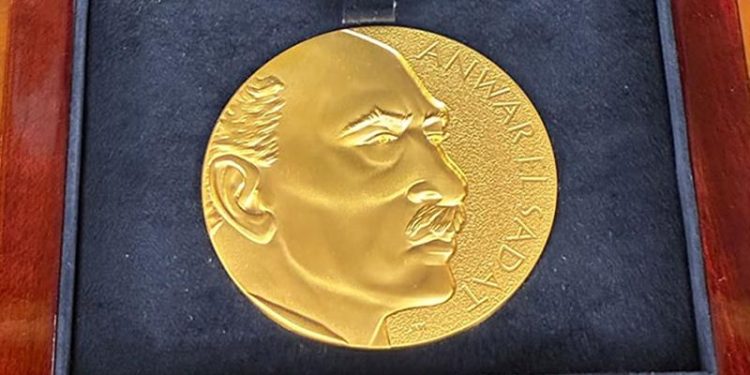
The US Congressional Gold Medal derives its prestige from the institution that bestows it, the legislative journey required to earn it, and the enduring place it secures in public memory.
In honoring President Anwar Sadat with this distinction, Washington acknowledges that a decision made by an Egyptian leader continues to shape regional security and diplomacy decades after his passing. Behind this milestone lies a sustained effort by advocates who believed Sadat deserved this recognition and worked tirelessly to realize it.
As Congress’s highest expression of national appreciation for distinguished achievements and contributions, the medal traces its lineage back to George Washington in 1776 and has since honored figures such as Winston Churchill and Nelson Mandela. Every award requires its own dedicated act of legislation—a process that imbues the honor with an institutional weight extending far beyond the ceremony itself.
In Sadat’s case, the bill authorizing the medal was signed into law on December 13, 2018, following a bipartisan effort supported by both Republicans and Democrats.
The legislation mandated a posthumous award in recognition of his historic achievements and courageous contributions to Middle East peace.
The significance of that framing warrants close reading.
The law explicitly links the Camp David Accords and the Egyptian-Israeli peace treaty to regional stability, partnership, dialogue, and American strategic interests—reflecting Washington’s stated reading of Sadat’s legacy.
From an Egyptian perspective, however, this moment also recalls the nation’s ability to translate military triumph into a diplomatic path that reclaimed sovereign land, and the courage to make a pivotal choice that profoundly reshaped the country’s future.
This honor affords us a valuable opportunity to tell our own story on our own terms: how did Sadat arrive at his decision? What did he set out to achieve? How did he balance military strength with diplomacy? And what did Egypt ultimately gain? These are the essential questions that must remain front and center whenever we present his legacy to the world.
In this regard, Mohamed Shafik Gabr merits clear recognition and appreciation.
Anyone who knows him is well aware of the high esteem in which he holds Sadat—a reverence he channeled into a concrete mission, shouldering much of the effort to champion the medal initiative and build momentum behind it.
Serving as International Chairman of the Medal Committee, Gabr helped organize a November 2018 reception on Capitol Hill in the US Senate to rally support for the legislation, bringing together prominent American and Egyptian figures.
Undertaking such an endeavor demands deep institutional fluency, sustained engagement, and the ability to unite supporters across diverse political lines.
Throughout this campaign, Gabr stood as one of its driving forces, working in concert with American partners and bipartisan lawmakers.
His persistence and loyalty deserve to be recorded as an integral chapter in the story of this tribute.
His role carries a broader lesson worthy of reflection in our public life: what becomes possible when an Egyptian leverages his network and experience in service of his nation’s memory and standing, pursuing a public goal over the course of years until it becomes reality.
Egypt’s global influence expands not only through statecraft, but also through the initiatives of its citizens and their capacity to forge alliances around causes they believe in.
With Sadat himself, honoring his memory leaves ample room for candid debate over his presidency.
One can disagree with certain choices he made while simultaneously acknowledging his courage and the magnitude of his impact.
Ultimately, this tribute celebrates an Egyptian president who altered the course of history, while the campaign that brought it to fruition offers a lesson in loyalty and perseverance. And much of the credit belongs to Shafik Gabr, whose devotion found lasting expression in a milestone that will endure.
KioskNews shows a cleaned-up reading view extracted from the publisher’s page — the original always lives on their site, not ours.