NPA cracks down on election meddling
BE VIGILANT: President Lai said that numerous suspicious accounts have been appearing on social media, some of which are flooding posts with comments to influence voters
By Jonathan Chin, Chen Cheng-yu and Sam Garcia / Staff reporter, with staff writers and CNA


Law enforcement agencies are cracking down on suspected cases of election disinformation and transnational repression ahead of the Nov. 28 elections, the National Police Agency (NPA) said yesterday.
Police have launched investigations into nine cases suspected to involve external forces colluding with criminal groups and private detective firms, it said in a statement.
Prosecutors have brought charges in four of the cases, the agency said.
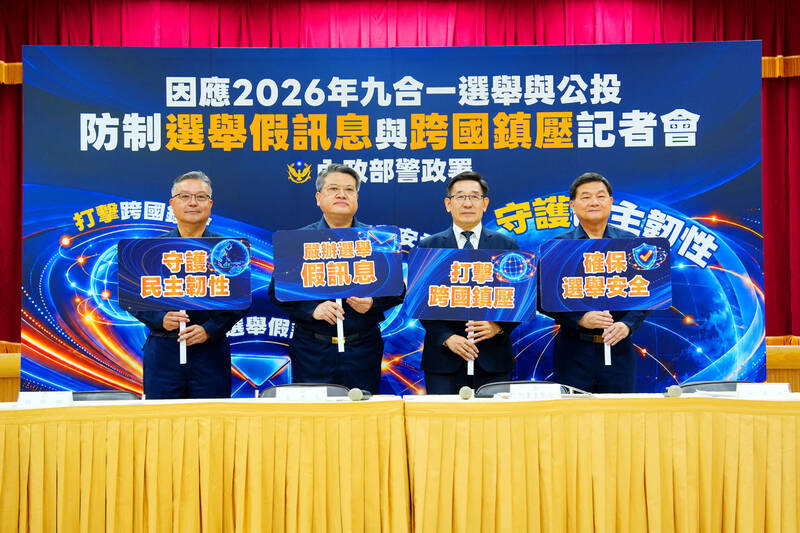
National Police Agency Deputy Director-General Kuo Shih-chieh, second left, and Criminal Investigation Bureau Commissioner Chiu Shao-chou, second right, hold placards at a news conference in Taipei yesterday.
Photo: CNA
The NPA is seeking to identify people or entities involved in politically motivated harassment and election interference with the aim of uncovering the networks behind the schemes, while protecting victims and defending the nation’s democracy and rule of law, it said.
All police agencies have been instructed to maintain political neutrality and impartially enforce the law as they step up efforts to investigate and crack down on illegal activities, while seeking to prevent the spread of disinformation and counter election interference, it said.
Election disinformation is primarily spread through social media and messaging apps, the NPA said.
Police have opened investigations into 184 suspected cases of disinformation, 112 of which have been referred to judicial authorities for further investigation, it said.
Candidates who discover “deepfake” audio, video or images of themselves can apply, for a fee, to the Criminal Investigation Bureau for forensic examination up until the day before the election, it said.
Candidates who believe the content constitutes a criminal offense can report it to the police and social media platforms, the agency added.
External forces have expanded their election-interference tactics to include manipulating election betting, sponsoring trips to China for Taiwanese, channeling campaign donations through Taiwanese businesspeople, and using temple and religious activities to influence voters, it said.
Upholding election integrity and national security requires effort from Taiwanese society as a whole, the agency said, urging people to check the authenticity and sources of suspicious information they encounter online and avoid sharing potential disinformation with others.
It also called on people to keep their political discourse respectful, rational and reasonable.
Meanwhile, President William Lai (賴清德) yesterday warned that disinformation, smear campaigns and cyberattacks on candidates’ Web sites would increase ahead of Nov. 28.
With the elections just 24 days away, tactics to influence voters would become increasingly sophisticated, he said at a Democratic Progressive Party (DPP) Central Standing Committee meeting.
Numerous suspicious accounts registered with overseas phone numbers, but listing their location as Taiwan, have appeared on social media in a short period and exhibited consistent activity patterns, Lai said.
The accounts have been appearing across social media platforms and under news posts about political issues, with some flooding comment sections to influence public opinion, he said.
Some campaign Web sites have been targeted by malicious cyberattacks designed to disrupt the sites by overwhelming them with high volumes of traffic, Lai said.
Similar attacks have been reported in Taipei, Kaohsiung and Hsinchu, raising concerns about cybersecurity and whether the elections could be conducted in a fair and orderly environment, he said.
In addition, misleading information about policy issues — such as the government’s NT$10,000 cash handout, health insurance coverage for people aged 65 or older and drug-driving amendments — has been circulating in closed social media groups, he said.
The president called on DPP officials and campaigns to remain calm and vigilant in dealing with disinformation, disruptions and harassment.
He also urged supporters to use the fact-checking section of the DPP’s official Web site and Line account to verify information and to only share accurate information from trusted sources.
KioskNews shows a cleaned-up reading view extracted from the publisher’s page — the original always lives on their site, not ours.