Lula and Milei in the mirror
t is fascinating to watch the Brazilian electoral process occurring just across the border, while comparing it to Argentina’s constant state of political and economic crisis.
Similar socio-political expressions in each country are justified using completely different arguments, reflecting a logical bias towards explaining things by associating causes and effects that happen to be correlated in time and space. While in Brazil, President Luiz Inacio Lula da Silva’s chances of re-election are extremely slim despite what appears to be a situation of economic strength, in Argentina, President Javier Milei is still totally in the game as the economy stumbles on its way to a technical recession. Brazil is exhibiting extreme levels of polarisation and there is fear about a potential coup d’état if either side loses by a thin margin and decides to question the election results, yet there are no expressions of massive public violence. In Argentina, there have been confrontations between protesters and security forces ever since the libertarians took office, like the one seen this week during the Federal University March, yet there are no expectations of a massive flare-up or something like a threat to the democratic order. Still, the aesthetics of the political divide are roughly the same: the outsider outcasts who have challenged the traditional political status quo from a “new Right” and elitist worldview clashing against the historic left-wing populists, who’ve had their turn at the helm for much of the 21st century.
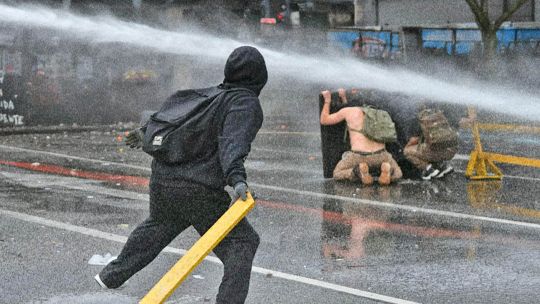
Argentines are accustomed to major stand-offs between protesters and police in the vicinity of Congress. There is a certain normalisation of violence that should be unacceptable between groups of protesters that generally include several “professionals of mayhem” who are there to pick a fight with the cops, and security forces that use exaggerated amounts of violence, particularly against many who are innocently protesting. It was an anomaly to see violence erupt at a march in support of public universities, given that four previous demonstrations had passed peacefully. Yet context matters. Milei’s support is cracking after nearly three years in office, and a majority of the population disapproves of his administration. At the same time, the Supreme Court has exposed itself with a set of rulings that picked at a nationalist sentiment, temporarily eliminating the caps on foreign land ownership, mobilising the people against Milei’s infamous DNU 70 emergency mega-decree. The emotions elicited are similar to those surrounding the Malvinas issue, generating a sensation that the elites want to sell off Argentina’s precious land to foreigners looking to extract our natural resources. The potential for a political earthquake for the government was very present in the opposition’s attempt to overturn DNU 70, yet it was ultimately deactivated by the Casa Rosada through direct negotiations with provincial governors. The march in defence of public universities became a rallying call for all of those opposed to the libertarian government and ultimately got hijacked by the confrontations.
Over in Brazil, Lula tried every trick in the book to seduce an electorate that is deeply divided. Most of his economic measures aimed at helping those who are worse-off were well-received by a majority of the population, as a recent AtlasIntel poll shows, and two-thirds of those surveyed believe employment and their individual economic situation is either normal or good. Brazil has the lowest political risk indicators in the region and Flávio Bolsonaro was directly linked with allegations of corruption involving Banco Master’s Daniel Vorcaro early in the campaign – Supreme Court Justice Alexandre De Moraes, who put Jair Bolsonaro in prison and barred him from holding political office, was also tainted by the Vorcaro affair. With all of that in his favour, Lula still lost the first-round vote to Flávio, 47 to 45 percent, and is polling some six points behind him ahead of the October 25 run-off, according to an average of the most recent polls. Once again, context matters – a majority of Brazilians seem to be saying that they are tired of Lula and his Workers’ Party (PT) and are willing to tolerate the uncharismatic son of a man imprisoned for trying to subvert the democratic order, who also faces multiple accusations of corruption and improprieties, and install him as president.
In Argentina, it seems that Milei has found his floor, at least according to AtlasIntel’s local poll. For about seven months the President’s positive and negative polling figures have gone down or sideways, now close to the lowest of his administration. Milei still ranks towards the top of the popularity figures with 38 percent approval, tied with leftist Myriam Bregman and beaten by only one percentage point by ex-president Cristina Fernández de Kirchner, also serving a prison sentence and barred from holding public office (another similarity with Brazil’s recent past). Just below them are libertarian Senate caucus leader Patricia Bullrich and Buenos Aires Province Governor Axel Kicillof, at 37 percent. Incredibly, when asked whether Milei is doing a better job than Alberto Fernández did, the results came out slightly in favor of the Peronist: 45.9 percent compared to 45 percent, with nine percent considering them the same. Corruption remains the most pressing problem with unemployment coming in close (50 to 44 percent), yet other issues like the weakening of democratic institutions (35 percent), the economic situation (32.2 percent), and inflation (27.8 percent) remain present in voters’ minds.
The comparison with Brazil is stark. Among the most pressing issues there are two which absorb nearly all of society’s interest: crime and drug-trafficking (59.3 percent) and corruption (58.3 percent). Everything else is secondary, such as health (17.8 percent), gender violence (16.9 percent) and high taxes (15.3 percent). Of the 13 measures taken by the Lula administration regarding people’s personal finances that were surveyed, 12 had strong to overwhelming levels of approval. Still, the growing possibility that Flávio Bolsonaro will win the second round has sparked a major jump in consumer trust, future economic expectations, the intention to purchase durable goods and the idea that inflation will fall.
As explained in last week’s column, there is clearly something globally attractive behind the “new right” aesthetic that connects Milei and Bolsonaro and US President Donald Trump. It isn’t economic ideology, but culture wars and “synthetic power” (a certain political and social construction built on the back of social media clout) that’s appealing to voters. Indeed, there are reports of a favourable bias for Bolsonaro, and against Lula, on Mark Zuckerberg’s controlled platforms under the Meta umbrella. In French philosopher Bruno Latour’s terms, the platforms and algorithms are not neutral connectors, they actively take part and shape the subjectivity around them. The attraction of this aesthetic shouldn’t be disconnected from the level of socio-political appeal exhibited by the progressives of the first half of the century, including Lula and Cristina. In the pre-social media era, they also controlled networks of information that gave them an edge and allowed them to construct their own narrative.
The run-off in Brazil takes place in a little over a week. The general election in Argentina could take place on October 24, 2027. In both cases, in this modern world, there’s more than enough time for things to change dramatically. Under their respective domestic prisms, both countries are observing the same political showdown. And seems that they are not just voting on the economy.
KioskNews shows a cleaned-up reading view extracted from the publisher’s page — the original always lives on their site, not ours.