Artists boycotted this portrait prize over AI entries. Now they’re back to take them on
After two years shunning the Brisbane portrait prize, several artists are entering again, with some First Nations painters counting on another AI – ‘ancestral integrity’ – to help them win
Poised above the lady in the red dress is a claw. Its metallic fingers grasp to pluck its prize from a jumble of other women while she looks dreamily upward, as if to say “Who, me?”
The woman in the red dress is Australian comedian Alice Fraser, as photographed on stage. The other women – generic superheroes and 1950s housewives – were created using the generative AI software Krea.
“It is the human being chosen over the AI element,” artist Jackie Ryan says. “But is being chosen a good thing?”
Ryan’s work The Catch is a finalist in this year’s Brisbane portrait prize (BPP). For Ryan, using AI is just a new addition to a career spent creatively exploring pop culture. More than 15 years ago, she used image editing software and a “fiddly” process of cutting and pasting by hand to render photos she took of real people into a graphic novel series.After taking the photo of Fraser posing earlier this year, Ryan wondered: could AI encase her subject in a claw machine?
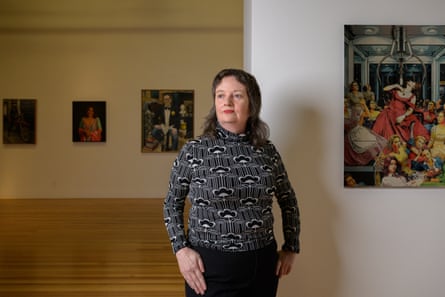
“I don’t know, can it?” she laughs, holding up a screenshot of Krea’s first effort.
The initial image is photorealistic and unsettling, doll-like figures standing stiffly inside a glass case. Ryan gave the software more prompts: add feminist tropes. Pile the figures messily atop one another. Alter the backdrop. Apply Ben Day dots.
“You don’t just wake up with these under your pillow,” Ryan says, of the final product.
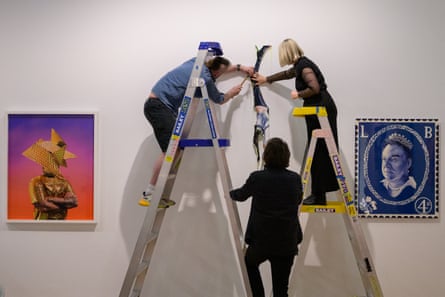
The gallery space in which Ryan stands is alive with preparations for the BPP’s opening night on Friday. A trio of artists tack a clown made of Lycra on to the wall with entomology pins. A charcoal Archie Moore watches solemnly on, his 2024 Venice Biennale Golden Lion winning work, Kith and Kin, behind him.
The BPP made headlines in 2024 when it opened its doors to AI-generated art, including the main Lord Mayor’s prize, worth $50,000. It came at a time art and photography prizes around the world were grappling with how to deal with the technological conundrum, after a number were left red-faced by unwittingly giving awards to AI generated works.
But the BPP’s response of opening its doors to declared AI shocked and outraged many in the city’s arts scene and prompted several former winners to publicly boycott the award, including Walkley-winning photographer Russell Shakespeare, who likened it to allowing “drugs in sport”.
Among the more prominent critics was former BPP packer’s prize winner and Wiradyuri artist Birrunga, who boycotted the prize in 2024 and again last year, along with his gallery’s stable of artists.
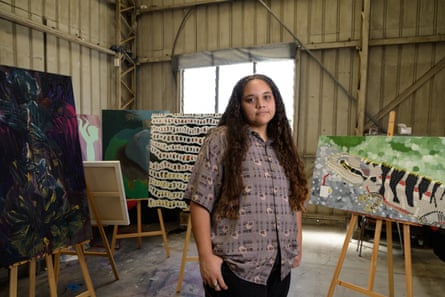
“An AI piece is not art,” Birrunga says. “It’s decoration, illustration at best. It doesn’t have cultural content. It doesn’t have connection to countless generations of practice. It’s a quick fix, instant gratification, fast food mentality that is actually poison to us.”
Birrunga still believes the BPP’s acceptance of work generated by AI is “a tacit green light” for the harvesting of First Nations cultural IP. But he figures the point has been made.
So this year, Birrunga says he and five First Nations artists his gallery represents collectively chose to “reinsert ourselves”, pitting “AI against AI” – painting a series of self-portraits that spoke not to artificial intelligence but their “ancestral integrity” – something he says can never be replaced by software.
“If you make a point and then ghost, then you just remove yourself from the narrative,” he says.
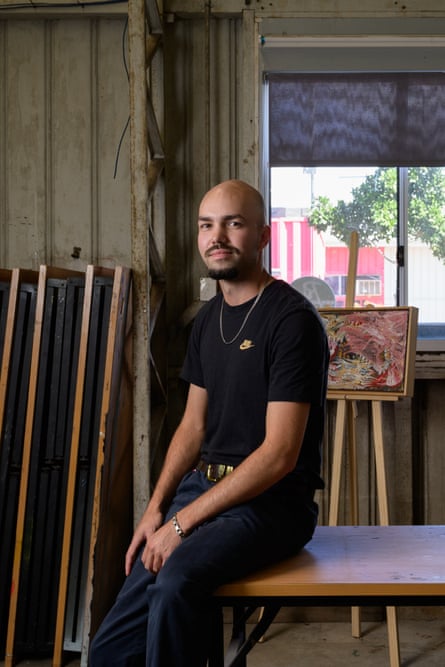
Gunggari and Kabi Kabi painter Kane Brunjes’ Ancestral Integrity and Kamilaroi artist Elysia Love-Anderson Reflections now hang among the BPP finalists.
“With my work, a lot of what I’m trying to get at is that everything comes from our ancestors,” Love-Anderson says. “That’s why AI is a big problem for me. AI cannot give a piece what we can. Knowledge that has been passed down from family, from Elders, down multiple generations.
“It’s just fake. AI’s just really fake to me.”
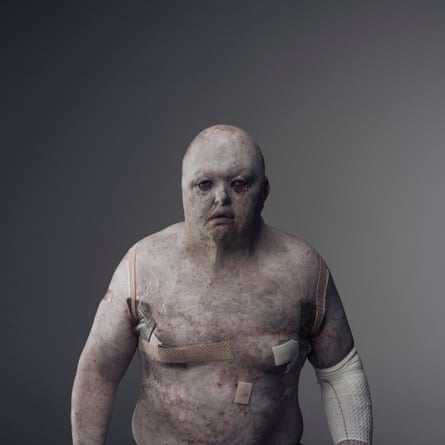
Photographer Glenn Hunt won the digital prize in 2020 but also led the boycott in 2024. He has also decided to enter again, and is a finalist this year with a portrait of Dean Clifford, who lives with epidermolysis bullosa, a rare skin disease of such severity that Meta AI once compared his appearance to a “zombie costume”.
“I still feel the same way about AI,” Hunt says. “But all I can do, in this instance, is create something that’s the opposite to that. I think I’ve done that with Dean. You can’t get more real than he is.”
The irony, Hunt says, is that when Clifford’s selfie went viral, many online believed he was AI-generated.
“What a time to be alive,” Hunt says.
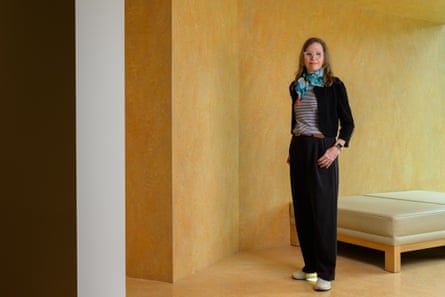
The BPP director, Anna Reynolds, says the prize is only open to generative AI works that do not infringe copyright, a rule introduced to “get a handle” on the emerging technology and regulate it.
“I think the argument about yes or no is kind of gone now,” Reynolds says of AI in art. “There’s more of a more sophisticated argument now, about how you use it as a creative tool … It’s about control, retaining the human capital, retaining the human creative control. That’s what’s important.”
The prize exhibition will open its doors to the public on Saturday after winners are announced on Friday night. Of the 49 works in the main competition, Ryan’s is the only to declare the use of generative AI.
Given the speed at which AI is shifting the foundations of society, what that ratio might look like in years to come is anyone’s guess.
For Brunjes though, some things will never change.
“Regardless of AI, we’ve still got our integrity – and our artworks aren’t going anywhere,” the First Nations painter says. “Our stories aren’t going anywhere.”
KioskNews shows a cleaned-up reading view extracted from the publisher’s page — the original always lives on their site, not ours.