The real ‘fifth force’: how quantum statistics shapes our world in profound ways
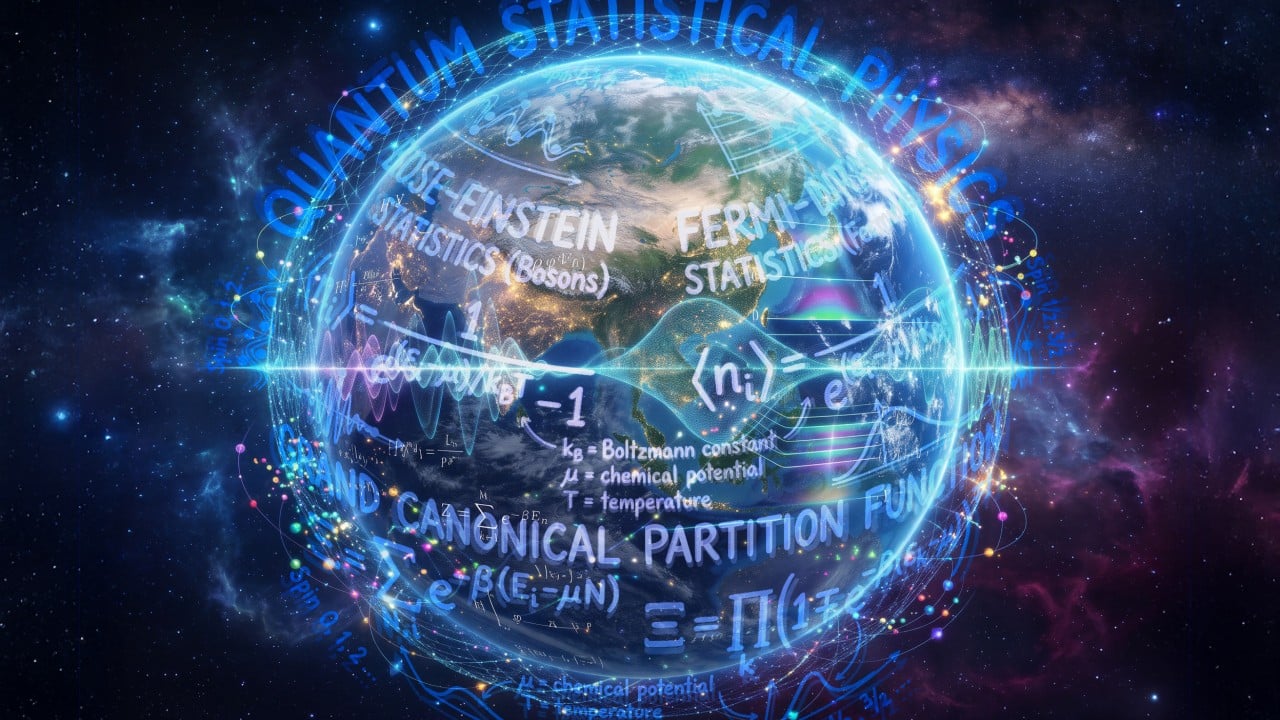
Modern physics recognises four fundamental forces: gravity, electromagnetism and the weak and strong subnuclear forces. (Professional physicists usually speak of “interactions” rather than “forces”, but here I’ll use the more familiar, more vivid alternative.) Each of these forces plays an important role in our description of the world.
Gravity rules the cosmos. Though gravity is extremely feeble at the level of individual particles, it is always attractive, and for astronomical bodies (and for Earth as a whole) it accumulates. Electromagnetism rules over a vast range of distances intermediate between astronomical and atomic.
Electromagnetism is intrinsically more powerful than gravity, but positive and negative charges act oppositely, and their influences tend to cancel in large bodies.
The strong and weak forces usually come into play at ultra-short distances, within atomic nuclei or in extreme conditions in astrophysics. They were only discovered in the 20th century. To study their properties in depth, physicists built – and continue to build – ultra-high-energy accelerators and colliders.
I like to think of the strong force as electromagnetism’s big brother. It is the most powerful force, fundamentally, but precisely because of this fact imbalances among its basic charges (so-called colour charges) conspire to cancel out even more thoroughly than electric charges.
The weak force is much feebler, as a force, but it has unique abilities to make changes. It allows transformations between protons and neutrons as well as many other more exotic ones.
By using the laws for these forces and working within the framework supplied by quantum theory, physicists have accounted for an extraordinary range of the properties of matter.
Speculations about a possible “fifth force” abound, but they have not borne fruit. So far, despite determined searches for new physics using sensitive instruments and powerful particle accelerators, the four forces have proved sufficient.
There is, however, an important consequence of quantum mechanics that functions as a strange and powerful effective force. We call this “quantum statistics”. Quantum statistics is the real fifth force. It shapes our world in profound ways.
Although physicists have been applying quantum statistics for many decades, recently there has been something of a revolution in the subject. We have discovered new possibilities that are suggesting new technologies. These discoveries have also exposed the roots of traditional quantum statistics.
To appreciate the beauty and depth of quantum statistics, we need to step back for perspective
Quantum statistics has little to do with “statistics” in the usual sense. It is not centred around sampling from a probability distribution. Its name has a complicated history, and it is a bit accidental.
It is simpler to think of quantum statistics as providing a kind of force, or interaction – a force that arises from the deep structure of quantum mechanics itself. In contrast, the “quantum” in “quantum statistics” is entirely appropriate. Quantum statistics is a natural consequence of quantum theory, but it has no classical analogue.
To appreciate the beauty and depth of quantum statistics, we need to step back for perspective.
A chief glory of quantum theory is that it unifies the description of the basic components of matter. The crux of this unification is wave-particle duality. Among the basic ingredients of physical reality, some – including electrons, protons and neutrons – usually present themselves as particles.
Others, including light and other forms of electromagnetic radiation, are usually described as waves. A fundamental duality of discrete and continuous ingredients was the state of the art in physics as it entered the 20th century.
Quantum mechanics transcended this duality. In quantum mechanics, all quantum objects are described by wave functions, or more whimsically wavicles, that describe the probability for finding them in different places.
Wave functions can be widely or narrowly distributed; in those special cases waves or particles provide alternative, approximate descriptions. Thus, in different situations, quantum objects can behave like particles or like waves (or like neither).
So far, so good. But that wonderfully unified description devolves back into a duality as soon as we go beyond the description of individual quantum objects to consider pairs of them, or larger collections. At that level, electrons and photons again become drastically different, because they have different quantum statistics.
Two forms of quantum statistics have been recognised for a long time, dating from the prehistory of modern quantum theory more than a century ago. Physicists divided quantum objects into two broad kingdoms, fermions and bosons. Though the details are entirely different, this division is reminiscent of how biologists once divided living things into plants and animals.
Electrons were the first recognised members of the kingdom of fermions. It was the 24-year-old Austrian physicist Wolfgang Pauli who, in 1924, first recognised that something profoundly new was afoot. The question he was wrestling with was very basic: how to account for the periodic table of elements.
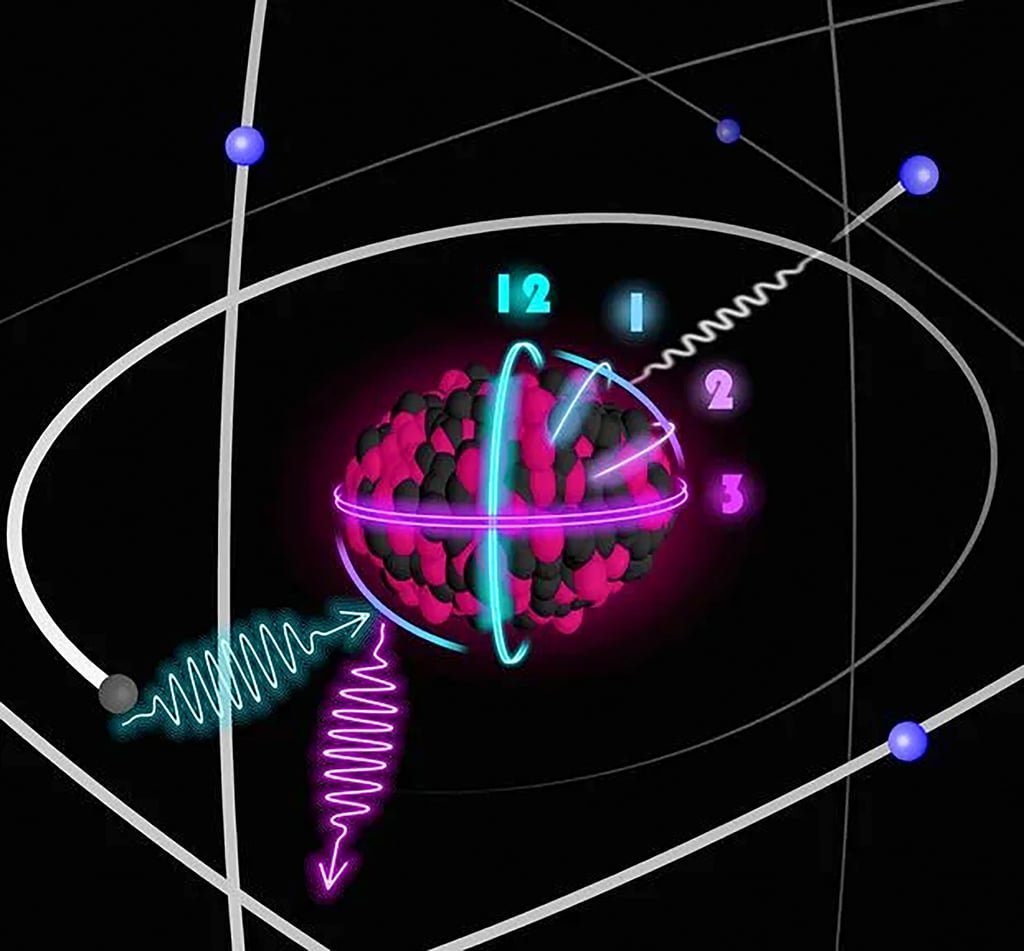
It was recognised that atoms consist of a tiny nucleus, containing all its positive electric charge, and a surrounding swarm of negatively charged electrons. Since positive charges attract negative ones, it was challenging to understand what kept the electrons from snuggling up close to the nucleus.
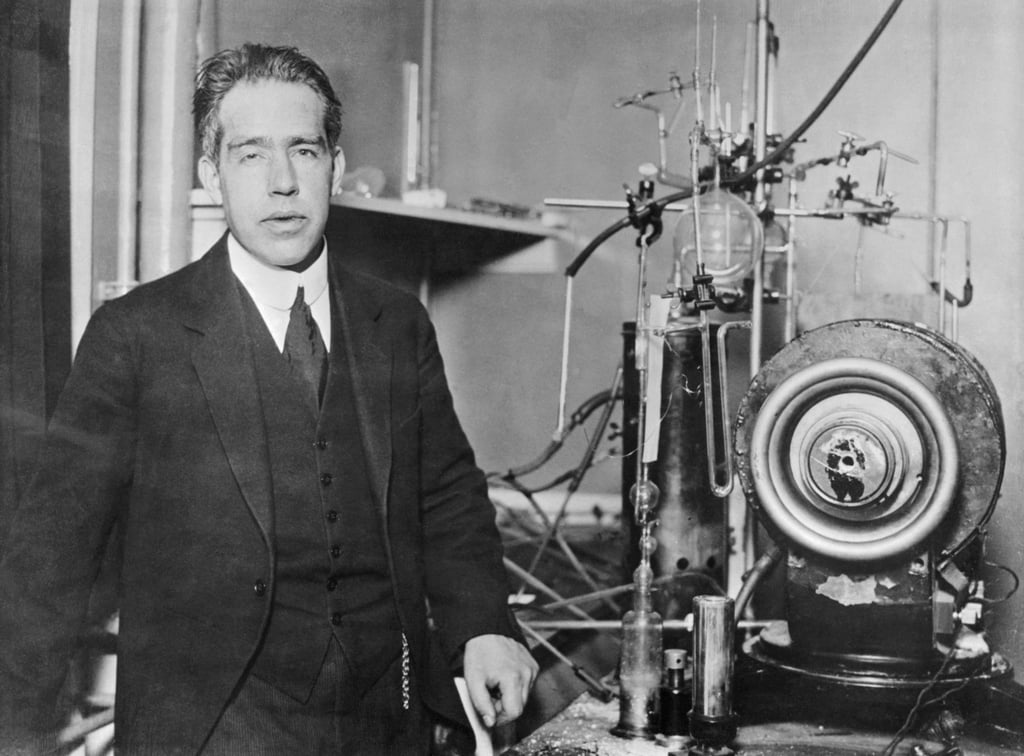
In 1913, Danish physicist Niels Bohr, with his quantum orbitals, had answered that question for hydrogen, where there is just one electron. But his ideas did not explain why multi-electron atoms contain electrons in many different orbitals, even though it costs extra energy to occupy the larger ones.
Pauli “explained” this feature by postulating a rule that today is called the Pauli exclusion principle. The Pauli exclusion principle says that no two electrons can be in the same physical state. By combining this idea with Bohr’s orbitals (and bringing in the idea of electron spin), Pauli was able to explain, in broad terms, the chemistry summarised in the periodic table of elements.
It was a spectacular, milestone achievement in the history of science. Yet it was deeply mysterious. Pauli himself admitted, “We cannot give a further justification for this rule …” beyond its empirical success.
A few years later, with the mathematics of quantum theory now on firmer ground, physicists Enrico Fermi and also Paul Dirac extended Pauli’s exclusion principle into a precise, general recipe that could be applied not just to electrons in atoms but to electrons in all situations, and to particles other than electrons. (I’ll return to discuss that recipe shortly.)
Their work formed the foundation for understanding and controlling the behaviour of electrons in solids, leading directly to the invention of solid-state transistors and modern microelectronics in general – a truly world-changing consequence!
We call the kind of quantum statistics electrons obey “Fermi statistics”, and the particles that obey it “fermions”, in recognition of Fermi’s key contributions.
Protons and neutrons are also fermions. Similarly to how the Fermi statistics of electrons keep atoms from collapsing, the Fermi statistics of protons and neutrons keep nuclei from collapsing, despite the attractive nature of the strong force between them.
According to the so-called shell model, as you add more protons and neutrons to make a richer nucleus they must occupy new, bigger orbitals.
Because Fermi statistics require the fermions that obey it to do something that they’d otherwise prefer not to, it functions as an effective force. And because a fermion carves out a state for itself, excluding its clones, the force is repulsive. This is why Fermi statistics can prevent the collapse of atoms and of nuclei, despite the attractive electric and strong forces that want to make it happen.
02:49
Underground lab in China aims to solve one of biggest mysteries in particle physics
Strikingly similar themes play out, on a cosmic scale, in the structure of exotic stars. Ordinary stars, like our Sun, are supported against gravitational collapse by the radiation emitted as they burn their nuclear fuel. When that fuel is exhausted, smallish stars will contract into white dwarfs.
These are like giant atoms, supported against gravitational collapse by the Fermi statistics of the electrons they contain. Somewhat larger stars will overcome this force and contract further, into neutron stars.
Neutron stars are like giant atomic nuclei, supported against gravitational collapse by the Fermi statistics of the neutrons they contain. (The gravity of the largest burnt-out stars will overcome this force too. They devolve into black holes.)
Photons were the first recognised members of the kingdom of bosons. The early history of fermions and bosons has eerie parallels.
The boson story begins with a paper by the 30-year-old Indian physicist Satyendra Bose who, in 1924, recognised that something profoundly new was required to understand the enhanced abundance of low-energy radiation from heated bodies (so-called blackbody radiation) and proposed a mathematical hypothesis to explain it.
The implied behaviour was opposite to Pauli’s exclusion: while electrons forbid other electrons from occupying the same state, photons encourage it.
Bose sent his paper to Einstein, who immediately recognised its importance and went into action, on two fronts. First, he arranged to have a German translation of Bose’s paper published in a leading journal.
Second, he generalised Bose’s idea so that it could be applied to other particles, besides photons. Thus was born the theoretical kingdom of bosons.
Lasers epitomise the bosonic nature of light. In a laser beam, many photons share the same colour and move in the same direction. True to their bosonic nature, they are especially happy when they are in the same state. (In ordinary light the photons are produced hot, so they occupy many states; then their bosonic nature is less obvious.)
It turns out that when an even number of fermions combine into a unit, that combination is a boson. Two outstanding examples of this have led to immensely important applications. Helium atoms are bosons, and this leads to helium becoming a superfluid at low temperatures.
In the superfluid phase, the atoms want to flow together, “laserlike”, in the same way. This so-called superflow allows efficient, lossless transport of heat and enables the kind of refrigeration that makes quantum technology possible.
The essence of superconductivity is that in a superconductor, electrons form pairs (“Cooper pairs”) that are bosons. Here too we get efficient transport, now not just of heat but also of electricity, since electrons are electrically charged.
This enables the energy-efficient, powerful magnets that power hospital MRI units and magnetically levitated trains, among many other applications.
All the wonders of fermionic and bosonic behaviour arise, at a deep level, from two alternative prescriptions for how quantum-mechanical wave functions behave when you interchange two particles. When you interchange two bosons, the wave function does not change at all.
When you interchange two fermions, the wave function simply changes sign. Amazingly, everything about quantum statistics can be deduced from those rules.
But why do we have such rules? “Why?” questions are notoriously vague and they can turn out to be unanswerable or even meaningless. I find that it is often better to replace “Why?” with “How could it be different?”. If, after investigating the latter question, you come up empty, then you have answered the former. And if you do not come up empty, you have discovered something interesting!
For quantum statistics, a crucial step along this path was taken by two Norwegian theoretical physicists, Jon Leinaas and Jan Myrheim, in 1976. They asked whether you could have rules for multi-object wave functions that depend not only upon whether particles are exchanged, but also upon how they wind around one another.
They discovered that this was a consistent possibility, mathematically, for particles that live a two-dimensional space. In three dimensions, however, only bosons and fermions are allowed.
A first reaction might be that this is an enlightening curiosity, but no more, since we live in three dimensions. Reflecting this perception, Leinaas and Myrheim’s work received very little attention, being cited in fewer than five publications through 1983.
But lots of physics takes place in two dimensions! Many materials are strongly layered, and thus effectively two-dimensional. Perhaps more importantly, it is convenient and useful to manufacture two-dimensional materials, notably including the nano-lithographed transistors and chips that power modern computer technology.
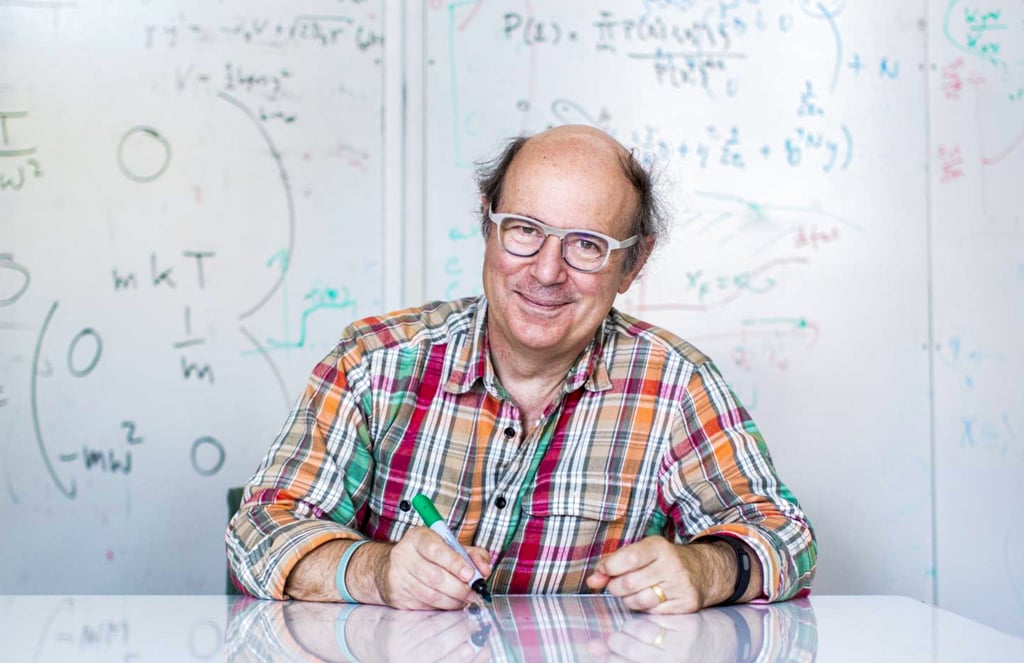
In 1982, I rediscovered Leinaas and Myrheim’s observation and introduced the term anyon for new kinds of quantum statistics. The possible rules for how wave functions respond are no longer simply “do nothing” or “change a sign”.
They can acquire arbitrary phases or even get multiplied by matrices. In naming anyons, I was inspired by the idiom “anything goes”, which reflects the feeling of liberation these ideas produced. More important, I indicated how anyons might arise physically in models based on widely accepted physical principles.
Still, since the models were highly idealised, I could not point to a candidate material. That changed remarkably fast. In 1984, American physicist Bert Halperin gave circumstantial arguments suggesting that anyons occur in a state of matter called the fractional quantum Hall effect.
In this state of matter the basic units are neither individual electrons nor pairs of them, but more collective structures. A few months later, also in 1984, physicists Dan Arovas, Robert Schrieffer and I (ASW) proved it by designing a clear, experimentally feasible protocol that implies anyon behaviour.
At that point I expected experimental confirmation to come within a few months. The fractional quantum Hall effect was – and still is – intensely studied in many laboratories around the world, and here was a striking, specific prediction that they could address.
In fact, it took decades – 36 years, to be exact – of intense effort to get clean and convincing experimental results. The basic issue is that material imperfections and the presence of other interactions, besides quantum statistics, obscure the signal.
Finally in 2020, two groups, one headed by physicists Gwendal Feve and another by Michael Manfra, reported independent – and quite beautiful – evidence for anyons in the fractional quantum Hall effect. The Manfra experiment was close to an ideal, literal embodiment of the ASW mathematics.
In some sense these magnificent experiments, while providing a wonderful and gratifying confirmation of deep theory, came as an anticlimax. In the intervening years the ideas around anyons had blossomed into an enormous theoretical enterprise, spawning many thousands of research papers.
An outstanding consequence was that people realised the potential of emergent interactions, generalising traditional quantum statistics, that could be engineered systematically. These can be used to store, correct and manipulate quantum information in powerful ways. Some leading approaches to error correction in quantum computers lean on ideas from anyon physics.
Whether these new ideas will ever become important outside the rarefied world of research physics is still not completely clear, though their prospects are bright. In any case, they are beautiful in themselves – and they accentuate, by way of contrast and perspective, the beauty of nature’s real fifth force.
KioskNews shows a cleaned-up reading view extracted from the publisher’s page — the original always lives on their site, not ours.