Is Indonesia’s new aircraft carrier worth its US$98,700 a day fuel cost?
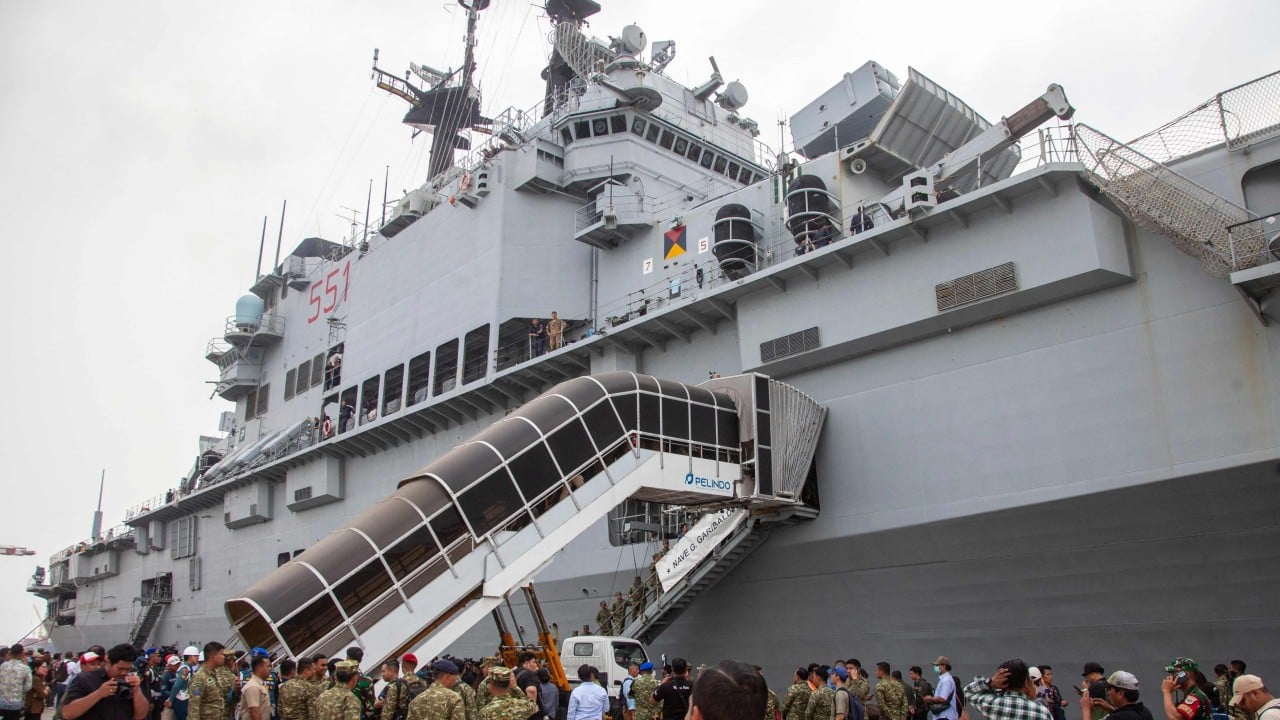
Indonesia’s fresh drills this month on its first and only aircraft carrier have refocused attention on the issue of whether the costly, ageing vessel is being put to good strategic use.
The KRI Sriwijaya-100, commissioned two months ago, should be deployed for power projection and military operations far from Jakarta’s shores, analysts say, warning that underutilisation risks turning the military asset into “a sitting duck”.
The Indonesian navy conducted helicopter operation drills aboard the carrier on November 2 to sharpen the pilots’ skills in manoeuvring off the carrier’s flight deck, local news agency Antara reported.
“The exercise involved five helicopters: three AS565 MBe Panther helicopters from Air Squadron 100 and two Bell 412 helicopters from Air Squadron 400 of Air Wing 2,” said Commodore Tunggul, the navy’s information service head. The helicopters were used in take-off and landing drills as well as disaster response simulations.
Indonesia’s first aircraft carrier arrived in the country on September 18 and was formally commissioned six days later. The 41-year-old vessel, formerly known as the ITS Giuseppe Garibaldi, was a gift from Italy as part of its efforts to build stronger strategic ties in Southeast Asia.
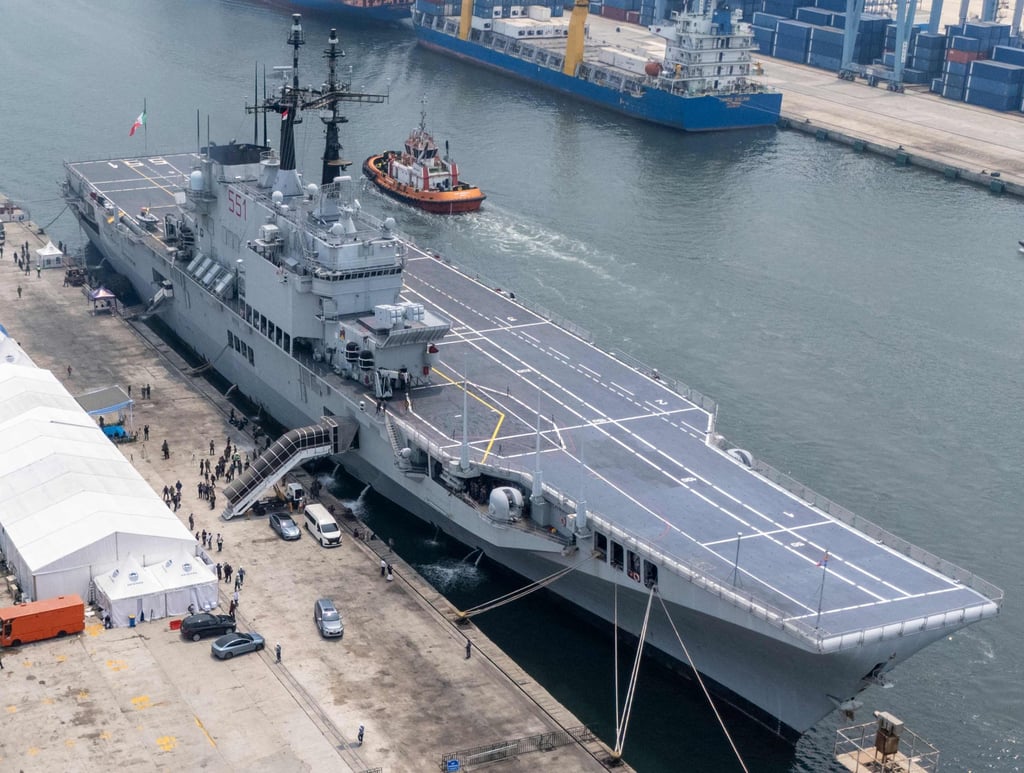
The Indonesian government and navy had earlier stated that the carrier was prioritised for humanitarian help and disaster relief, defence diplomacy such as port visits, and military operations other than war (MOOTW).
Abdul Rahman Yaacob, a research fellow at the Rabdan Security and Defence Institute in the United Arab Emirates, argued the Sriwajaya could be used more effectively.
“The main purpose of an aircraft carrier is power projection and military operations far from a country’s shores,” he said. “Countries do not acquire aircraft carriers for MOOTW missions … because it is not an optimal use of an expensive military asset.”
Humanitarian aid and disaster response, he added, required speed, flexibility, shallow-water access and the ability to move personnel, equipment and relief supplies directly ashore. “An aircraft carrier is not suitable for these missions,” he said, pointing out that the Navy has 23 landing ship tanks capable of such missions.
Indonesia’s current economic challenges and the rupiah’s depreciation could place considerable pressure on the carrier’s operational deployment, he said. It would cost about US$1 billion to fully refit the carrier and acquire suitable transport helicopters – and that “does not include the ongoing day-to-day operating expenses”.
“If the financial burden proves unsustainable, we may see reduced deployment frequency or a more limited operational role,” he said.
Useful options
One way to increase its use would be to turn it into “a mother ship for unmanned aerial vehicles” such as the Bayraktar TB3, Rahman said. Turkey’s medium-altitude drone has successfully shown its ability to take off and land on short-deck aircraft carriers such as the Sriwijaya.
“This could significantly expand Indonesia’s surveillance and strike capabilities in the maritime domain,” he said.
The Sriwijaya’s fuel consumption is expected to be about 1.8 billion rupiah (US$98,700) a day, according to Febry Triantama, an international relations lecturer at Paramadina University. “This figure certainly poses a significant challenge for the Indonesian navy considering the limitations of the defence budget.”
Indonesia’s defence spending historically hovers around 0.6 to 0.8 per cent of its GDP – which is lower than global and Asia-Pacific averages.
To ensure the carrier’s optimal operations, Febry said Indonesia must ensure the availability of support vessels such as transport helicopters, frigates and escort vessels. Failure to do so will only turn the carrier into “a sitting duck in the middle of the Nusantara sea when a disaster occurs on land”.
01:04
Indonesian firefighters celebrate as first rains bring relief to haze-hit regions
“Indonesian defence policymakers must understand that having a weapon platform is not the same as having the desired military capability,” he said. “Having an aircraft carrier without building the supporting ecosystem is the same as Indonesia having a ship to be only showcased at ceremonial events.”
The Indonesian navy has said that after the commissioning, the carrier will undergo four to five months of retrofitting to replace Nato standards communications and on board systems.
However, the PT PAL shipyard – the country’s largest state-owned maritime shipbuilder – is not ready to start the refurbishment, according to Febry. Apart from being busy constructing the Fregat Merah Putih and Scorpene submarines, the shipyard is also trying to complete an order for a 163-metre (535-foot) landing platform dock for the United Arab Emirates.
Vanity project?
Defence analysts have directly compared Indonesia’s acquisition of the Sriwijaya to Thailand’s HTMS Chakri Naruebet, warning that it risks becoming a costly “white elephant” or “vanity project” that drains naval funds.
Built in Spain at a cost of about US$285 million and commissioned in 1997, the Thai carrier has often been described as an expensive, high-maintenance military asset offering very little combat utility relative to its massive cost.
Tita Sanglee, an associate fellow with the Thailand Studies Programme at the Iseas-Yusof Ishak Institute, said neither carrier “makes sense” strictly from an operational cost-effectiveness standpoint.
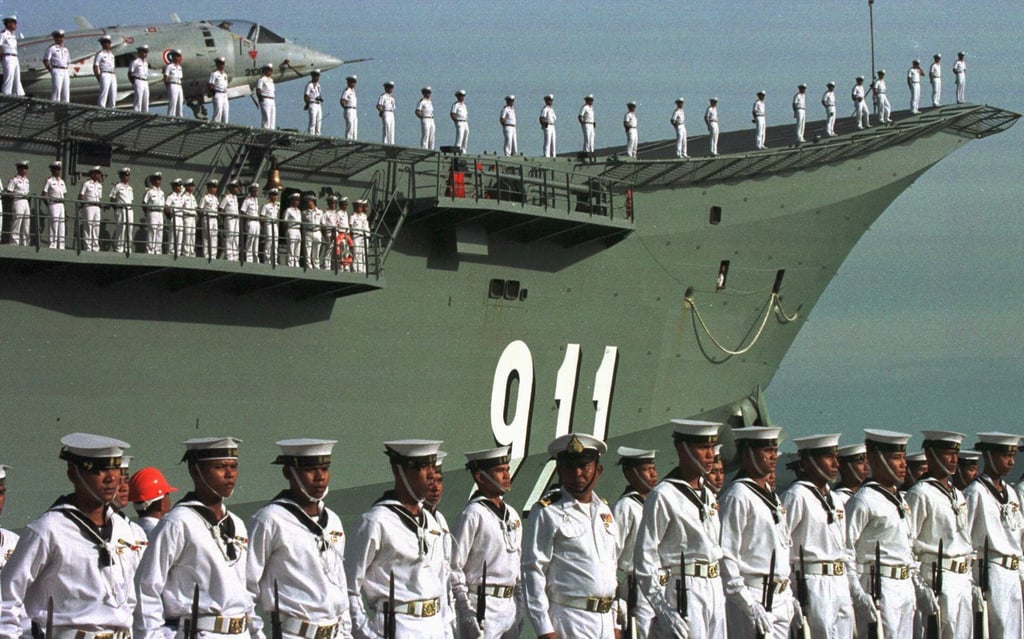
“The question becomes which acquisition is worse. Some might say the Thai one because Indonesia is more of a maritime country than Thailand is,” she said.
“The Indonesian archipelago is much larger and more disaster-prone, and Thailand is still very much land-focused in its defence posture. But the Indonesian acquisition was made with the full hindsight of Thailand’s struggles.”
Unlike the Sriwijaya, its Thai counterpart was brand new and ordered in 1992 when the country’s economy was doing well, Sanglee said, noting that its commissioning around the time of the Asian Financial Crisis was “just unfortunate”.
“It all comes down to the prestige of owning an aircraft carrier. Prestige matters in weapons procurement more than states want to admit.”
KioskNews shows a cleaned-up reading view extracted from the publisher’s page — the original always lives on their site, not ours.