‘Phenomenal’ amount of capital going into AI could be more spread out: Temasek CEO
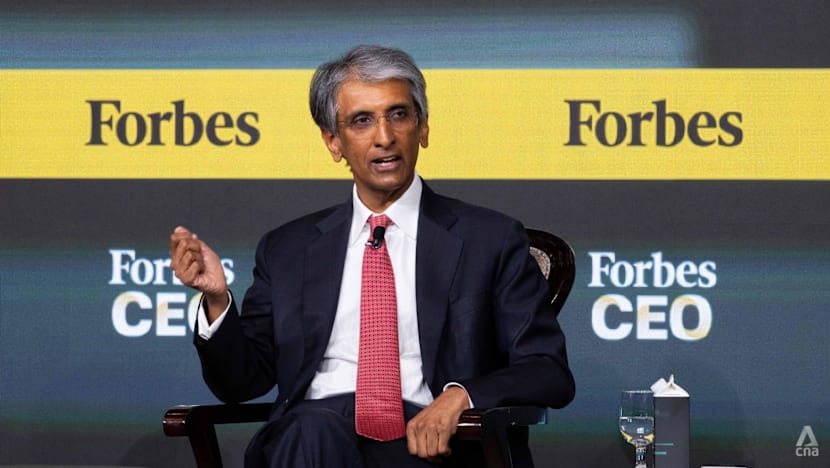
SINGAPORE: With a “phenomenal” amount of money going into artificial intelligence, the capital could be spread more widely to areas such as AI adoption, Temasek Holdings CEO Dilhan Pillay Sandrasegaran said on Wednesday (Oct 7).
Speaking on a panel at the Forbes Global CEO Conference, the head of Singapore's sovereign wealth fund said much of the money is flowing into chips and infrastructure. The panel included billionaire Ray Dalio, Franklin Templeton CEO Jenny Johnson and Bangkok Bank president Chartsiri Sophonpanich.
Mr Sandrasegaran questioned whether the cost of capital will rise because of inflationary pressures from investment in AI infrastructure.
“So much (is) moving into AI infrastructure and so on that we have to start thinking now about how much capital is available for the adoption going forward,” he said.
Temasek is considering this now because its companies need to borrow for their operations, transformation and AI adoption, he said.
Capital is flowing into the five layers laid out by Nvidia CEO Jensen Huang: energy, chips, infrastructure, models and applications, said Mr Sandrasegaran. Much of the profit pool has gone to the chip sector.
“The memory chip guys are making a bundle now compared to any time in the history of semiconductors,” he said.
He also addressed the decision by ST Telemedia, a Temasek subsidiary, to sell its 82 per cent stake in ST Telemedia Global Data Centres to investment firm KKR and Singtel for S$6.6 billion (US$5.16 billion).
“People asked me, ‘Why would you want to sell a data centre operator when all that money is going to AI right now?’” said Mr Sandrasegaran.
The subsidiary relied on Temasek's triple-A rating to get good credit at good rates, he said, adding that costs would have risen had it continued to invest in energy capacity or better technology for its data centres.
“You have to think about the morning after when you're the owner of a business, and then your risk tolerance level is different from that of an investor, because the ability to rotate is not the same,” he added.
EXPERIMENTATION AND TRUST IN AI ADOPTION
On a later panel, DBS Group CEO Tan Su Shan discussed how companies can encourage AI adoption.
The panel, which covered the growth of technology amid geopolitical and workforce changes, included Northeastern University president Joseph E Aoun, Singapore Exchange chairman Koh Boon Hwee, Trip.com Group CEO Jane Sun and SM Investments vice-chairperson Teresita Sy-Coson.
One way to drive AI adoption is to allow experimentation and failure in a safe environment, said Ms Tan. DBS gives employees a safe space grounded in enterprise knowledge, with controls and governance policies, to build their own AI agents, she added.
KioskNews shows a cleaned-up reading view extracted from the publisher’s page — the original always lives on their site, not ours.