One case worker, one plan: Sparing each struggling family from retelling stories across agencies
SINGAPORE – Families seeking help for multiple issues like marital conflict, domestic violence and their children’s behavioural problems will go through a simpler process from 2029, with fewer assessments by different agencies.
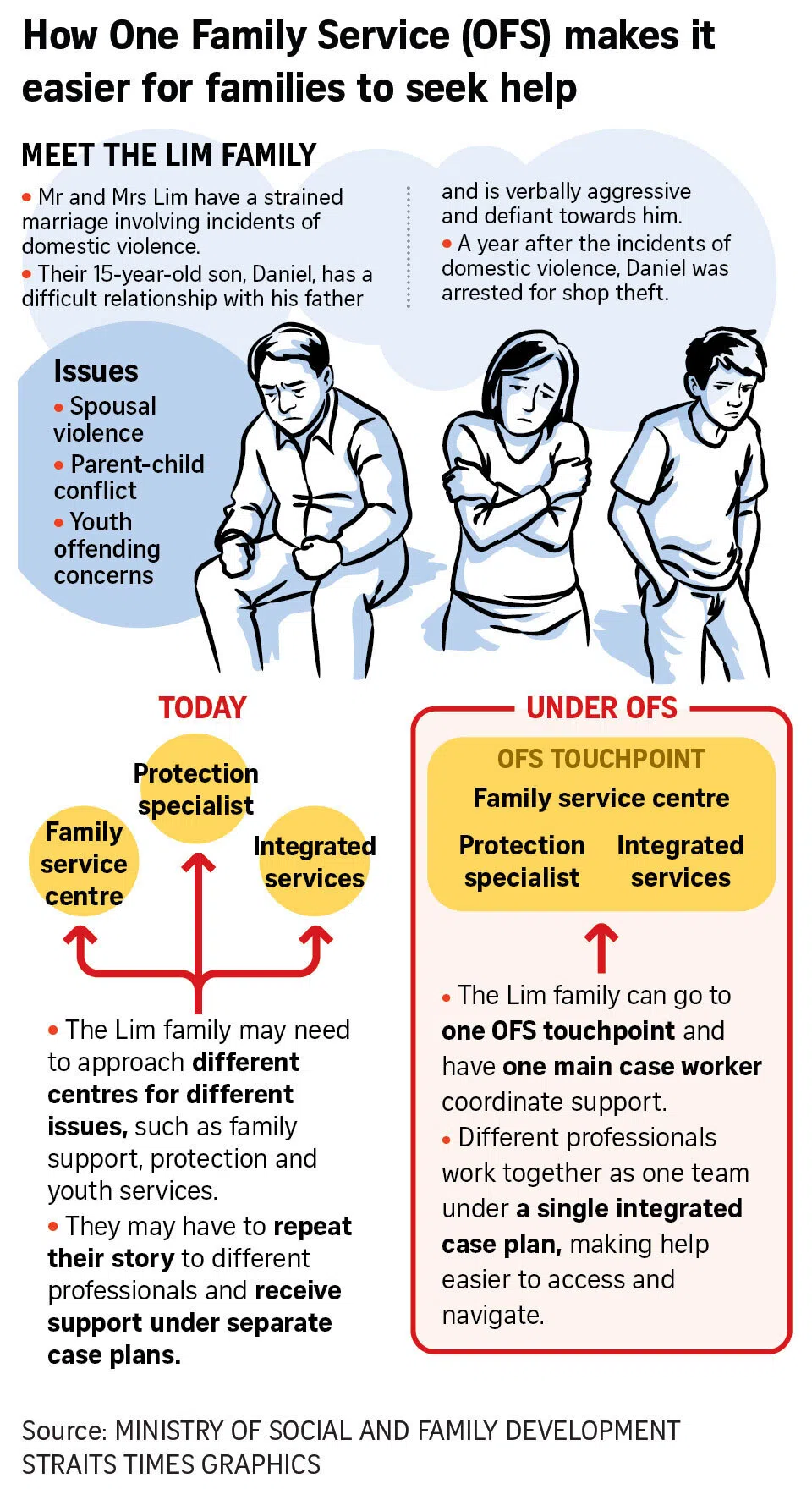
Each family will have one main case worker coordinating support from various professionals, instead of having to navigate different programmes, meet multiple social workers and explain their circumstances repeatedly.
This is among the key changes proposed under the One Family Service (OFS) model, which will bring together nine existing programmes spanning family support, protection and youth services.
Currently, the nine programmes collectively serve about 35,000 individuals or families each year. Almost one in five families is supported by more than one programme.
The new approach, recommended by the Family Services Review Committee, is expected to be phased in across seven regions in Singapore, starting with three in 2029.
The committee was convened in June 2024 to examine how family services could better meet families’ evolving and increasingly complex needs. The Government has accepted in principle all 19 recommendations from the review, including the proposed OFS model.
Currently, a family dealing with several difficulties may need support from different programmes, each with its own assessments, eligibility criteria and case plans.
Ian Christopher Peterson, director of family and community services at Care Corner Singapore, said each case could involve several social workers, counsellors or specialist practitioners working on issues such as financial difficulties, marital conflict, parenting concerns and family violence.
“The main difficulty is not the absence of committed professionals, but the way services are organised around programme boundaries,” he told The Straits Times.
Families may have to undergo repeated assessments, attend multiple appointments and navigate different case plans, even when their problems are closely linked.
Sarah Soh, centre head of the Strengthening Families Programme (FAM) at Lakeside Family Services, said families may need to visit different centres, depending on where the services are based.
“Retelling painful experiences to different professionals is emotionally tiring,” she said.
Juggling several appointments may also mean taking time off work, arranging childcare and incurring additional transport costs.
Soh recalled a family that approached a family service centre for help with marital difficulties and parenting concerns involving two sons.
Conflict between the parents had turned physical, with the children witnessing the violence. Their 15-year-old son had also been physically violent towards his mother during conflicts, while their 13-year-old son was staying out at night and skipping school.
Social workers at the centre worked on the family’s safety and engaged youth services to reach out to the younger son. Once the immediate risks were stabilised, FAM was brought in to provide counselling for the parents’ marital conflict and parent-child issues.
The mother had to retell painful experiences to several professionals while navigating the staggered support.
Under the proposed OFS, the family will instead have one primary case worker overseeing an integrated plan that addresses their safety, parenting concerns and the children’s needs.
The case worker would serve as the family’s main point of contact, coordinating the professionals and ensuring that responsibilities and priorities are clear. The family would hopefully spend less effort keeping track of different services, Soh said.
The Ministry of Social and Family Development said the operational details are still being worked out.
The proposed restructuring of services comes as social service agencies observe that more families are grappling with multiple, interconnected challenges.
According to the committee’s report, the proportion of active family service centre cases assessed as having higher risks or more complex needs rose from 25% in 2019 to 30% in 2025.
Siti Noor Adilla Daud, head of Allkin Family Service Centre @ Punggol 616, said the challenges are not necessarily new, but they often interact in more complex ways.
For example, financial stress may contribute to parental conflict, which affects a child’s well-being and school functioning. Mental health difficulties may also make it more difficult for someone to sustain employment or seek support.
Adilla, who has worked in social services for 13 years, recalled a family whose adult son had developmental needs and had been involved with the police.
More than five professionals were supporting the family, including social workers and specialists addressing the son’s needs and his caregivers’ well-being.
The caregivers found it stressful communicating with multiple professionals and managing different intervention plans, while coping with their responsibilities, she said.
Under OFS, having one primary case worker and a shared plan could reduce this burden and help professionals coordinate interventions based on the family’s readiness and circumstances, she added.
Muhammad Zahin Saini, deputy head of PPIS Family Service Centre (West), noted that professionals already coordinate support through a framework called Case Map, which facilitates collaboration through communication and joint case conferences. Where appropriate, a case lead or lead agency may be appointed.
However, organisations may still operate with separate systems and processes, while receiving agencies may conduct their own assessments.
Under the OFS, families will be able to approach any service within the integrated model and have their needs assessed holistically, with relevant expertise brought together as required, he said.
“The principle that the first point of contact should be the right point of contact is particularly meaningful,” said Zahin.
By streamlining the process, the model also aims to strengthen preventive support, allowing professionals to identify emerging difficulties and intervene before they escalate.
Soh said a child’s distress or a parent’s growing struggle to cope could point to wider challenges within the family, which professionals taking a more holistic approach may be able to identify earlier.
“I hope families will feel more confident seeking help, knowing whom to approach and trusting that those supporting them are working towards goals agreed with them,” she added.
KioskNews shows a cleaned-up reading view extracted from the publisher’s page — the original always lives on their site, not ours.