Western Sydney airport has been 40 years in the making. Why is it needed and how do you get there?
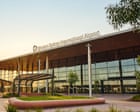
Who will be using the city’s second airport – and which airlines will be flying in and out?
Why did we need a second Sydney airport?
WSI is intended to complement Sydney’s primary Kingsford Smith airport at Mascot, which has capacity constraints, and cater for the local growth corridor.
While proposals for a second airport in Sydney date back further, the Hawke government only began acquiring 1,780 hectares of farmland in Badgerys Creek in 1986 after an intervention by the then treasurer, Paul Keating.
The airport was put on hold during the construction of a third runway at Kingsford Smith, and the Howard government subsequently withdrew funding, but retained the land.
Planning began again in the mid-2000s, and the Badgerys Creek site was confirmed as the site of Sydney’s second airport under the Abbott government in 2014, with construction starting in 2018.
The federal government says more than 2.5 million people will call WSI their local airport, such is the size of western Sydney.
Kingsford Smith is subject to strict movement limits of 80 takeoffs and landings – known as slots – in any one hour alongside an 11pm-6am curfew, to curb noise pollution for people who live near the airport. WSI, in contrast, is approved to run 24 hours a day. It also has ambitions of handling lots of freight, further relieving pressure on Kingsford Smith, with plans to eventually cater for up to 1.8m tonnes of air cargo a year.
The government has said that, from 1 November, freight flights which had been exempt from Kingsford Smith’s curfew and allowed to land in Mascot overnight will fly into WSI instead. WSI said it could not say how much freight or how many flights would be diverted as a result and this was a question for the freight carriers.
How much did it cost?
The commonwealth government has said it spent $5.3bn on building the airport. In addition, about $22bn worth of transport and enabling infrastructure has been or is being delivered to support the airport, according to a CommBank estimate. The commonwealth and New South Wales government have committed to jointly fund a metro rail to the airport at an estimated cost of about $11bn.
The NSW government and the airport will also subsidise four of the international airlines that have agreed to service WSI through the $16m “Take-Off Fund”: Air New Zealand, Singapore Airlines, VietJet and Qatar Airways.
The NSW tourism minister, Steve Kamper, would not disclose how much any of the individual airlines would be receiving, but says the fund will help grow the state’s visitor economy.
“Direct flights make it easier for visitors to discover everything NSW has to offer, while creating new opportunities for businesses across Sydney and our state,” Kamper says. The government hasn’t said how long the airlines will receive the extra cash for.
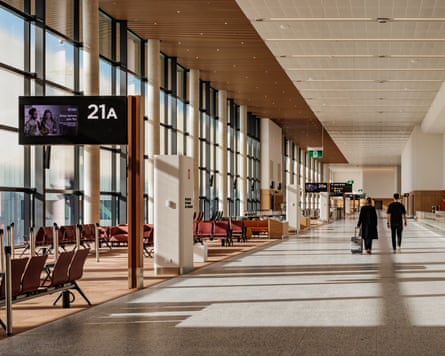
Which airlines and routes will use it?
Fiji Airways has also signed up for three flights a week to Nadi from March 2027.
Air New Zealand has committed to three flights a week from Auckland from 26 October, while Singapore Airlines has said it will start daily flights between Changi and Western Sydney International from November 2026. VietJet is due to start two weekly services between Ho Chi Minh City and WSI from January 2027, with plans to scale up to three services a week.
Qatar Airways has agreed to start three flights a week from Doha to Western Sydney from December 2027. The federal transport minister, Catherine King, says the new flights are the result of an updated bilateral air services agreement with Qatar. The government continues to restrict how many services the Qatari government-owned airline can operate into Australia’s four major airports in Melbourne, Sydney, Brisbane and Perth.
Jetstar will begin on Sunday, with an inaugural flight to the Gold Coast. Qantas has started selling tickets for four weekly flights to Brisbane and Melbourne from 28 March 2027. However, WSI notes the Qantas services are “subject to government and regulatory approval” and their “schedule is subject to change”.
Can I get a good deal on flights?
That depends on where you’re going, and when. When Guardian Australia looked at the fares for several popular destinations from WSI and Kingsford Smith for a hypothetical return trip from 1 to 12 December, factoring in the cost of getting to the airports from four locations around Sydney, the older airport was generally the more affordable option. Parking at WSI, however, was significantly cheaper than at Kingsford Smith.
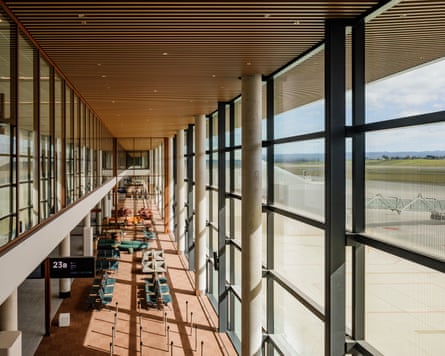
How will I get there?
The airport in Badgerys Creek is more than 60km from the Sydney CBD. A high-speed metro line connecting to the heavy rail line at St Marys station, originally scheduled to open alongside the airport, will not be complete until at least December next year, amid a dispute between the state government and the private consortium building it.
Until then, a free shuttle bus will run between the airport and St Marys every 30 minutes, while a $25 “super shuttle” will run from Parramatta and Central stations. A network of five new local bus routes in western Sydney connects surrounding areas to the airport. Coach operator FlixBus has announced a twice-a-day service connecting Canberra to WSI starting Sunday.
Journeys via car include the new, toll-free M12 motorway, although journeys to and from the Sydney CBD or connecting flights at Kingsford Smith are likely to include tolled travel.
A Guardian Australia analysis of Uber fares from different areas in Sydney suggested travel to Kingsford Smith was slightly more affordable, but parking at WSI was significantly cheaper, at least during an introductory discount offer.
Is everyone happy about it?
There is a long history of community opposition to the airport dating back to the 1960s, when Badgerys Creek was first proposed as a potential location for a second Sydney airport.
Wayne Willmington, the president of the Luddenham Progress Association, says his family farmed the land on which the terminal has since been built from the mid-19th to the early 20th centuries.
He was a member of the Badgerys Creek Anti-Airport Group in the 1980s, but he accepted the inevitability of the airport when the government began buying up land for the site in 1986. He says he now sees WSI not as Sydney’s “second airport”, but an airport “for the people of western Sydney”.
He is booked on the first commercial passenger flight to the Gold Coast at 11am on Sunday.
KioskNews shows a cleaned-up reading view extracted from the publisher’s page — the original always lives on their site, not ours.