Trump-Xi meeting: Xi made little progress in summit: official
EMPTY-HANDED: Unable to make concrete gains on trade and tech restrictions, Beijing would likely use propaganda to promote narratives that China is rising, the official said
By Chen Yun and Sam Garcia / Staff reporter, with staff writer


The second meeting this year between US President Donald Trump and Chinese President Xi Jinping (習近平) ended with little progress, as Beijing’s attempt to pressure Washington to reduce arms sales to Taiwan failed to gain traction, a national security official said yesterday.
Beijing had hoped to use the summit to frame US-China ties as a stable and constructive relationship between equal powers, while deflecting attention from its economic slowdown, excess production capacity and authoritarian expansion, the official said, speaking on condition of anonymity.
While the US rolled out the red carpet for Xi, Washington focused on its own political values and challenged Beijing’s narrative, they said.
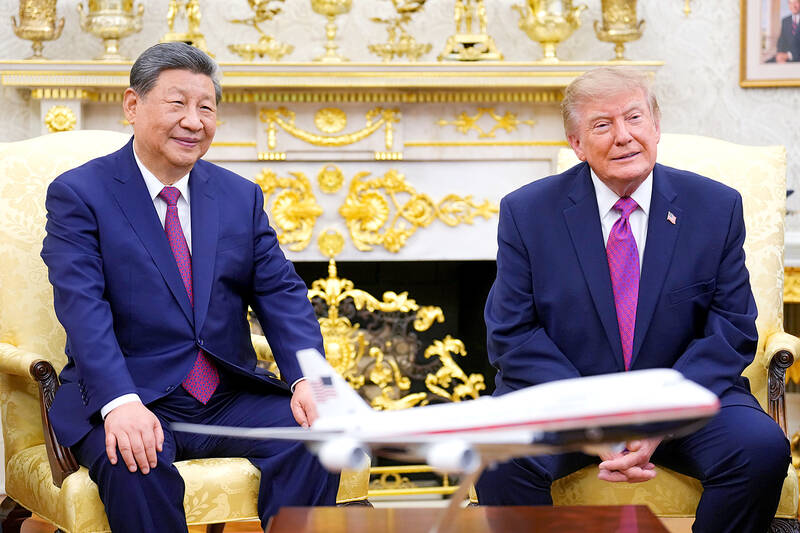
Chinese President Xi Jinping, left, and US President Donald Trump meet in the Oval Office of the White House in Washington on Thursday.
Photo: AP
US-Taiwan ties are based on US national interests, shared democratic values and Taiwan’s key role in the global high-tech supply chain, which Washington cannot simply set aside in dealing with Beijing, they said.
With China unable to make concrete gains such as lower tariffs or lifting high-tech restrictions, it might turn to propaganda, using images of Xi receiving the red-carpet welcome to promote narratives that China is rising as the West declines and that the US has abandoned Taiwan, the official said.
If Taiwan wavers between authoritarianism and democracy under pressure from pro-Beijing forces, it could lose international trust and its strategic advantages, they said.
Taiwan needs to strengthen its “silicon shield,” maintain its leading position in artificial intelligence (AI), semiconductors and advanced manufacturing, and accelerate technological and industrial development, turning its economic strengths into a central part of its national defense, they said.
Taiwan should deepen its alliances and asymmetric defense capabilities by bolstering cooperation with the EU and other democracies in the Indo-Pacific region on supply-chain security, cybersecurity, civil defense and geopolitical strategy, the official said.
It should continue to build its defense capabilities and pursue greater self-reliance, ensuring that any regime seeking to change the “status quo” in the Taiwan Strait would face unacceptable costs, they added.
Taiwan should also maintain a steady approach to cross-strait relations by not provoking the other side, while playing an active role in promoting regional peace, they said.
In his remarks, Trump highlighted US-China cooperation during World War II, cited the US founding documents to emphasize liberal democracy as the “true approach” and invoked Sparta’s final victory to take aim at Xi’s Thucydides Trap narrative, they said.
Washington’s references to World War II cooperation underscored that the history being invoked was not one the Chinese Communist Party (CCP) had experienced firsthand, as it was the Republic of China at that time, they added.
That challenged Beijing’s claims that “the East is rising and the West is declining” — a political narrative introduced by Xi in January 2021 — as well as the CCP’s legitimacy as China’s representative, the official said.
On trade and economic issues, Washington kept diplomatic gestures separate from its strategic interests, making no concessions on tariffs or AI controls, they said.
US-China relations have entered a new normal of frequent communication and intense competition, they said.
While the two sides use dialogue to prevent immediate conflict, competition over high-tech restrictions, supply-chain restructuring and geopolitical influence is likely to intensify, the official said.
The government would continue to provide timely and transparent information to help people understand relations between major powers, they said, adding that Taiwan’s future depends on its own strength and democratic values.
KioskNews shows a cleaned-up reading view extracted from the publisher’s page — the original always lives on their site, not ours.