Satellite imagery shows villages removed, roads built at Chinese dam site near Arunachal border
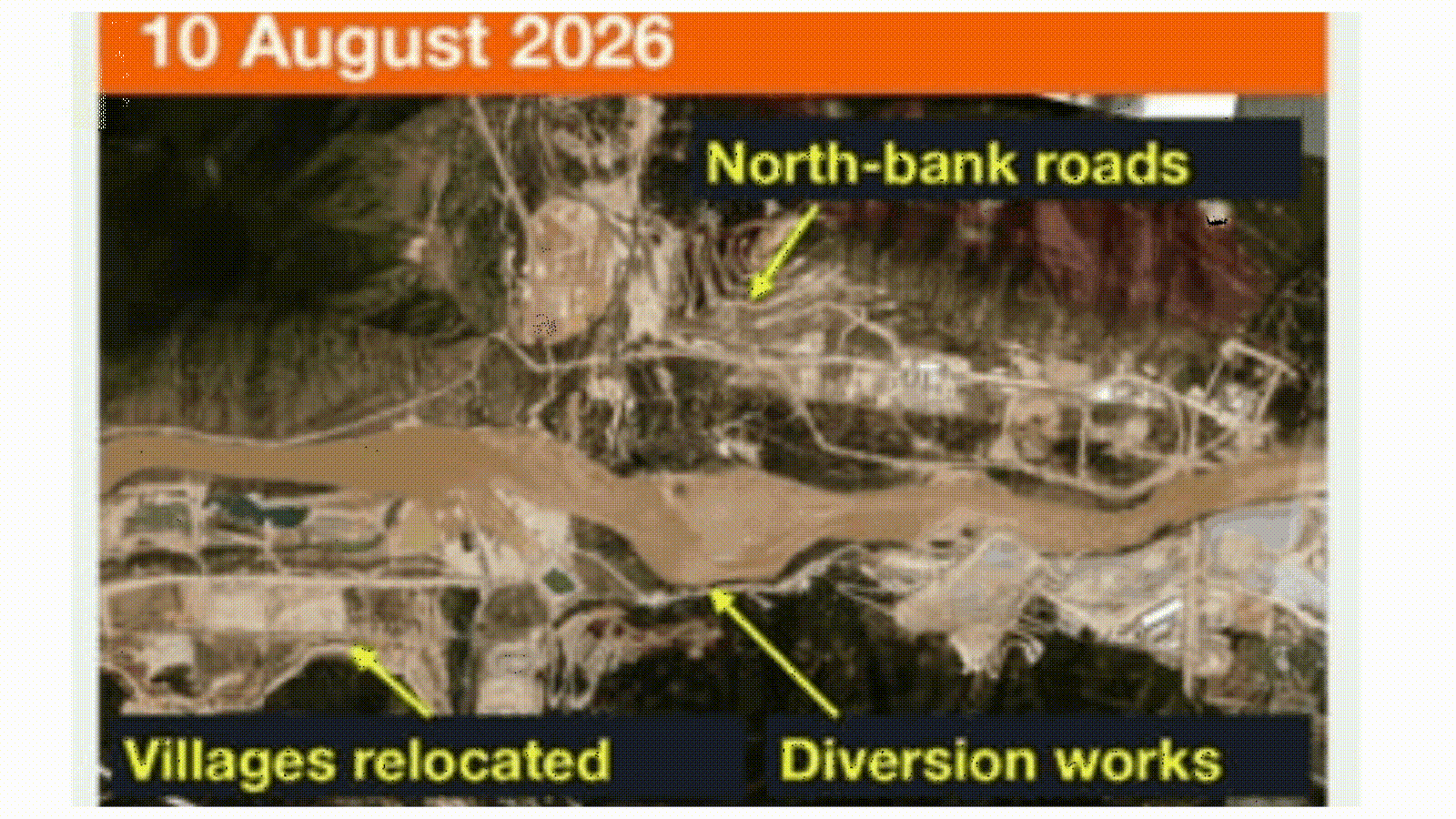
Villages have been removed, and major construction is underway in Southeastern Tibet over a year after China began constructing the world’s biggest hydropower project on the lower Yarlung Tsangpo River near the border with Arunachal Pradesh, satellite imagery showed.
The project, expected to cost $168 billion, involves a multi-structure dam system and a tunnel across the Great U-Bend, where Yarlung Tsangpo loops around the Namcha Barwa mountain and enters India via Arunachal Pradesh. It is set to become the world’s largest dam and have multiple power stations and exits. The installed capacity of 60 GW is three times that of China’s Three Gorges Dam, currently the world’s largest.
“We have been tracking construction activity on the project from space for nearly two years now. The satellite imagery shows villages and farmland on the south bank of the river, upstream of the dam, being cleared,” said Nirdesh Sharma, CEO of Earthsense Labs, a geospatial AI deep-tech startup, which released its first report on the Medog Hydropower Project (Motuo Dam) on Monday. The construction of the project began in July last year.
Also Read: Siang dam protests: Dialogue crucial to balancing strategic and local concerns
India is planning the 11,200 MW Siang Upper Multipurpose Project (SUMP) in Arunachal Pradesh to offset the impact of China’s dam and changes in the river’s water discharge. A section of residents are opposing the project, citing threats to lives and livelihoods. Last week, Union home minister Amit Shah reassured that all concerns would be addressed before going ahead with the project as he visited Arunachal Pradesh.
Efforts to contact the Arunachal Pradesh government and representatives of organisations opposed to the SUMP for their responses were unsuccessful. The copy will be updated once they comment.
Sharma said a new access road along the north bank and river diversion works, which is usually done during the early phase of the project, are under construction.
The Earthsense Labs report, which HT has seen, highlights a large dam near Mainling town, the lower dam near Pai town, a tunnel through Namcha Barwa mountain, and the water outlet near the India-China border, downstream of Medog county. The Yarlung Tsangpo is known as Siang in Arunachal Pradesh and Brahmaputra once it enters Assam after it joins the Dibang and Lohit rivers.
Satellite imagery at the Mainling high dam site on July 11 last year, before the groundbreaking ceremony on July 25, showed villages and agricultural fields on the south bank of the Yarlung Tsangpo. By December, the villages were cleared, fields removed, and earthwork started. Imagery from the north bank at the site taken in August this year showed road construction, diversion works, and offices and other buildings.
Also Read: Two Arunachal organisations urge Union Home Minister Amit Shah to scrap Siang mega dam project
Imagery from the lower dam site at Pai did not show. Conclusive structural work between October last year and October this year suggested that work may start from the lower tunnel end in Namcha Barwa.
Comparison of satellite imagery of the likely tunnel area between 2021 and 2024 showed that no prominent development work was seen earlier. Major construction and development work was undertaken later and is ongoing. Images showed new bridges, roads, machinery, a concrete batching plant, trucks, and vehicles.
By February 2025, there was extensive road development. Housing and industrial buildings came up in the area. Groundwork in the area was seen to have started as early as 2019. By 2023-24, 30-35 residential and industrial buildings came up.
Other findings indicate the establishment of a concrete batching plant between April and August 2024, forest cover (seen in 2019) replaced by industrial buildings and trucks, a bridge built in 2022, and a network of roads leading to the river.
ABOUT THE AUTHOR
A seasoned senior journalist, I have nearly three decades of experience across print, digital, and online platforms, covering political transitions, insurgencies, environmental issues, and development stories in India and Nepal. I am skilled in breaking news, leading editorial teams and launch of newspaper editions. I am adept at leveraging digital trends and social media to expand global reach, with a strong ethical foundation and a reputation for impactful journalism. An alumnus of Asian College of Journalism, I joined Hindustan Times in New Delhi as a trainee reporter in May 1997. Over the years, I have been posted in Dehradun, Kathmandu (Nepal) and Guwahati. Currently, as Senior Assistant Editor at Hindustan Times, I lead a team reporting on India’s northeastern states. My work involves in-depth analysis, and engaging multimedia storytelling across formats, including text, photo, video, and interactive content. I am skilled in producing timely, shareable content, leveraging digital platforms and social media to engage global audiences. Throughout my career with the Hindustan Times, I have led diverse editorial teams, designed capacity-building activities, and supported reporters in developing strong story ideas, ethical reporting practices, digital skills, and fact-checking techniques. As Senior Assistant Editor for Northeast India, I have been responsible for guiding correspondents through complex political, humanitarian, and community-level stories using multimedia formats. Earlier, as Foreign Correspondent in Nepal, I produced extensive reporting during Nepal’s democratic transition and the 2015 earthquake and its aftermath.
KioskNews shows a cleaned-up reading view extracted from the publisher’s page — the original always lives on their site, not ours.