China’s Shenzhou-24 spacecraft lifts off with first foreign astronaut on board
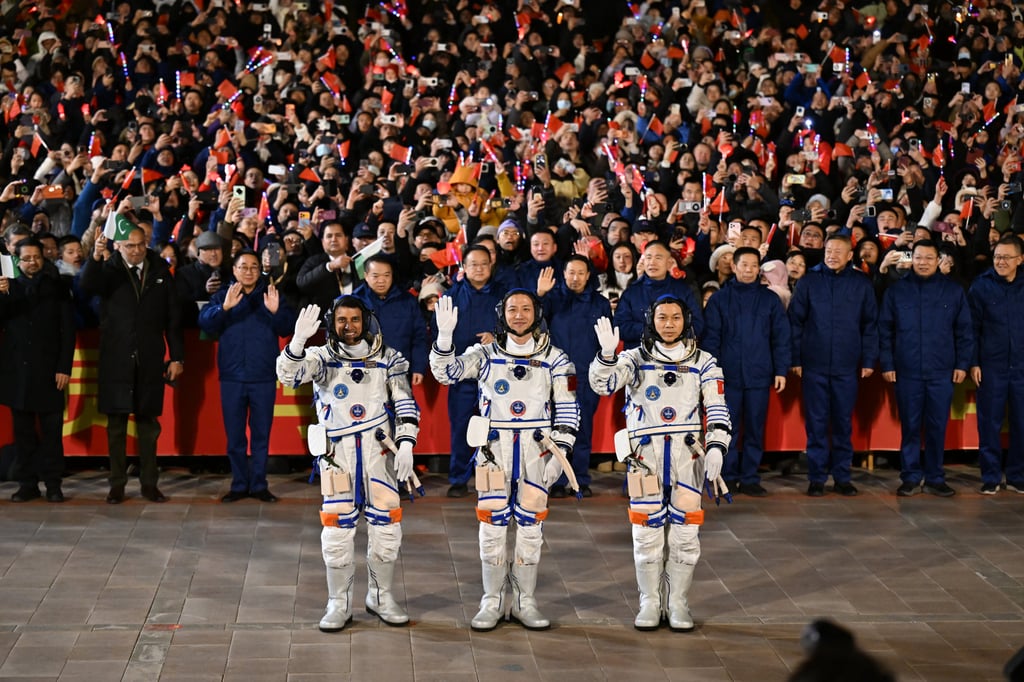
In a sign of the space programme’s increasing diversity, for about a week, the station will be home to four astronauts from mainland China, one from Hong Kong and one from Pakistan.
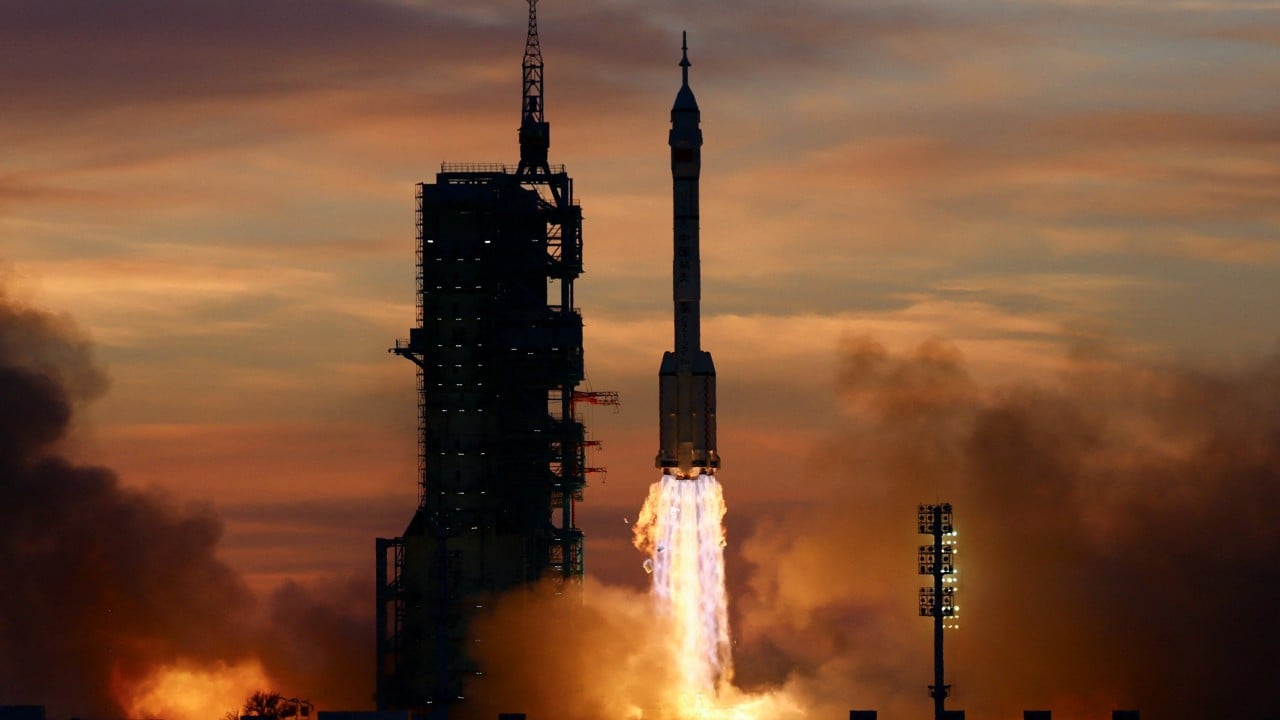
A Long March-2F rocket carrying the spacecraft blasted off from the Jiuquan Satellite Launch Centre in the northwestern province of Gansu at 8.18am, according to the China Manned Space Agency.
Bathed in an orange sunrise, the rocket rose from the launchpad with a deafening roar, sending massive plumes of smoke and desert dust into the sky.
Once in orbit, Shenzhou-24 will travel to the Tiangong and dock in 3½ hours – all going to plan.
The crew of three consists of commander Tang Hongbo and flight engineer Wu Yi, as well as payload expert Muhammad Zeeshan Ali, Pakistan’s first astronaut in orbit.
“I hope the next chapter of China-Pakistan space cooperation will grow from one astronaut, one flight to multiple joint flights, the moon, Mars and beyond,” Ali said on Tuesday.
Ali will stay in the Tiangong for about a week and will return to Earth on Shenzhou-23 together with Zhang Zhiyuan and Hong Kong’s first astronaut Lai Ka-ying, who have spent the past six months on the space station.
01:28
Pakistani astronaut set to become first foreigner aboard China’s space station
Tang and Wu will spend six months on the Tiangong together with Zhu Yangzhu, the third member of the Shenzhou-23 crew, who will become the first Chinese astronaut to spend a whole year in space.
Zhu’s experiences will be used to study how the human body adapts to long periods in space and to test health, work and living support systems for astronauts, Zhang Jingbo, a spokesman for the China Manned Space Agency said.
The data collected will help support future missions.
Beijing plans to send three astronauts to the moon before 2030, two of whom are expected to set foot on the lunar surface.
During the Shenzhou-24 mission, the crew will carry out 90 experiments and test technology used in fields such as space life sciences, aerospace medicine, microgravity fluid physics and combustion.
The mission will include four joint China-Pakistan projects in biotechnology and materials science.
WATCH: Hong Kong’s first astronaut Lai Ka-ying gives live lecture from space
Ali will be the first foreign astronaut to board the space station. During his time in space, he will carry out experiments on photosynthesis in bacteria and the impact of space radiation and microgravity on quinoa seeds, according to Cang Huaixing, a researcher at the Technology and Engineering Centre for Space Utilisation at the Chinese Academy of Sciences.
Chinese is the main working language on the space station. Ali had no knowledge of the language when he was selected for the mission but after seven months of training, he said he would be able to communicate with the other astronauts in Chinese.
Wu Dawei, from the China Astronaut Research and Training Centre, said the training team had compiled glossaries of space flight terms and procedure checklists with audio recordings to help Ali practise.
He had also learned some Chinese songs to help him understand the language.
“For this short-term rotation mission, he has met the basic Chinese-language requirements, and our astronauts have also undergone relevant English training. When necessary, we [the astronauts] will use both Chinese and English to ensure they clearly understand the mission status and respond properly,” Wu added.
Ali would also have a halal menu during his stay aboard the Tiangong, tailored to both his nutritional needs and personal preferences, she said.
China has been trying to diversify its crewed space programme in recent years. Lai from the Shenzhou-23 crew was Hong Kong’s first astronaut and a candidate from Macau is also undergoing training.
KioskNews shows a cleaned-up reading view extracted from the publisher’s page — the original always lives on their site, not ours.