US firm to make battle-tested drones in Taiwan, boosting supply chain resilience
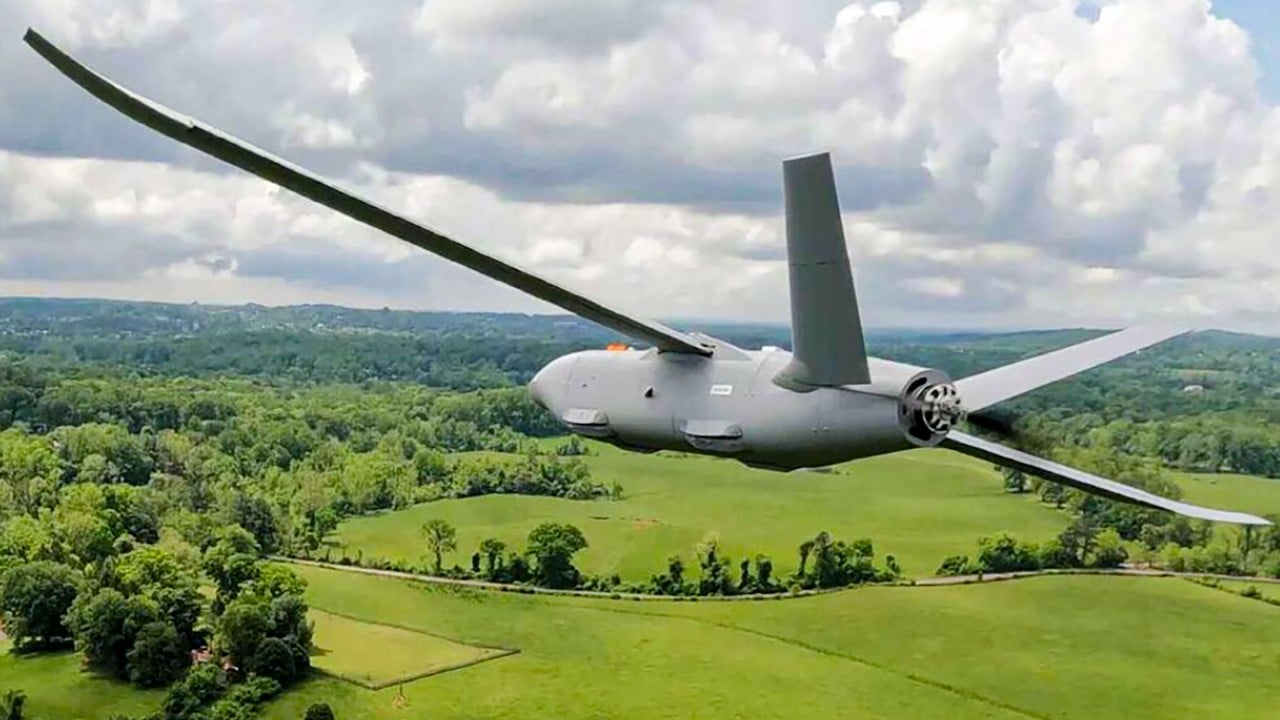
Two combat-tested American drones could become part of Taiwan’s expanding unmanned arsenal as the island seeks to build a “drone shield” against the People’s Liberation Army.
California-based defence technology company Aevex Aerospace is working with Taiwan’s Coretronic Intelligent Robotics Corporation (CIRC) to produce its Vandal and Onyx drones locally, combining lessons drawn from the war in Ukraine with the island’s electronics and manufacturing capabilities.
Both aircraft have been tested under combat conditions in Ukraine, where intensive electronic warfare has helped shape their development, according to Aevex executives.
Vandal, the smaller of the two, is designed for intelligence, surveillance and reconnaissance missions, as well as electronic warfare and precision strikes.
According to Aevex, the electrically powered aircraft can carry a 4.5kg (10lbs) payload and fly more than 460km (286 miles), while its low-signature design is intended for contested environments.
The larger Onyx can carry 13.6kg, and has a range exceeding 270km and an endurance of up to 2.8 hours. Its modular payload bay can accommodate sensors and equipment for surveillance, targeting, communications or precision strikes.
02:55
Taiwan concludes annual war games, including preparing for PLA sea blockade
Both are designed to operate when satellite navigation is degraded or unavailable – potentially important in a cross-strait conflict in which the PLA would be expected to employ extensive electronic warfare.
Aevex integrates the drones with its CompassX navigation architecture, which uses technologies including computer vision to operate in GPS-denied or degraded environments.
Together, the systems could provide complementary capabilities ranging from persistent reconnaissance and targeting to electronic warfare and precision strikes, with ranges extending well beyond Taiwan’s coastline.
But analysts said their significance for Taiwan could lie as much in how they are produced as in what they can do in the air.
“The Aevex-CIRC production model could be particularly useful during a conflict because 3D printing could allow Taiwan to manufacture replacement drones rapidly rather than relying entirely on overseas resupply,” said Lu De-yun, a former Taiwanese defence ministry press secretary.
“In wartime, 3D printing could be used to rapidly produce thousands or even tens of thousands of drones in Taiwan,” Lu said.
Containerised 3D-printing facilities could also be moved between locations, dispersing production and supporting a “high-low” force mix combining advanced weapons with large numbers of cheaper systems, he said.
According to Aevex, its ForgeX 3D printer also allows drones to be rapidly modified in response to battlefield requirements.
Such resilience could become critical if the PLA imposed a blockade or disrupted supply routes across the Pacific, Lu added.
Beijing regards Taiwan as part of China to be reunited by force if necessary. Most countries, including the United States, do not recognise self-ruled Taiwan as an independent state, but Washington is opposed to any unilateral change to the cross-strait status quo by force and is committed to supplying it with weapons.
08:44
Will Thailand’s southern conflict ever end?
Announcing the partnership in Taipei on Friday, Aevex chief growth officer Murali Krishnan said the Ukraine war had created a rapid feedback loop in which information from frontline operators was passed to engineers, incorporated into designs and returned to production.
Taiwan would “inevitably fight a little bit differently” from Ukrainian and Russian forces, he said, but lessons about what worked and what did not could be applied to the island.
That experience is being paired with the local engineering and manufacturing capabilities of robotics-maker CIRC.
CIRC chairwoman Ann Wu said flight-control systems, edge computing and payloads for locally produced aircraft would be developed and supplied by the Taiwanese company, while motors and batteries would also be sourced on the island.
The drones would be produced at CIRC’s Zhunan facility in northwestern Taiwan, where capacity could reach 4,000 aircraft a month depending on demand, she said.
The partnership comes as Taipei pursues a broader effort to turn Taiwan into a major unmanned-systems manufacturing hub, creating a military “drone shield” and what officials hope will become another strategically important technology industry alongside the island’s semiconductor sector.
Economic affairs minister Kung Ming-hsin said on Monday that Taiwan needed more than 200,000 drones to create a deterrent effect, with components and software sourced from what he called a “non-red” supply chain, meaning one free of mainland Chinese products.
He said local production was crucial to avoid shortages during a crisis.
He added that global demand for supply chains free of mainland Chinese components offered Taiwan an opportunity to become an important part of “democratic supply chains”.
The economics ministry recently raised its forecast for the value of Taiwan’s drone industry in 2030 from NT$40 billion (US$1.3 billion) to NT$50 billion.
The government is also implementing a six-year, NT$44.2 billion unmanned-vehicle industry development programme covering government procurement, technological support and testing facilities.
01:47
North Korea launches second 5,000-tonne nuclear destroyer in 75 days
Lu said the combination of government spending and demand for supply chains free of mainland Chinese components was making Taiwan increasingly attractive to foreign drone companies.
Foreign manufacturers had commercial reasons for seeking Taiwanese partners, but their technology and operational experience could also strengthen the island’s defences and help local companies enter global markets, he said.
Krishnan described the logistical challenge facing Taiwan as the “tyranny of distance”, saying local production could reduce reliance on moving replacement systems across the Pacific during a crisis.
Aevex senior vice-president of growth Craig Anders said the partnership was therefore intended to go beyond a conventional arms sale.
“Some companies will talk about working with Taiwan, but what they really mean is they’re going to sell to Taiwan,” he said.
“That is not what we are doing. What we are doing is bringing technology to Taiwan and working with our partners to allow that to happen from Taiwan itself.”
KioskNews shows a cleaned-up reading view extracted from the publisher’s page — the original always lives on their site, not ours.