A Fox Under a Pink Moon review – Iranian teen refugee paints boldly imaginative self-portrait
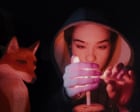
The world feels like an overwhelmingly forlorn place in this striking refugee self-portrait, shot on smartphone by Soraya Akhlaghi over five years and assembled remotely by co-director Mehrdad Oskouei. Fleeing a dead-end life as a Tehran maid, Soraya – who is just 16 at the beginning of the film – starts out at an Istanbul asylum centre. Most “games” – as border-crossing sorties with people-smugglers are euphemistically called – end in failure in the wilderness at the hands of hostile law enforcement officers.
Soraya is hoping to join her mother, who left for Austria after the death of Soraya’s father when she was a child. She winds up back in the Iranian capital, with her violent husband. Of Afghan heritage, she watches the Taliban takeover on TV – and over-identifies with the stricken populace desperate to board a US plane. Gearing up for the next escape attempt, if she can dodge being beaten by her partner, the Turkish border police offer more of the same. Whatever the latest travail, she narrates it to camera in a numbed monologue.
Luckily, Soraya has art. A born creator, she channels her struggles and despair into florid, intense drawings that repeatedly feature four figures: the moon, to whom she expresses her longing; a fox, who gives advice; her proxy, the clown, an avatar of her inner strength; and the craggy demons of her fears, which she also moulds into physical sculptures. This pantheon spills out in the film into vaporous, yearning animations, giving full rein to the imaginative force hemmed in by her harsh reality.
These outpourings lend a mythological tint to her already-sisyphean existence, as Soraya continually returns to the starting grid. Her innate visual sense counts behind the camera, as she frames often-chaotic migrant situations in overloaded trucks and sinking dinghies with purposeful clarity. (Hopefully there is a cinematographer shortage wherever she ends up.) If Soraya herself doesn’t make a strong enough case for her activities as a source of resilience, then there are other budding artists here starting out on the same path. Stranded hopelessly in a forest, a group of refugee children fashion a “mouse house” with twig walls and a roof of leaves. This disquieting and stirring film is an unmistakable plea for art as a first step in staking out the boundaries of home.
KioskNews shows a cleaned-up reading view extracted from the publisher’s page — the original always lives on their site, not ours.