Pro-Palestine activist sought by US in extradition case: ‘I still have a right to my beliefs’
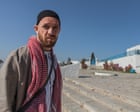
James “Fergie” Chambers, the wealthy leftwing activist and donor controversially sought in extradition by the US, has told the Guardian that he is “not asking anyone to endorse my ideas or not think I’m a jerk – but I still have a right to my beliefs and should not be unjustly accused because of them”.
Chambers’s case is the first known instance of the US seeking to extradite a citizen over alleged support for Hamas, an accusation apparently tied to an international money-laundering charge in the criminal complaint underpinning the extradition request and donations to organizations helping Palestinians in Gaza.
The complaint also includes riot and conspiracy to riot charges stemming from 2023 protests against New England branches of Israeli weapons manufacturer Elbit.
Chambers was speaking from his Madrid apartment in his first in-depth interview after a Spanish appeals court ordered his provisional release on bail on Friday. That release was due to issues with the legally required US translation of the extradition request’s core documents into Spanish, first reported by the Guardian.
“Support for my case doesn’t imply support of me, or my ideas,” Chambers said. “It’s about my right to have those ideas – and not be falsely accused of things.”
Chambers, whose case has gained attention across the world, had been detained since 10 July, when Spanish authorities arrested him in Ibiza.
The order granting Chambers’s provisional release asserted that the translation issues cause “a diminishment, at least for the time being, in the solidity or foundation of the extradition request”. Spanish judges had previously denied bail three times.
The wealthy heir to at least $250mn from his family’s business – Atlanta–based Cox Enterprises – was in the middle of his first visit without being separated by glass with his mother, Lauren Hamilton, when he was summoned to receive the “good news” on Friday, Chambers told the Guardian.
Minutes later, he returned to tell his mother he was being released. “She freaked out crying. We went nuts for about five minutes. Then we got to contacting my lawyer and getting my kids on a plane to Spain.”
On Monday, Chambers’s five-year-old son with actor and activist Stella Schnabel could be heard in the background. The tableau was in stark contrast to his months in prison.
“I tried to build a cocoon to deal with the immense unknown, the immense fear,” he said of his time in Aranjuez prison. “I would pray a lot. The only idea I could hold onto was, my home is the truth. The truth of who loves you. The truth of my own innocence. And the truth of what is happening in Palestine and all the things connected to what is happening in Palestine – other wars, gas prices. No one can take that away from you.”
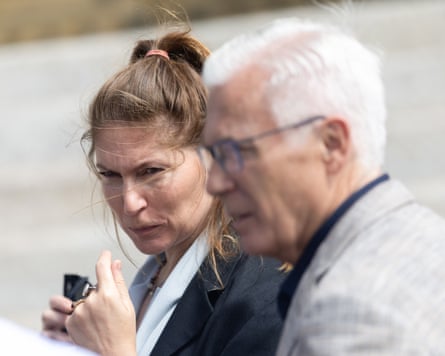
Chambers has been supported by his mother throughout his case, and has reconnected with his father, James Cox Chambers – who owns an estimated 17% stake in Cox Enterprises but does not play an active role in the company – for the first time in five years.
“Speaking with my parents has provided emotional stability – and intelligent, adult minds to help make decisions,” Chambers said.
Although he has had political disagreements with his father, a donor to the Democratic party, Chambers said his father “sees this situation as totally unthinkable and out of step with anything resembling a just society”.
He also invoked his grandfather, the ACLU civil rights lawyer James Cox Hamilton, who died in 2014. “He would’ve turned in his grave over this,” Chambers said.
While locked up, Chambers, a US citizen, received hundreds of letters of support from friends, family and strangers, postmarked from Atlanta to Barcelona – including, he said, “from a guy who had been imprisoned under [Spanish dictator Francisco] Franco, who painted the ‘key of return’ [a symbol of homes lost in the 1948 Nakba] on the Palestinian flag”.
Chambers’s views and donations to progressive and humanitarian projects have been extensively profiled in US media, including his controversial public comments on Israel and Gaza. A week after the 7 October Hamas attacks on Israel, he posted on X about Israel’s response: “Stop calling it ‘collective punishment’/There’s nothing to be ‘punished’ for/No faction of the Palestinian resistance, Hamas or other, has done *anything* wrong/It’s simply genocide/Like it has been.”
after newsletter promotion
His release followed a separate decision on Thursday by a three-judge panel at Spain’s high court tasked with deciding on the extradition to pause the proceedings in order to evaluate the impact of the alterations the US made to the original, machine-made translation of the extradition request into Spanish.
The US admitted to making several of the changes, calling them “substantial [and] inadvertent”. These and dozens of other changes introduced prejudicial notions with specific legal implications that in turn wound up in the Spanish prosecutor’s report on the case, Aitor Martínez, a member of Chambers’s defense team, told the Guardian last week.
It was also recently revealed that there is no indictment behind the complaint, meaning the federal government has not had a grand jury evaluate evidence against Chambers, and instead is seeking his extradition based on the affidavit of a single FBI agent, the core of the sealed criminal complaint.
During his time in prison, Chambers also began the process of applying for political asylum in Spain. He cannot be extradited until the asylum case runs its course, and also cannot be extradited if he is granted asylum. His legal team has notified the government office evaluating his asylum petition of the altered translations.
Chambers was arrested 10 July as he and Schnabel pulled into the driveway of a school they were visiting to see about enrolling their five-year-old, part of plans to move to Spain. They had been staying in Ireland, where Schnabel was working on a film.
Although the arrest came as a surprise – “I was confused! Did I speed?” he thought – Chambers revealed to the Guardian that a car had been following him around Dublin only days before, and that someone had broken into their car parked outside their house at night, without taking anything of value.
“I noticed signs of surveillance,” he said. Months later, last Wednesday, Irish police raided the same house, acting on a request from US authorities.
With his immediate future uncertain, Chambers said he was “looking forward to sharing a couple of nice dinners with my family this week”.
As for the past, he said the millions he has donated to an estimated 100 projects in about 20 countries is “the most important thing I’ve done”.
“Somebody with the political orientation I have and with resources, no matter how good of an activist I am, it’s not gonna be as effective as medical aid or feeding children in Gaza, supporting independent media that wouldn’t otherwise exist, or paying people’s bail who have been arrested for protesting.
“I’m giving a lot of money to things that other people aren’t giving money to.”
Chambers also said he was “grateful for the way Spanish courts have dealt with this – just focusing on the facts. It shouldn’t matter that I’ve made some emotional statements.”
KioskNews shows a cleaned-up reading view extracted from the publisher’s page — the original always lives on their site, not ours.