Will China close the technology gap with the US?
Experts and recent reports say China has emerged as an AI counterweight to the US and this year appears to be erasing the US lead
By Chan Ho-him and E, Eduardo Castillo / AP, HONG KONG


As the rapid development of artificial intelligence triggers a renewed debate about its risks, the US and China keep racing to develop increasingly powerful models.
The US has outpaced China and other countries in AI model capabilities, research, citations and other areas. China has been rapidly catching up as an AI superpower even as US-led restrictions have blocked China from accessing some of the most advanced technologies, including the cutting-edge chips and the machines to make them.
Experts and recent reports, like one by the Stanford Institute for Human-Centered Artificial Intelligence, said China has emerged as an AI counterweight to the US and this year appears to be erasing the US lead.
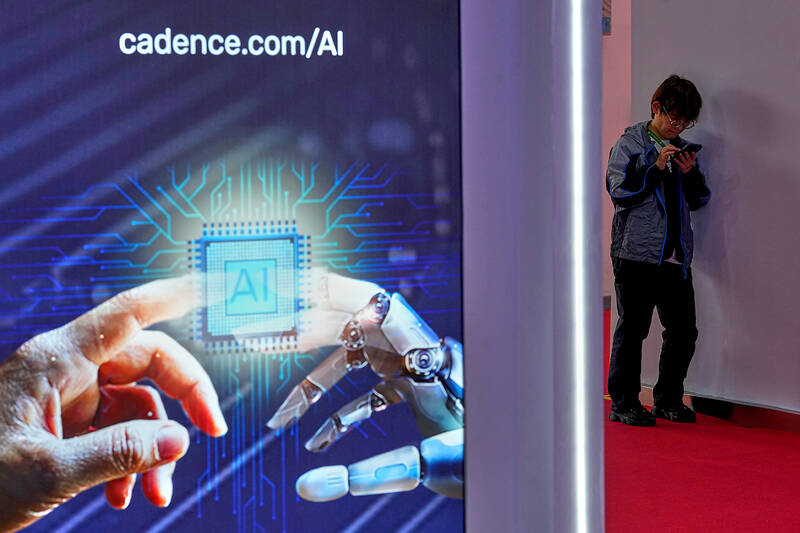
A man in June browses his phone near an artificial Intelligence booth at the China International Supply Chain Expo in Beijing.
Photo: AP
“The gap between US and Chinese models is narrow and fragile,” said Samm Sacks, a senior fellow at the Johns Hopkins School of Advanced International Studies’ Institute for America, China, and the Future of Global Affairs.
But both the US and China have also expressed growing concerns over AI. The current debate takes on greater importance ahead of Chinese President Xi Jinping’s (習近平) expected visit to Washington this month to meet US President Donald Trump, and as experts say the future of AI will depend significantly on what China and the US do and don’t do.
Here’s a quick look at some of the most important Chinese AI models and the concerns in both Washington and Beijing:
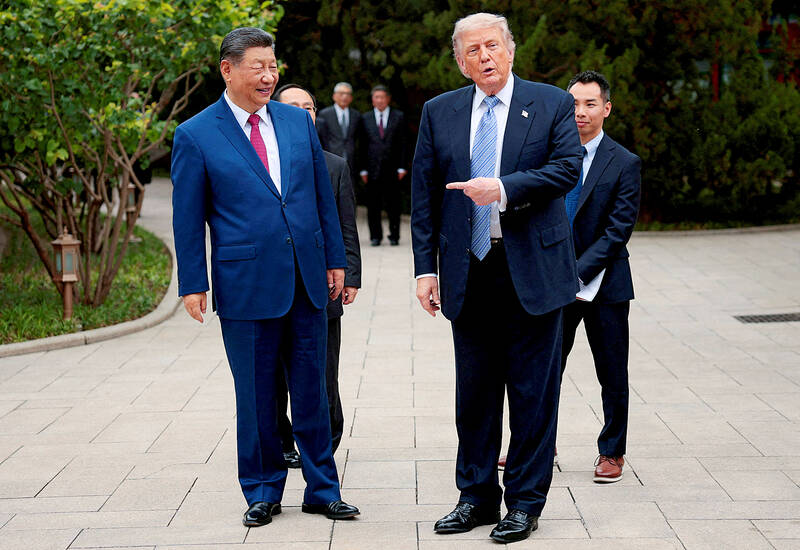
US President Donald Trump on May 15 gestures towards Chinese President Xi Jinping while leaving after a visit to the Zhongnanhai Garden in Beijing, China. Xi will visit Washington this month.
Photo: Reuters
MOONSHOT AI
Beijing-based startup Moonshot AI made a splash with the release of Kimi K3, taking Silicon Valley by surprise with capabilities close to US rivals. It was ranked No. 3 globally in model intelligence in July, shortly after its release, behind Anthropic’s Claude Fable 5 and OpenAI’s GPT-5.6 Sol, according to AI benchmarking platform Artificial Analysis. But Kimi K3 now ranks ninth, behind new frontier models from Anthropic, OpenAI, Meta and SpaceXAI, indicating China’s AI lead can be fluid.
AI startup darling DeepSeek was the first to upend global stock markets by proving Chinese AI models are capable of challenging the US lead. The company’s R1 model, released early last year, was more cost-effective than similar US models. In April, DeepSeek previewed its powerful V4 model, saying it has big improvements in knowledge, reasoning and “agentic” capabilities, referring to the ability to plan and execute complex steps autonomously, under limited human guidance.
The powerful GLM-5.2 from startup Z.ai that rolled out in June raised Silicon Valley eyebrows with comparisons to the most advanced Anthropic and OpenAI models. Z.ai then launched GLM-5.3 in August with improved coding and agentic capabilities that pushed it up the global AI model rankings.
In July, China’s Alibaba previewed its Qwen3.8-Max model, which the tech giant said was its most powerful model in the series, challenging Anthropic’s Claude and OpenAI’s GPT.
RISKS TO SECURITY
In China, the head of its state security ministry has warned artificial intelligence poses a range of potential threats to the country, from political and ideological security to cyberattacks, data leaks and even challenges to governance.
In an article published Sunday, Chen Yixin (陳一新) said the technology could threaten China’s political, institutional, and ideological security if used by “hostile forces and individuals with ulterior motives.”
Some individuals might use AI-generated deepfake audio and video to create “political rumors” on a massive scale, he wrote.
Chen specifically mentioned the capabilities of Anthropic’s Claude and OpenAI’s GPT as examples of how AI could be used to more easily identify and “weaponize” cybersecurity vulnerabilities. He warned certain nations and groups can now “execute complex hacking tasks.”
Top Chinese leaders have said China should accelerate AI development and pursue technological self-reliance. But they also noted the need to control the risks and establish a global framework for AI governance.
CAN US MAINTAIN EDGE?
In the US, Trump and his administration have repeatedly highlighted the importance for the US to maintain its AI edge over China. “Whoever wins AI, wins,” Trump told reporters on Sunday.
The V has accused China’s AI developers of engaging in what it has called “industrial-scale distillation,” in which AI models are trained to copy or imitate the capabilities of more powerful ones. Last week, Anthropic also accused Chinese startups DeepSeek and Moonshot of routing a number of their user requests to its Claude AI models.
In the most comprehensive report by the government to date, the FBI, the National Security Agency and the Cybersecurity and Infrastructure Security Agency said Sept. 8 that Chinese AI developers extracted capabilities from some of the most advanced AI models in the US in “aggressive, malicious, and targeted distillation activities.”
Beijing has rejected that and said distillation is commonly used by many AI companies. It asked the United States to refrain from making “unfounded accusations” and accused the US of pursuing a “monopoly of the AI industry.”
The US allegations “should be read as a contested claim” but not as the explanation for China’s catch-up, said Professor Will Cong of Nanyang Technological University in Singapore.
The United States has put in a lot of energy controlling the inputs into frontier AI, especially chips, said Lizzi C. Lee, a fellow at the Asia Society Policy Institute’s Center for China Analysis. But now “it may also have to think about the outputs of frontier AI as a form of technology transfer,” she said.
“The US labs spend enormous amounts of compute pushing out the frontier. But Chinese developers can learn from those systems,” said Lee. “And Chinese companies then (can) release very capable open-weight models that spread globally.”
KioskNews shows a cleaned-up reading view extracted from the publisher’s page — the original always lives on their site, not ours.