8 Essential Open-World Games, Ranked

Sign in to your Collider account
Open-world games live or die by what happens between the objectives. A giant map means very little when every road leads to another icon, another checklist, and another activity designed to keep the completion percentage moving. The essential ones make wandering feel worthwhile. They give the player enough freedom to become curious, enough systems to create unexpected stories, and enough personality that the world starts feeling familiar long before every corner has been explored.
These eight games changed that formula in different ways. One helped establish the modern 3D city sandbox. Another gave players a world they could physically rebuild. And while Skyrim turned distraction into a lifestyle, later games pushed environmental storytelling, systemic exploration, and player freedom much further. The best open worlds rarely need to tell you where the fun is. They make getting lost feel like the correct decision. That’s what these 8 essential games gave to the world.
8 'Grand Theft Auto III' (2001)

Grand Theft Auto III dropped players into Liberty City and made the simple act of ignoring the mission feel revolutionary. This was long before waiting for GTA VI was cool. This was after those 2D graphics of GTA 1 gave the world something actual. GTA III follows Claude as he arrives in a criminal world divided among gangs, corrupt officials, mob families, and hustlers, but the city itself quickly becomes the main attraction. Cars can be stolen almost anywhere, police attention escalates according to your behavior, pedestrians react to chaos, and missions can be approached with enough freedom to encourage experimentation. Earlier open-world games had already explored many of these ideas, but GTA III put them together in a 3D city that millions of players could immediately understand.
Its importance is difficult to overstate because so much of the modern urban sandbox followed its basic grammar. Drive anywhere. Take work from different characters. Learn which districts are dangerous. Cause trouble simply because the systems allow it. Liberty City might look tiny beside later Rockstar maps, and the shooting and camera controls have aged considerably, but the sense of possibility remains easy to recognize. GTA III belongs here because open-world games after 2001 had to reckon with what Rockstar had just made possible.
7 'Minecraft' (2011)

Most open worlds give players a place to explore. Minecraft gives them a world and then hands over the construction rights. A new map begins with almost nothing beyond terrain, resources, animals, hostile creatures, and whatever goals the player decides to invent. Survival creates immediate priorities through food, shelter, tools, and danger after sunset. Creative Mode removes those limits and turns the same landscape into an unlimited building space. That flexibility is why a child constructing a dirt house and a technical player designing automated machinery can both be playing Minecraft correctly.
Its procedural generation also changed how people thought about exploration. A distant mountain, cave entrance, village, or strange biome matters because nobody placed a quest marker there asking for attention. The player noticed it. Redstone adds logic and engineering, multiplayer turns construction into collaboration, and years of updates have layered new dimensions, creatures, materials, and structures onto an already enormous foundation. Minecraft may barely resemble the cinematic open worlds surrounding it on this list, but that difference strengthens the argument. Few games have given players this much literal ownership over the space they inhabit.
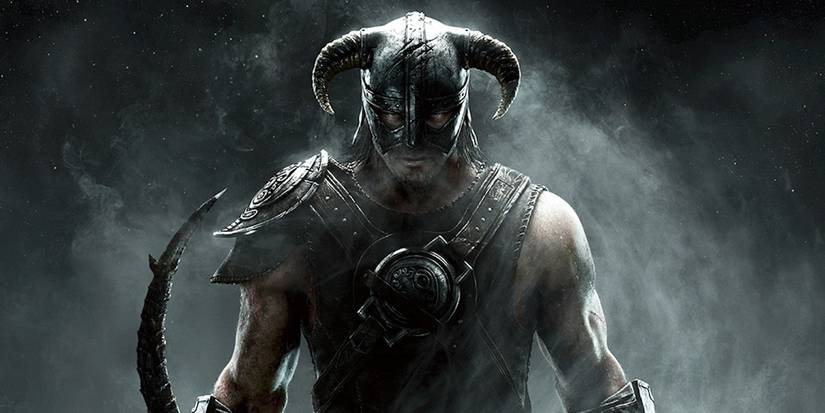
Bethesda’s The Elder Scrolls V: Skyrim begins with dragons returning to a northern province already fractured by civil war, and the player eventually discovers that their character is the Dragonborn. That sounds urgent. Skyrim then places a cave, village, ruin, strange stranger, or suspicious-looking mountain in your peripheral vision and happily lets the main crisis wait for another fifty hours. The province is built around distraction, with guilds, Daedric quests, ancient tombs, political conflicts, random encounters, and small stories competing constantly for attention.
Bethesda’s great strength here was making exploration feel conversational. A bartender can mention a rumor that becomes an entire questline. A road can lead to a fort that hides a journal pointing toward another mystery. Character progression reinforces that freedom because skills improve through use, allowing a heavily armored warrior to gradually become a stealth archer through the ancient RPG tradition known as changing your mind. Skyrim has bugs, repeated dungeon pieces, and combat that newer games have surpassed. Its pull, however, remains extraordinary. More than a decade later, people still reinstall it because returning to Whiterun somehow feels less like replaying a map and more like revisiting a place.
5 'Grand Theft Auto V' (2013)

Los Santos in Grand Theft Auto V is less a backdrop than an enormous satire with traffic and still sits in the heart of millions because of its online counterpart. The story rotates among Michael, Franklin, and Trevor, three criminals at different stages of ambition and self-destruction whose lives collide through robberies, government interference, and increasingly complicated schemes. Switching instantly between them gave Rockstar an elegant way to move across the map and made major missions feel broader than one character could manage alone.
The world around that story is ridiculously dense. Radio stations comment on the culture, strangers generate side stories, businesses and neighborhoods change the social texture of different areas, and the geography stretches from wealthy Los Santos streets to mountains, deserts, highways, and the communities around Blaine County. Its heists remain the structural highlight because preparation, crew selection, and execution give large missions a sense of scale without disconnecting them from the sandbox. GTA Online later became its own phenomenon, but the single-player map already demonstrated how much activity could coexist inside one convincing region. There is always another road worth taking, even when the GPS is begging you to behave.
4 'The Witcher 3: Wild Hunt' (2015)

Geralt of Rivia crosses The Witcher 3 searching for Ciri, his adopted daughter, while war and supernatural danger reshape the Northern Kingdoms around him. The emotional urgency of that search could have made every side activity feel like procrastination. Instead, CD Projekt Red filled Velen, Novigrad, Skellige, and the surrounding regions with stories substantial enough to justify stopping. A missing person can uncover family abuse. A monster contract may expose a human crime. A seemingly ridiculous village problem can become surprisingly sad before Geralt collects his payment.
That quest writing changed expectations for open-world RPGs because secondary content was given consequences, characters, and moral uncertainty rather than functioning as map cleanup. The Bloody Baron storyline remains famous for exactly that reason, though smaller contracts often achieve the same effect on a tighter scale. Geralt’s Witcher Senses, alchemy, signs, monster knowledge, and preparation also connect exploration to his profession. Even Gwent (the card game) gives taverns and merchants another reason to matter. The Witcher 3 contains an enormous amount of content, but quantity is never its best argument. The world stays memorable because so many detours feel authored with the same care as the road everyone was supposedly following.
3 'Elden Ring' (2022)

Elden Ring takes FromSoftware’s demanding action RPG design and places it inside the Lands Between, a fractured realm where the player seeks the power necessary to become Elden Lord. The major bosses and legacy dungeons provide obvious milestones, but the game rarely treats them as appointments. A ruined church may conceal an upgrade. An elevator can descend into an underground region large enough to feel like another world. A harmless-looking cliff edge might hide a path that changes the next several hours.
That refusal to over-explain gives discovery genuine weight. The map begins incomplete, quest logs are minimal, and NPC storylines demand attention rather than constant interface reminders. Players learn through architecture, item descriptions, enemy placement, and the simple suspicion that FromSoftware probably hid something behind that wall. Build variety also makes exploration mechanically meaningful because spells, weapons, summons, talismans, and upgrade materials can completely alter how a character develops. The difficulty receives most of the conversation, but curiosity is the stronger engine. Elden Ring keeps rewarding the player who asks what is over there and then actually goes to check.
Collider Exclusive · Universe Personality Quiz Which Iconic Universe Do You Belong in the Most? Star Wars · Lord of the Rings · Harry Potter · Game of Thrones · Star Trek
Five legendary universes. Five completely different visions of what the world could be — or already was. One of them is the world your instincts, your values, and your particular way of existing were built for. Eight questions will tell you which one.
🚀Star Wars
💍Lord of the Rings
🧙Harry Potter
👑Game of Thrones
🖖Star Trek
01
What gives your life its deepest sense of meaning? Every universe is built around a different answer to this question.
02
Which kind of world do you most want to inhabit? The environment shapes who you become. Choose carefully.
03
How do you prefer your conflicts resolved? The shape of a world's conflicts tells you everything about its soul.
04
Who do you want beside you when things get difficult? Your ideal companions reveal the world you were made for.
05
What is your relationship with power? How you seek, wield, or resist power is the map of who you are.
06
How does your universe treat good and evil? A world's moral architecture tells you more about it than any map.
07
What role would you naturally fall into? Every universe has archetypes. Which one fits you without trying?
08
What do you ultimately believe about the future? The answer to this is the clearest window into which universe already lives inside you.
Your Universe Has Been Chosen You Belong In…
Your answers point to the iconic universe your values, your instincts, and your particular way of seeing the world were built for. This is where you would find your people — and your purpose.
Star Wars
You believe in the cause — in the idea that freedom is worth fighting for even when the odds are impossible and the empire is vast.
- You are drawn to the moral clarity of a universe where hope itself is a form of resistance.
- You'd find your people in the Rebellion — a ragtag coalition of true believers held together by conviction more than resources.
- Star Wars is fundamentally a story about ordinary people choosing to matter in an extraordinary conflict — and that is exactly your kind of story.
- The Force may or may not be with you. But the will to use it for something larger than yourself certainly is.
Lord of the Rings
You understand, in the deepest part of yourself, that the journey matters as much as the destination — and that the world's beauty is worth protecting even at great cost.
- Middle-earth is a world of ancient wonder, deep friendship, and a darkness that only retreats when enough small acts of courage accumulate.
- You would thrive here because you value the fellowship more than the glory — the road more than the arrival.
- Tolkien's universe rewards patience, loyalty, and the willingness to carry something heavy across a very long distance.
- Those are not burdens to you. They are simply how you move through the world.
Harry Potter
You believe that love, loyalty, and doing what's right are not naive sentiments — they are the most powerful forces in any world, magical or otherwise.
- The Wizarding World is a place of wonder hidden in plain sight, where learning is transformative and the bonds you form at school follow you into every battle.
- You would flourish here because you take both the magic and the friendships seriously — and you understand that one without the other is incomplete.
- Harry Potter's universe ultimately rewards those who choose to stand for something even when standing is terrifying.
- That choice — made quietly, without guarantee — is something you understand completely.
Game of Thrones
You see the world clearly — its power structures, its hypocrisies, its brutal arithmetic — and you are not paralysed by that clarity. You use it.
- Westeros is a world that rewards intelligence, adaptability, and the willingness to understand that every alliance is also a negotiation.
- You would survive here — possibly thrive here — because you don't confuse the world as it is with the world as you'd like it to be.
- Game of Thrones is a story about what happens when the idealists and the realists collide. You are sharp enough to know which one lasts longer.
- Winter always comes. You are already prepared.
Star Trek
You believe the future is worth building — that curiosity, cooperation, and the expansion of understanding are not just ideals but the most practical path forward for any civilisation.
- Star Trek is a universe where the questions matter as much as the answers, and where encountering something utterly alien is cause for wonder rather than fear.
- You would belong here because you are fundamentally optimistic about what intelligence and decency can achieve — while being honest about how hard that achievement is.
- The Federation is the universe's most ambitious thought experiment: what if we actually got better?
- You don't just hope that's possible. You think it's the only thing worth working toward.
2 'Red Dead Redemption 2' (2018)

Red Dead Redemption 2 follows Arthur Morgan and the Van der Linde gang in 1899 as the American frontier closes around people who built their identities outside conventional society. The gang moves between temporary camps while robberies, law enforcement pressure, and Dutch van der Linde’s increasingly unstable leadership threaten the family Arthur has spent most of his life serving. Rockstar gives that story extraordinary space, allowing camp conversations, hunting trips, quiet rides, and encounters with strangers to build Arthur as carefully as any major mission.
The open world succeeds because it appears to continue without needing the player. Animals hunt one another. Travelers get robbed. Weather transforms roads and visibility. Towns carry different economies and social tensions, while Arthur’s appearance, horse, equipment, and relationships develop through ordinary routines. Some players find the deliberate animations slow. That physicality is also why actions develop weight. Cleaning a weapon, brushing a horse, cooking food, or returning to camp reinforces the feeling that Arthur inhabits this world rather than simply passing through it. Red Dead Redemption 2 is enormous, but its finest moments are often surprisingly small. Give it time and the frontier starts feeling painfully alive.
1 'The Legend of Zelda: Breath of the Wild' (2017)

Hyrule opens almost immediately in The Legend of Zelda: Breath of the Wild. Link awakens after a century, learns that Calamity Ganon has devastated the kingdom, and eventually receives the familiar responsibility of saving Princess Zelda. Nintendo then does something far more important. It lets the player decide how to get there. Mountains can be climbed from almost any direction, distant landmarks can be marked manually, and the physics and chemistry systems encourage solutions that feel discovered rather than prescribed.
That freedom reshaped open-world design because the landscape itself became the interface. Smoke suggests activity. Unusual rock formations invite inspection. Cold regions require preparation, thunderstorms make metal equipment dangerous, and abilities such as Magnesis, Stasis, and Remote Bombs can interact with the environment in ways that produce wonderfully personal solutions. Shrines teach individual ideas without dictating how those lessons must later be used. Weapon durability remains divisive, yet even that system keeps players experimenting instead of settling permanently into one loadout. All this essentially expands what GTA III or perhaps Elden Ringbrought to the table. Breath of the Wild makes curiosity feel like progress. You see something strange on a mountain, change direction, and an hour later realize the journey there became the story you will remember.
KioskNews shows a cleaned-up reading view extracted from the publisher’s page — the original always lives on their site, not ours.