Review urged after blood-spattered shirt ads ran alongside domestic violence news in Australia

News stories about domestic violence inadvertently ran alongside advertisements for faux-bloodstained shirts reading “problem solved”, prompting advocates for victim-survivors to urge publishers to avoid making light of recent deaths.
Australia is reckoning with a surge in family and domestic violence incidents after three women were allegedly murdered in unrelated incidents on Saturday, and police allege a mother stabbed her three children on Sunday.
On Sunday articles about the incidents were published on a number of Australian news websites, where readers were confronted by a gruesome advertisement for the blood-soaked costume shirts.
The shirts are sold under titles containing the words “bloody” and “halloween” by online clothing retailer Menweary. Similar products are listed as Halloween outfits on Amazon, Etsy and other larger retailers.
Denise Buiten, an expert in media and gendered violence, said the ad placement created an inappropriate contrast with the subjects of the articles.
“When you put in that context, it’s more than just tasteless humour, it becomes something else, gives a very different meaning to the story on that page,” said Buiten, a senior lecturer in sociology and social justice at the University of Notre Dame Australia.
“It strips a lot of the dignity away.”
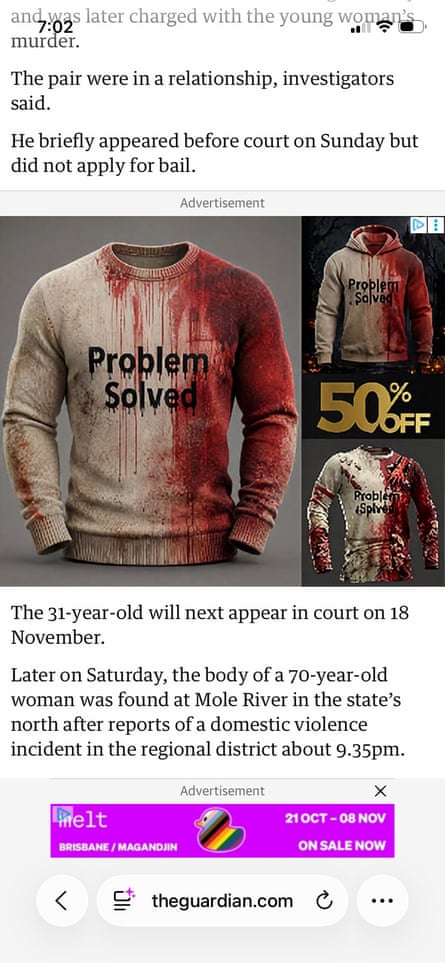
Patty Kinnersly, chief executive of advocacy group Our Watch, said the unexpected ads in the article could distress victim-survivors and “make light” of the violence they have faced.
“We know that one of the key drivers of violence against women is the condoning of violence, [including] messages that excuse violence, make light of it, or present it as normal or acceptable,” Kinnersly said.
Kinnersly said media outlets and advertisers needed to review the incident and implement stronger measures to protect consumers from potentially harmful advertising mismatches.
The Guardian has technical protocols to block harmful advertising but was among the outlets to feature the ad. A spokesperson said the ad breached Guardian advertising guidelines and was taken down after the organisation was made aware of the ad.
The Sydney Morning Herald’s parent company, Nine, attributed its publication of the ad to the Google-run distributor, AdSense.
“AdSense is responsible for screening these type of ads before they go live,” a Nine spokesperson said. “Once our teams were alerted to the content, we removed and blocked the advertiser.”
News.com.au’s editor, Kerry Warren, said parent company News Corp was working with the third-party provider to ensure the “error” did not happen again.
“Once brought to our attention we removed it as quickly as possible,” Warren said. “We apologise for any distress caused.”
after newsletter promotion
‘Slipped through a crack’
While websites can sell their own advertising space, some give Google power to allocate ads in real time from an international open market, linking millions of advertisers with millions of sites.
A Google spokesperson said the company reviewed ads under its policies and allowed publishers to impose further limits if they wished, by blocking specific sources, advertisers, websites or categories.
Christopher Brown, from the University of New South Wales’s Australian Graduate School of Management, said ads carry content tags but clothing-tagged ads would not have been caught by screening measures.
“It’s slipped through a crack,” Brown said.
Advertisers could also try to target their ads to automatically appear in articles with related content. Brown said content-targeting software, if used in this case, could have miscalculated.
The incident suggested that bad actors could potentially use mass digital advertising systems to distribute potentially harmful content without being flagged, Brown said.
Menweary and its owner were contacted for comment.
In 2017, Google’s ad systems plastered ads from governments and major companies, from Pepsi to the Guardian, across extremist content on YouTube, leading to the loss of millions of dollars of advertising contracts.
The “problem solved” shirt design attracted controversy in 2025 when worn by school teachers in Arizona, US, weeks after the fatal shooting of political activist Charlie Kirk. The choice of the shirts was reportedly unrelated to Kirk’s death.
“Although these shirts can be purchased on Amazon, they celebrate real-life murder, and are, minimally, extremely short-sighted and tone deaf,” Republican state representative, Rachel Keshel, said at the time.
KioskNews shows a cleaned-up reading view extracted from the publisher’s page — the original always lives on their site, not ours.