Philippine indigenous group in limbo over tech hub
Indigenous leader Petronila Munoz walked across the sweeping Philippine grasslands her people called home for generations, uncertain about its future, as a sprawling tech hub for a US-led initiative takes shape.
With little information and no prior consultation, the indigenous chieftain said the Aeta Hungey people were uncertain how much of their land could be affected or what would become of the livelihood it provides.
“There’s still no clarity,” Munoz said inside the Aetas’ traditional meeting hall. “What will happen to us? That’s our biggest question.”
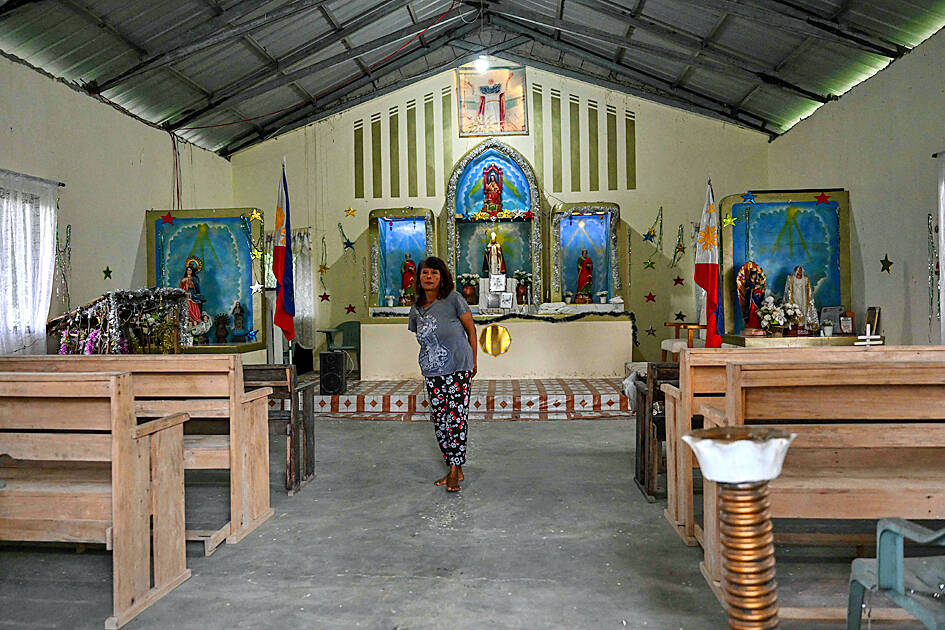
Aeta Hungey Chief Petronila Munoz stands in a church in Capas, Philippines, on Sept. 2.
Photo: AFP
The US in April announced that the Philippines had joined Pax Silica, a US-led effort to bolster supply chains for semiconductors and rare earth elements and reduce participating countries’ dependence on China.
The Philippines has designated a 1,620-hectare site in New Clark City in Tarlac province, north of Manila, for a manufacturing hub aimed at producing high-end components for use in artificial intelligence (AI) data centers.
The government estimates the initiative could attract up to US$70 billion in investment and create about 190,000 jobs, a major boost to a country with more than 3 million unemployed people.
The project has a long timeline. No tenants have been confirmed.
Plans to domestically process the country’s mineral resources could be even further away.
However, for about 1,000 Aetas, the prospect of displacement is already here.
In July, they received a letter from the Bases Conversion and Development Authority (BCDA) warning that the project “could affect your occupied lands.”
Visiting BCDA employees told them to leave by December and relocate to an area about 16km from their current home, without providing a master plan showing which parts of their ancestral domains would be affected, Munoz said.
The BCDA has offered them just 30 pesos (US$0.48) per square meter for their lands, an offer all declined, she said.
“Our lives, our livelihood and our culture are tied to this ancestral land,” Munoz said. “Land is more important. Money runs out.”
The BCDA declined to address specific questions about the Aetas’ situation and rejected a freedom of information request for the site’s official boundary map and geospatial data.
It said the information was being “withheld temporarily until the official action is finalized or published.”
At a Philippine Senate hearing last month, BCDA president Joshua Bingcang said the Aetas were living on government land.
Like many indigenous groups in the Philippines, they hold no land title.
Civic groups have also raised concerns about the project’s environmental impact, particularly the demand for water and electricity in a country plagued by droughts and rotational power outages.
The US Department of State said that “environmental, water, energy and community-impact studies” would inform the project’s design.
“Before any major development happens, we expect rigorous stakeholder impact assessments will take place,” a spokesperson said.
Bingcang told the Philippine Senate that investors would be required to build their own power and water systems.
Alvin Camba, research director at an AI firm focused on supply chains and risk assessment, said Manila’s close relationship with the US could motivate investors to set up shop despite the power concerns.
Last month, reports said Washington planned to warn countries they could be excluded from Pax Silica if they joined a rival framework backed by Beijing.
“This is where the advantage of the Philippines comes in. The Philippines is the least affected by Chinese capital in Southeast Asia,” Camba said, adding that the Philippines would offer foreign companies the ability to “disentangle” from China.
Political economist Calixto Chikiamco said that Pax Silica represents a “historic opportunity” for the Philippines to move beyond its traditional wheelhouse of microchip testing and packaging.
“We have to open up to foreign investment so that technology transfer [to the Philippines] will happen,” he said.
The BCDA has been conducting public consultations in Tarlac and nearby provinces, but the agency has yet to hold talks with Aeta Hungey, Munoz said.
The Aetas remain uncertain if the government would help them build new homes or provide land to cultivate for income if they are moved.
“I wish they would listen to us. They’re just talking among themselves,” she said, adding that she worried her people would not be qualified for the sort of new jobs Pax Silica promised.
While a proponent of the initiative, Chikiamco said the government was doing “a terrible job” explaining the benefits and tradeoffs it represented.
Camba agreed.
“I would actually advise the Philippine government to be very transparent about what’s happening. A big problem is transparency,” he said.
Still, the benefits outweigh the risks, he said.
“Every country that has ... jump-started development has had to make sacrifices,” Camba said.
However, 63-year-old Munoz, who hopes to be buried in her people’’s traditional burial ground, said she would not leave, even if a backhoe flattened her home.
“Why do we have to be the ones to sacrifice for the kind of development they want?” she asked.
KioskNews shows a cleaned-up reading view extracted from the publisher’s page — the original always lives on their site, not ours.