1,159% growth in nine years: How Manchester City's financial rise outpaced their football
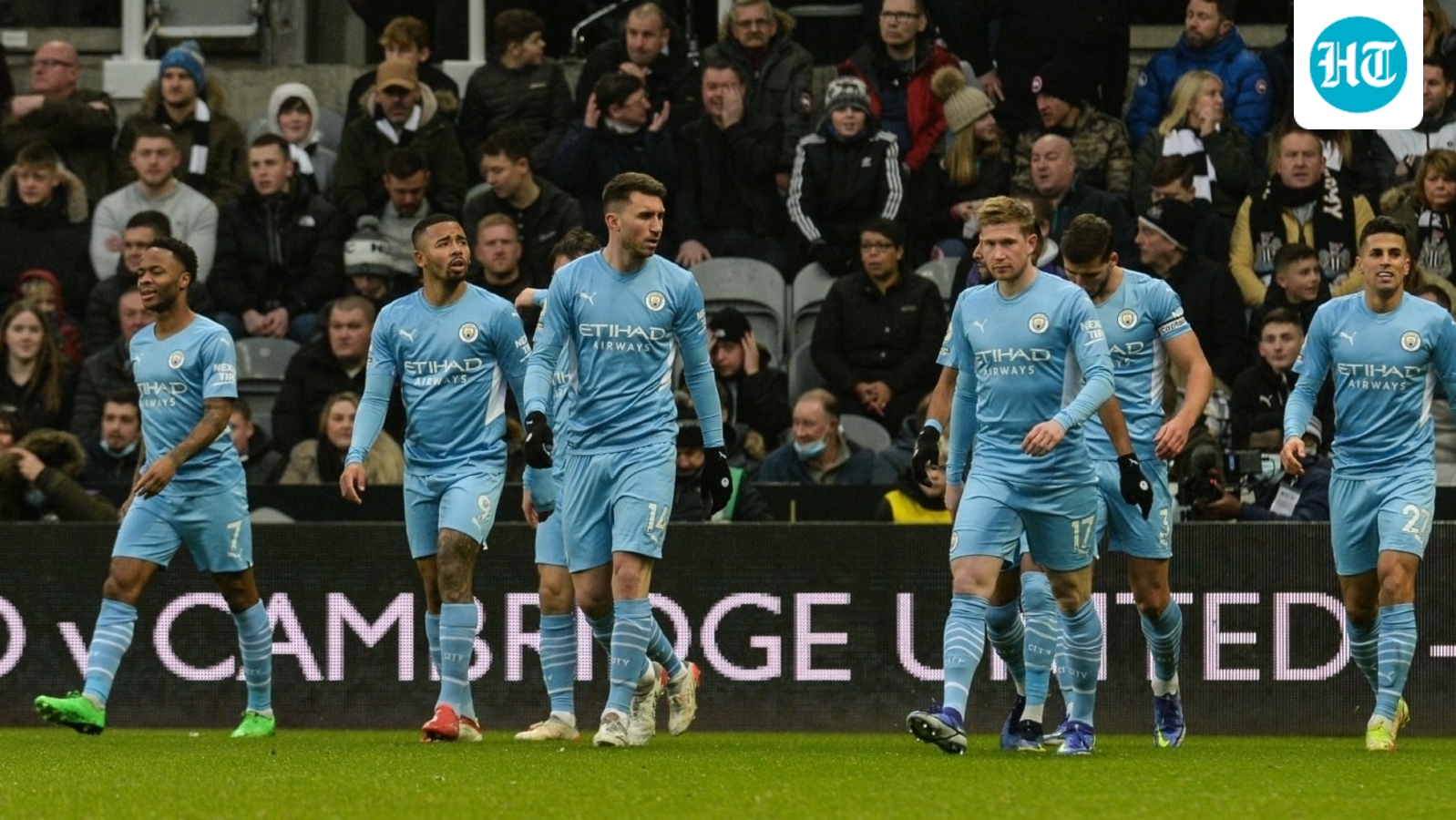
Manchester City's commercial revenue surged from £18m to £232.3m in nine years, with their financial rise often racing ahead of their European progress.

 Prefer HTon Google

Manchester City’s transformation is usually remembered through footballing landmarks: Sergio Aguero’s title-winning goal in 2012, Pep Guardiola’s arrival four years later, the 100-point Premier League season and eventually the Champions League triumph. But the financial numbers reveal another rise occurring alongside that sporting ascent — and, at crucial moments, moving considerably faster than it.
That trajectory has acquired fresh significance after the Premier League Commission’s findings against City over financial rule breaches covering the 2009/10 to 2017/18 period. City insist they are innocent, have described the Commission’s opinion as containing material errors and intend to appeal, but the ruling has inevitably returned attention to the extraordinary commercial expansion recorded in the club’s accounts during precisely those years.
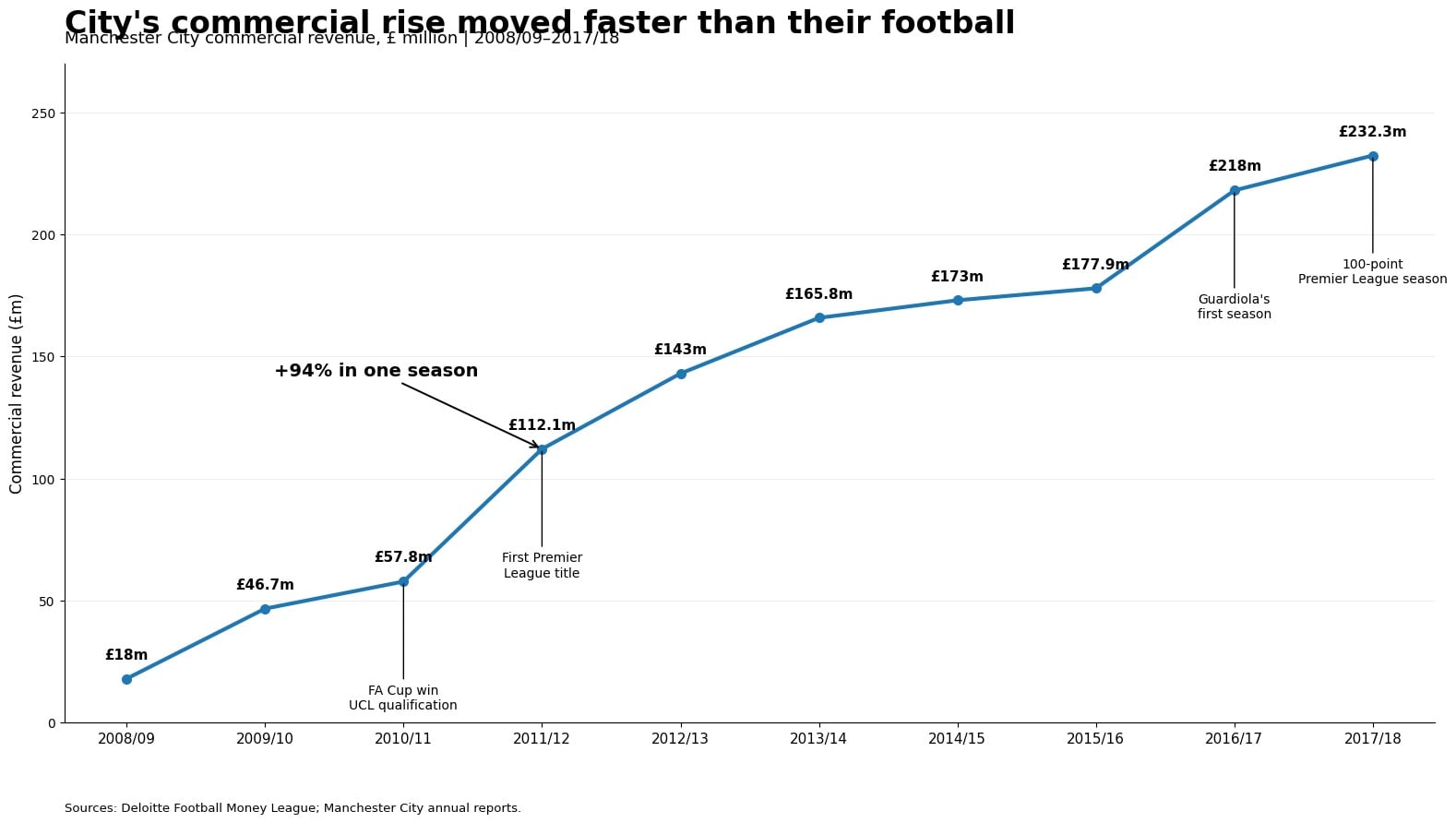
Deloitte’s Football Money League provides a revealing starting point. In 2008/09, the first season following the Abu Dhabi United Group takeover, Manchester City generated only £18 million in commercial revenue. They finished 10th in the Premier League, had not played Champions League football and sat 19th in Deloitte’s ranking of Europe’s highest-revenue clubs, with total revenue of £87 million.
One year later, City's commercial income had already surged to £46.7 million. Deloitte noted that improved agreements with Etihad Airways and Umbro contributed to the increase, alongside an expanding partnership portfolio containing companies including Abu Dhabi Tourism Authority, Etisalat and Aabar. By 2010/11, commercial revenue had risen again to £57.8 million as City finished third in the Premier League, won the FA Cup and finally qualified for the Champions League.
The season Manchester City's commercial curve changed
The most dramatic acceleration arrived in 2011/12. City's commercial revenue jumped from £57.8 million to £112.1 million in a single season, an increase of almost 94%, while their overall revenue climbed from £153.2 million to £231.1 million. Deloitte described the £77.9 million rise in total revenue as the largest increase recorded by any club in that edition of the Money League.
The timing is striking because City were only beginning to acquire the sporting profile normally associated with those numbers. They won their first Premier League title that season, but 2011/12 was also their first Champions League campaign of the modern era and they failed to escape the group stage. Despite that limited European pedigree, City had climbed from 12th to seventh in Deloitte’s global revenue ranking.
Also Read: Manchester City ‘disappointed and surprised', claim Premier League opinion is ‘unsafe’ and flawed
Commercially, they were already approaching Manchester United. In 2011/12, United generated £117.6 million from commercial activities, while City produced £112.1 million — a gap of merely £5.5 million. Liverpool stood at £80.2 million, Chelsea at £70.5 million and Arsenal at £52.5 million, meaning City had already surpassed three established English clubs with far longer histories of sustained Champions League participation and international commercial development.
Central to that season was the new 10-year Etihad partnership announced in July 2011. The agreement combined shirt sponsorship with naming rights for the stadium and Etihad Campus, as well as broader commercial, media and international cooperation; Manchester City did not disclose the financial terms in its announcement. Deloitte subsequently identified the commencement of the Etihad partnership as the most significant component of City's commercial revenue growth during 2011/12.
What happened next makes the divergence between financial and European progress even more conspicuous. City endured an even worse Champions League campaign in 2012/13, becoming the first English club in the Champions League era to finish a group without winning a match. They ended bottom with three points, yet their commercial revenue continued upwards to €166.9 million and accounted for 53% of their €316.2 million total revenue.
That €166.9 million commercial figure was only around €11 million below Manchester United’s €177.9 million in the same season. More remarkably, it was far ahead of Chelsea’s €97.9 million, Liverpool’s €114 million and Arsenal’s €72.8 million; City consequently climbed to sixth in Deloitte’s Money League, moving above both Chelsea and Arsenal by total revenue despite having still never played a Champions League knockout match.
The commercial expansion did not stop once the football caught up. Deloitte’s figures show City’s commercial revenue rising to €198.3 million in 2013/14, €228.5 million in 2014/15 and eventually €265.7 million by 2017/18. In that final season of the period covered by the Commission’s financial findings, only Manchester United among English clubs generated more commercially, with €316.1 million; Chelsea stood at €191.8 million, Liverpool at €170.8 million and Arsenal at €120.7 million.
There is an important distinction in reading those numbers. Rapid commercial growth is not, by itself, evidence of financial wrongdoing, and the figures cannot independently establish whether individual sponsorship arrangements were appropriately valued or funded. Different clubs also classify some revenues differently, while currency movements complicate comparisons across seasons, which is why sterling provides the cleaner measure of City's early year-on-year acceleration, and euro figures are most useful when comparing clubs within the same campaign.
What the data does establish is the extraordinary speed of Manchester City’s transformation. In 2008/09, commercial income was £18 million and the club sat outside Europe’s financial elite; three seasons later, it had reached £112.1 million and was within touching distance of Manchester United commercially, even though City had yet to win a Champions League knockout game.
That is what makes the financial history newly relevant. Manchester City eventually became one of the finest football teams in Europe, but the numbers show that their transformation into a commercial superpower arrived remarkably early — before their European results carried anything close to the same authority. As City's appeal proceeds, that rapid ascent will remain one of the most consequential financial stories embedded within the wider case.

Probuddha Bhattacharjee is a sports writer and analyst with expertise spanning cricket, football, and multi-sport events, with a strong emphasis on data-driven journalism and tactical storytelling. He currently focuses on international cricket, the Indian Premier League, global tournaments, and emerging trends shaping modern sport, blending advanced statistics with strong narrative context to explain performance, strategy, and decision-making. His work aims to bridge the gap between numbers and storytelling, helping readers understand not just what happened on the field, but the tactical and structural reasons behind it. Trained in data journalism through the Google News Initiative (GNI) Data Journalism Lab, Probuddha works extensively with ball-by-ball datasets, performance metrics, and trend-based modelling to produce evidence-backed reports, explainers, and long-form features. His analytical approach focuses not only on outcomes but also on process—selection strategies, phase-wise tactics, workload management, and the influence of preparation and planning on match results. He is particularly interested in how statistical patterns reshape conventional cricketing narratives and provide clearer tactical insight for modern audiences. Beyond cricket, Probuddha has written analytical and news-driven pieces on football and other major sporting events, with a growing interest in sports governance, scheduling dynamics, and the economics of elite competitions. He also tracks how rule changes, franchise structures, and broadcast pressures influence the evolution of contemporary sport. He has previously contributed to platforms such as OneCricket, Sportskeeda, and CrickTracker, and continues to specialise in analytical storytelling, live coverage, and audience-focused reporting. His work prioritises clarity, context, and credibility, while consistently exploring innovative ways to present data through accessible narratives and structured match analysis.Read More

KioskNews shows a cleaned-up reading view extracted from the publisher’s page — the original always lives on their site, not ours.