China embeds ‘loyal wingman’ drone simulations in fighter pilot training
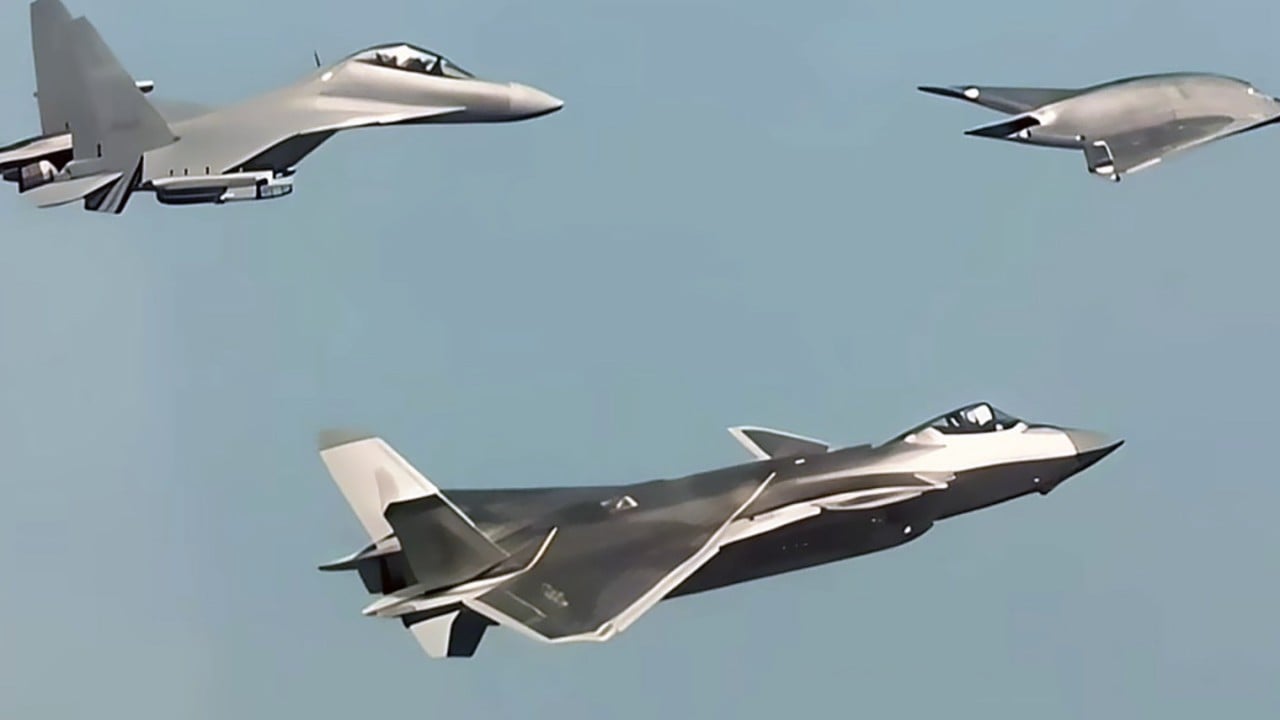
China’s military is increasingly integrating artificial intelligence – including AI-driven “loyal wingman” drones – into its routine training for frontline fighter pilots, official media reports have confirmed.
People’s Liberation Army newspaper PLA Daily showed the growing use of manned-unmanned teaming (MUM-T) simulation training systems that feature support from accompanying drones, as well as AI-enhanced simulated battle conditions.
In a report on Tuesday, it said an unnamed aviation brigade with the Southern Theatre Command had embedded MUM-T training into its ground flight simulators for young pilots.
“Using the simulation system, pilots can also conduct continuous combat exercises against adversaries with the support of unmanned loyal wingmen,” it said.
“The system faithfully recreates complex battlefield conditions, like multiple waves of approaching targets and electromagnetic interference, to push pilots to sharpen their combat skills.”
The report did not specify which of the PLA Air Force’s fighter planes the pilots were training to operate. However, it was accompanied by an image of a Shenyang J-16 in flight, captioned as showing an aircraft assigned to the unnamed brigade.
It followed a PLA Daily report from December last year that described a Central Theatre Command pilot’s experience of a combat training session in a flight simulator which generated high-fidelity visuals of simulated battlefields changing in real time.
“Teaming up with system-generated loyal wingman drones, he engaged in a continuous series of simulated combat encounters with live troops operating real equipment thousands of kilometres away,” it said.
A study published in June by the US Air Force’s China Aerospace Studies Institute suggested that Chinese airforce units began taking part in the combat method validation process for MUM-T as early as 2024.
According to the CASI report, the PLA Air Force’s Ninth Aviation Brigade was supporting the validation of new combat methods for the J-20 involving “MUM-T coordinated penetration operations”.
The brigade, which is part of the Eastern Theatre Command and based at Wuhu airbase in Anhui province, was one of the first PLA Air Force units to operate the fifth-generation stealth fighter.
China’s first public showing of its MUM-T technology came in a promotional video released by the PLA Air Force on its 76th anniversary in November 2025.
The footage featured a Gongji-11 stealth unmanned combat aerial vehicle, code-named Xuanlong 08, flying in formation and coordinating with a fifth-generation Chengdu J-20 and a J-16D electronic warfare aircraft.
Earlier this month, China’s state broadcaster CCTV aired further footage highlighting the GJ-11’s capabilities, this time showing the drone operating in concert with a J-16 fighter and also, separately, with J-20s.
China’s multiple types of autonomous loyal wingman combat drones, as showcased in last year’s Victory Day military parade in September, are believed to be capable of collaborative operations with manned and unmanned aircraft in an intelligent network.
KioskNews shows a cleaned-up reading view extracted from the publisher’s page — the original always lives on their site, not ours.