EU to make addictive app features easier to turn off
‘IN THE RIGHT DIRECTION’: The EU is planning to impose stricter rules on how brands promote content through influencers, demanding clear labels on advertisements
The EU yesterday unveiled new rules to crack down on influencer marketing, ban online features that trick Europeans and force platforms to give users the right to turn off “addictive” features.
The EU already has a raft of laws covering data protection, artificial intelligence and online content, but Brussels and campaigners argue there are gaps that leave consumers exposed to harmful digital practices.
The bloc’s executive unveiled a much-needed update of consumer rules dubbed the “Digital Fairness Act” that would give it the power to slap fines on companies of up to 6 percent of their annual turnover in large-scale cases.
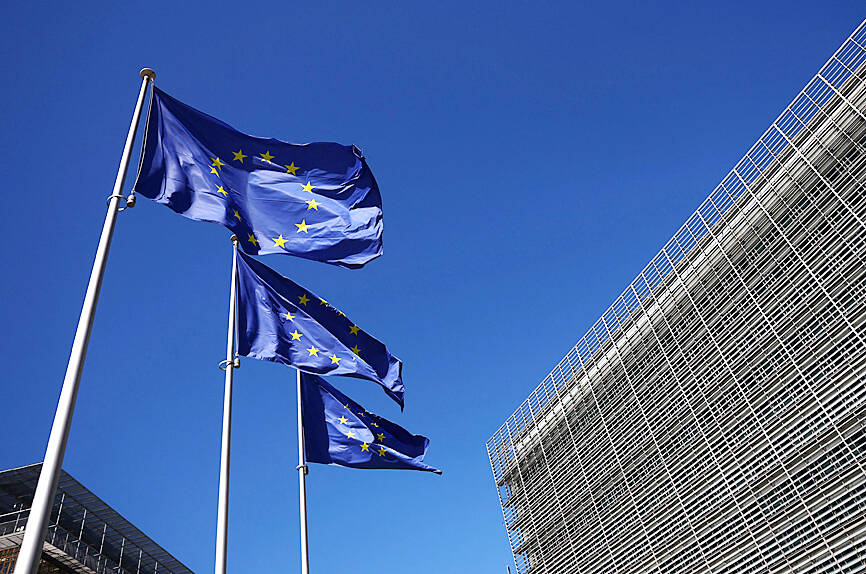
EU flags flutter outside the European Commission headquarters in Brussels on April 29.
Photo: Reuters
The financial harms to European consumers are vast: Official data showed “problematic” digital practices led to losses for people reaching 10.3 billion euros (US$11.47 billion) a year.
The proposal includes a ban on “dark patterns,” the practice of tricking users into making unwanted purchases or opting in to certain settings without their knowledge.
The bloc is also planning to impose stricter rules on how brands promote content through influencers, demanding clear labels such as “advertisement” on posts.
It will ban offering minors “pay-to-win” or “pay-to-progress” features, and require in-game virtual currencies to show their real-world value.
Platforms would be obliged to remind consumers when a free trial period ends with details about the end date and how much it would cost to continue
They would also be obliged to provide users with access to human customer service operators when users demand it.
European Commissioner for Democracy, Justice, the Rule of Law and Consumer Protection Michael McGrath has previously said the new rules aim to “step up our fight against unfair commercial practices,” pointing to data that shows 97 percent of popular platforms use dark patterns.
The European Consumer Organization legal and economic affairs director Agustin Reyna said the proposal is a “much-needed tool to give consumers back control of how much time and money they spend online.”
Questions have been raised over the EU’s expanding digital rulebook after Brussels unveiled plans to ban children under 13 from social media, and force companies to make platforms safe for use by minors — in addition to sweeping rules already in place under the Digital Services Act.
The proposal aimed to make a “safer online space for everyone, children and adults alike,” Member of European Parliament Laura Ballarin Cereza said, adding that it would “fill the gaps” as “consumer law is meant to act as a safety net.”
The EU also wants users to know the full price of an order before checkout, banning a practice known as “drip pricing” where fees are hidden until the end.
The European Commission, the bloc’s digital watchdog, has faced pressure from lawmakers and consumer advocates who accuse it of failing to enforce its online content and competition rules.
“Strong rules only matter if they are properly enforced,” said the Euroconsumers group, which represents users’ rights across several EU countries.
The proposal on dark patterns goes “in the right direction, but they lack ambition to sufficiently protect consumers in financial services,” non-governmental organization Finance Watch said.
The group also said there were “significant holes” in the draft plans.
“Firms could still pay influencers to promote risky investments,” it said.
KioskNews shows a cleaned-up reading view extracted from the publisher’s page — the original always lives on their site, not ours.