College Football Playoff format for 24-team field: How rankings would look in 2026

Under the new playoff format, which debuts in 2027, eight teams receive first-round byes, with campus sites hosting the first two rounds

• 3 min read
The College Football Playoff formally announced that it will expand to 24 teams in 2027, ushering in a new era in college football. While the format does not debut until next season, we thought it might be interesting to look at how it could change the sport by examining its impact this season using Tuesday night's CFP Rankings.
The 24-team playoff will feature eight teams getting first-round byes -- up from four -- and feature eight first-round games. It will consist of the Power Four conference champions -- the SEC, Big Ten, ACC and Big 12 -- plus the highest-ranked Group of 6 team, as well as 19 at-large selections.
Right off the bat, it's clear the new world will be complicated. There are substantially more teams involved, and the numbers don't fit any typical bracket used in major college athletics.
However, the 2026 season presents us with plenty of interesting dynamics. What if there are elite blue bloods having down years, but with plenty of talent available? How much of an advantage will it be being a high seed? And in this moment, are there even true elite teams in college football?
Of course, this is a projection. Technically, the CFP selection committee's process shouldn't change much, but more attention will certainly be paid to the bottom of the rankings. But one year out from primetime, here's our best projection.
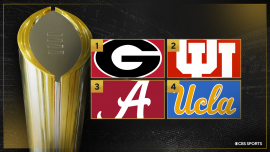
College Football Playoff Rankings: Georgia moves to No. 1 as Alabama, UCLA join top four in second release
Brad Crawford
First Round
All games will be on the campus of the higher seed.
- 9. Indiana vs. 24. Boise State (Memorial Stadium -- Bloomington, Indiana)
- 10. BYU vs. 23. Arizona (LaVell Edwards Stadium -- Provo, Utah)
- 11. Kentucky vs. 22. Missouri (Kroger Field -- Lexington, Kentucky)
- 12. Texas Tech vs. 21. LSU (Galaxy Stadium -- Lubbock, Texas)
- 13. Wake Forest vs. 20. Ohio State (Allegacy Federal Credit Union Stadium -- Winston-Salem, North Carolina)
- 14. Houston vs. 19. Ole Miss (TDECU Stadium -- Houston, Texas)
- 15. Iowa vs. 18. USC (Kinnick Stadium -- Iowa City, Iowa)
- 16. Oregon vs. 17. South Carolina (Autzen Stadium -- Eugene, Oregon)
The first round would have a couple of especially strange matchups because of high-level teams flailing. I look at a matchup like Wake Forest vs. Ohio State -- even without Julian Sayin, the Buckeyes would probably be heavy favorites. But if the Demon Deacons could win that game at home, it would be one of the biggest wins in program history. It's unfortunate to get a few conference battles like Kentucky vs. Missouri, but it's almost inevitable with this many teams.
Second Round
All games will be on the campus of the higher seed.
- 1. Georgia vs. 16/17 winner (Sanford Stadium -- Athens, Georgia)
- 2. Utah vs. 15/18 winner (Rice-Eccles Stadium -- Salt Lake City, Utah)
- 3. Alabama vs. 14/19 winner (Bryant-Denny Stadium -- Tuscaloosa, Alabama)
- 4. UCLA vs. 13/20 winner (Rose Bowl -- Pasadena, California)
- 5. Notre Dame vs. 12/21 winner (Notre Dame Stadium -- South Bend, Indiana)
- 6. Texas vs. 11/22 winner (Darrell K. Royal-Texas Memorial Stadium -- Austin, Texas)
- 7. Miami vs. 10/23 winner (Hard Rock Stadium -- Miami Gardens, Florida)
- 8. Tennessee vs. 9/24 winner (Neyland Stadium -- Knoxville, Tennessee)
The second round is probably the hardest to conceptualize because of the sheer number of names and numbers you have to consider. But with the strangeness of this season, it could actually lead to a couple of meaningful matchups. Where would Oregon sit heading to Athens, Georgia, in December after finding some fire late? It'd be a major prove-it spot for Texas Tech to travel to Miami if they beat LSU in Round 1.
The Rest
These are projections based on the highest seed winning.
Quarterfinals
- 1. Georgia vs. 8. Tennessee
- 2. Utah vs. 7. Miami
- 3. Alabama vs. 6. Texas
- 4. UCLA vs. 5. Notre Dame
Semifinals
- 1. Georgia vs. 4. UCLA
- 2. Utah vs. 3. Alabama
CFP National Championship Game
- 1. Georgia vs. 2. Utah
The quarterfinals and onward are identical to previous configurations. Let's be clear, there's almost no chance that the final few rounds go to this level of chalk. There are plenty of opportunities for teams to lose along the way, and the only compound is that teams lose. Wear and tear will start to pick up, too. For a team to go from the first round to the national title game, it will take five games, far longer than any previous postseason.
KioskNews shows a cleaned-up reading view extracted from the publisher’s page — the original always lives on their site, not ours.