Gadkari’s barrier-free tolling lifts NHAI revenue; Rs 539 cr collected in 6 months
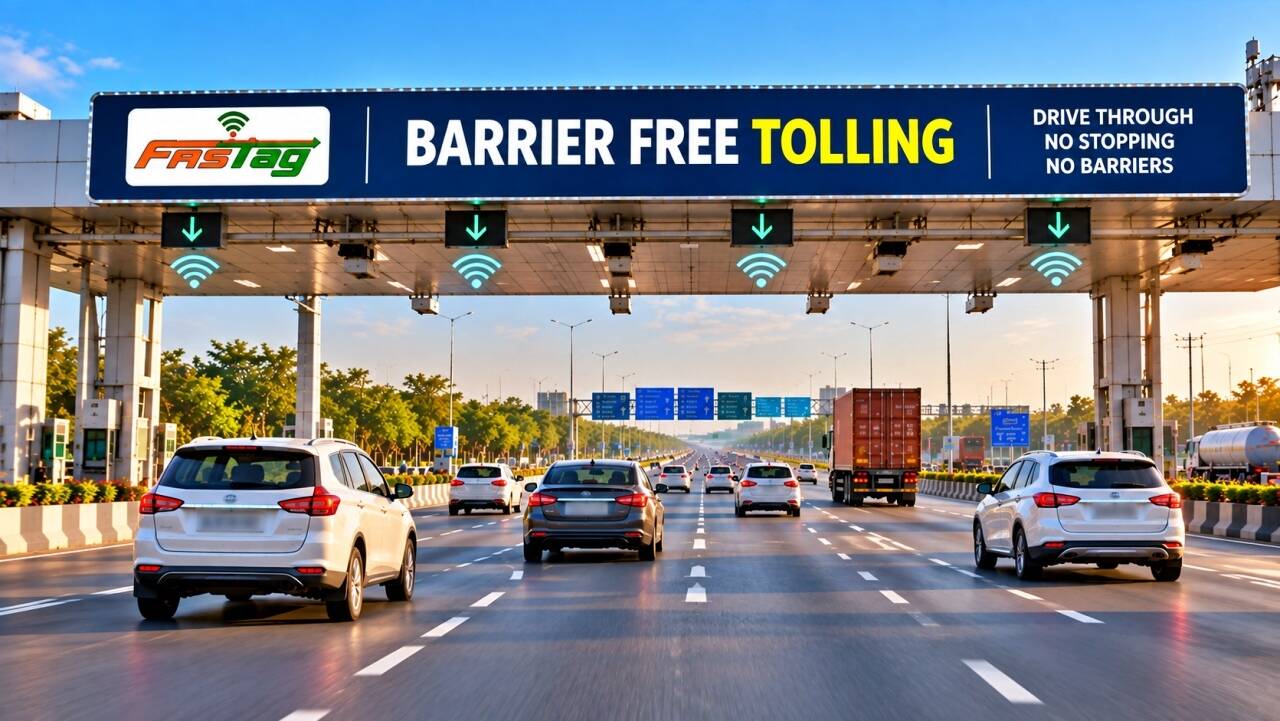
According to the government, the shift to barrier-free toll collection has delivered considerable operational and financial benefits. (Image for representative purpose only)
In what is being seen as a major boost from barrier-free tolling use, the National Highways Authority of India (NHAI) has recorded a 19.84% rise in net toll collections to Rs 538.95 crore between May and October 2026 through the system.The barrier-free Multi-Lane Free Flow (MLFF) tolling system is functional across seven operational fee plazas.The government is introducing Multi-Lane Free Flow (MLFF) technology across national highways as part of its move towards barrier-free toll collection.The system is being viewed as the next stage in the evolution of FASTag. Although FASTag has enabled digital toll payments, motorists still have to reduce their speed and pass through designated toll lanes and physical barriers.
Barrier-free tolling launched this year
On May 1, 2026, Road Transport and Highways minister Nitin Gadkari launched the country’s first barrier-free tolling system at the Choryasi Fee Plaza in Gujarat.It was subsequently rolled out at Mundka, Daulatpura, Gharaunda, Manoharpura, Shahjahanpur and Paranur. The Nemili and Chenasamudram fee plazas began operating under the system in November 2026.Excluding Nemili and Chenasamudram, the operational plazas collectively generated net toll revenue of Rs 538.95 crore, compared with Rs 449.72 crore during the corresponding pre-MLFF period in 2025.
"As on October 31, 2026, the cumulative performance across these seven plazas indicates an increase of 19.84 per cent in net revenue to NHAI, compared to the corresponding pre-MLFF baseline. Transaction volumes have also registered significant growth," NHAI said in a statement.The state-owned authority said the shift to barrier-free toll collection has delivered considerable operational and financial benefits.
However, it has also encountered cases in which vehicle owners deliberately obscure, cover or tamper with their registration number plates to avoid paying tolls."NHAI has taken serious cognizance of such instances and is closely coordinating with the concerned state governments and enforcement agencies to ensure strict action against such defaulters," NHAI said.The statement said police check posts have been set up at select MLFF locations, including Gharaunda Fee Plaza.
Vehicles caught engaging in such practices are being stopped and issued challans under the applicable provisions of the Motor Vehicles Act, 1988.NHAI is also introducing technology-based measures powered by artificial intelligence to identify these vehicles and trace their registered owners. These include Vehicle Fingerprinting and integration with the VAHAN database, the authority said.It added that electronic notices are being issued to recover unpaid user fees.
Where the dues remain unpaid despite these notices, access to applicable VAHAN services is being restricted in line with the prescribed enforcement framework.
Understanding barrier-free tolling
Under barrier-free tolling, vehicles are able to continue travelling at normal highway speeds as cameras and FASTag technology identify them and deduct the applicable toll automatically.
FASTag has become central to India's electronic toll collection system.
FASTag is also serving as the payment mechanism for India's transition to barrier-free tolling.The technology combines Automatic Number Plate Recognition (ANPR), AI-based analytics and FASTag-enabled electronic toll collection to replace the physical barriers that currently require vehicles to slow down at toll plazas.With this arrangement, tolls can be collected without motorists having to stop, reduce speed or remain in a designated lane. Once a vehicle crosses a specified point, the system identifies it, automatically deducts the toll from its FASTag account and sends a notification to the user.
KioskNews shows a cleaned-up reading view extracted from the publisher’s page — the original always lives on their site, not ours.