Singapore-developed radio frequency transmitters, unmanned aerial vehicle win defence technology prizes
SINGAPORE – The use of radio frequencies (RF) from locally built transmitters allows the Singapore Armed Forces to blind hostile drone sensors before they reach our shores.
These frequencies can also be used to create an image of a target, similar to how a bat uses echolocation, extending the reach of the army.
The custom-made RF transmitters developed over more than 16 years by the DSO National Laboratories won Vincent Leong the Defence Technology Prize Individual (Research & Development) award on Nov 6.
“A major issue in developing this new technology is the manpower aspect. Radio frequency is not the ‘in’ thing in terms of engineering disciplines – that would be AI robotics, right?” he said.
He added: “I hope this award can bring inspiration to other defence scientists and engineers.”
The home-grown RF transmitters – which can be smaller than a smartphone and up to 50% smaller than similar systems being sold on the market – boosts Singapore’s resilience and self-reliance amid global disruptions to supply chains. It also protects the island in a warfare environment increasingly dominated by drones.
A crucial part of the transmitter is the high-power amplifier. There are not many suppliers in the world for the amplifier, said Leong.
“If we depend on just a few suppliers for this important capability, then we will be at risk in terms of the system delivery and implementation. To avoid all this supply chain uncertainty and potential disruption, we have our own capabilities in building the transmitters,” he said.
Apart from Leong, three teams also received prizes from Defence Minister Chan Chun Sing at an award ceremony held at the DSO National Laboratories.
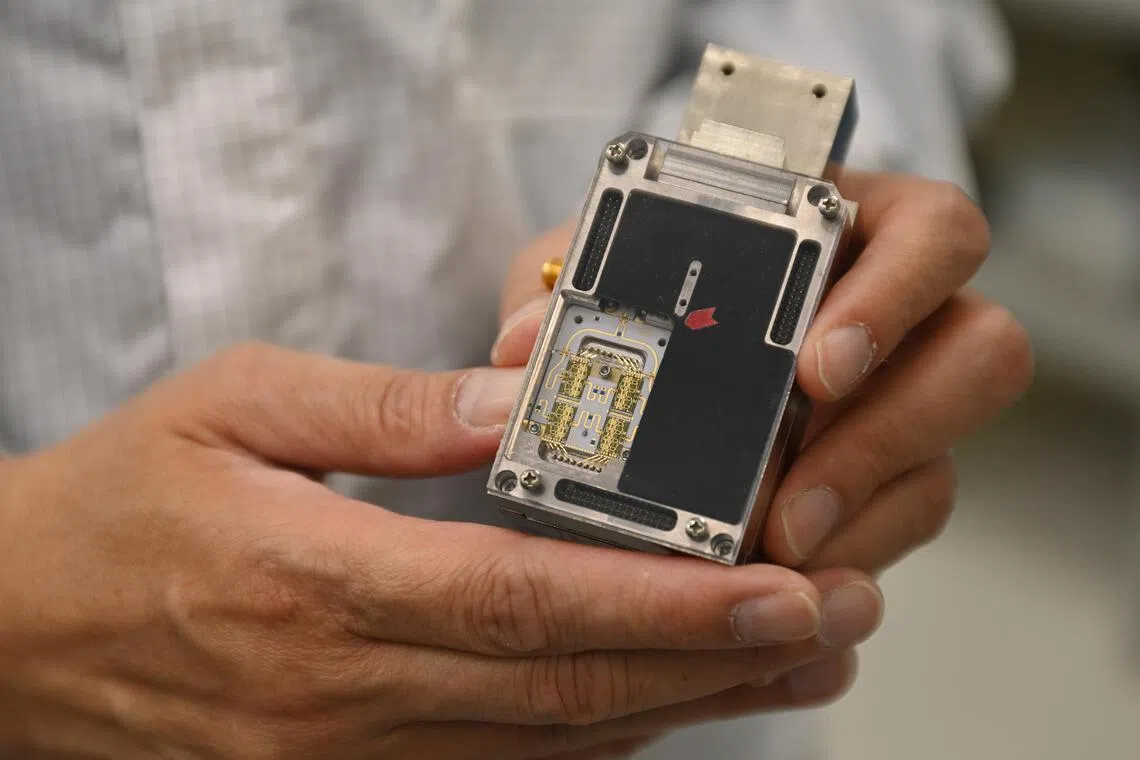
The RF transmitters developed by the DSO National Laboratories can be smaller than a smartphone and up to 50% smaller than similar systems being sold on the market.
ST PHOTO: NG SOR LUAN
Established by the Ministry of Defence in 1989, the annual award recognises individuals and teams that have made significant technological contributions to Singapore’s defence capabilities.
Leong said his key achievement is building up a team of scientists and engineers capable of customising the transmitters to the SAF’s different operational needs. For instance, they may add more power amplifiers to the transmitters for missions requiring a larger radio frequency range.
The DSO started work on them in 2009 with a team of between three and five people. Now, there are 15 to 20 people working on the transmitters.
The Defence Minister said the face of warfare is changing with advances in computing power, AI, autonomous systems, drones and robotics.
Emerging technologies present opportunities that are particularly significant for Singapore because they offer new ways to overcome constraints – such as limited size, manpower and resources – that have shaped the nation’s strategic calculations for decades.
“In national defence, long-term advantage depends on patient capability-building. Deep expertise cannot be bought off the shelf… The achievements we celebrate tonight did not emerge overnight,” he said.
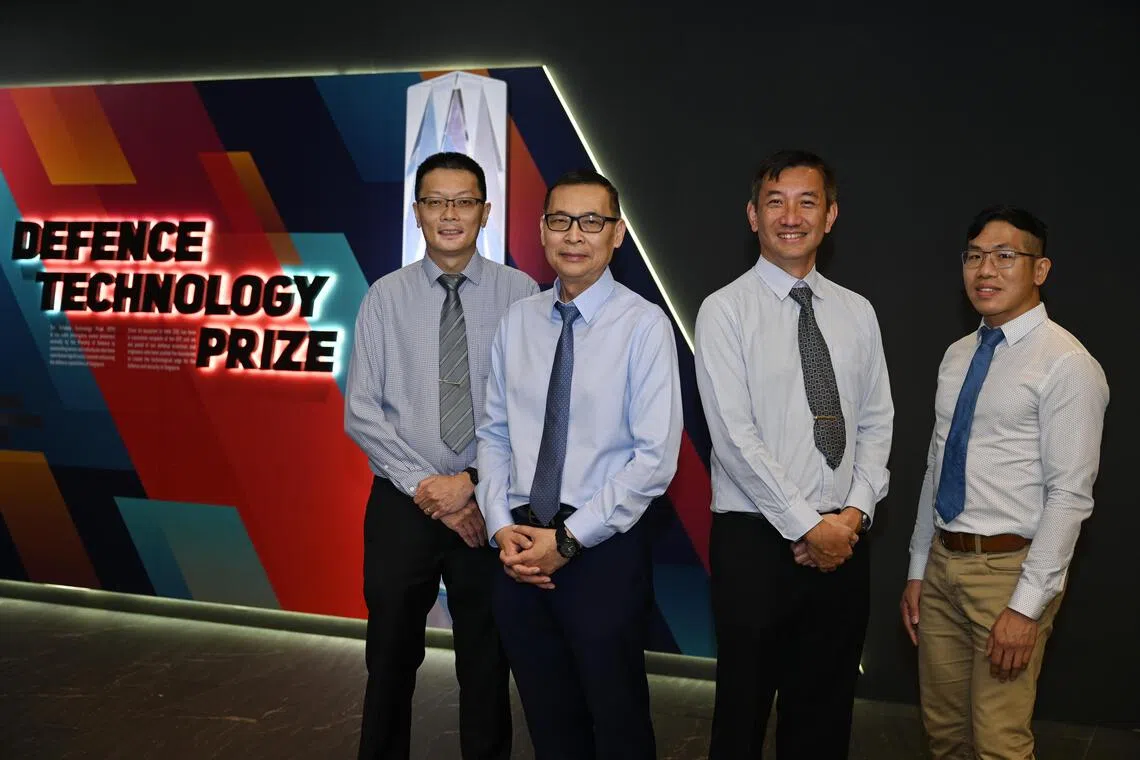
(From left) Leader of the A330 Multi Role Tanker Transport automatic midair refuelling team Chut Zhen Biao, Leong, leaders of the V60 team Toh Sze Wei and Xie Yao Yu.
ST PHOTO: NG SOR LUAN
Of the three winning teams, one from the DSO, Defence Science and Technology Agency (DSTA), the Republic of Singapore Navy and ST Engineering developed the navy’s first indigenous drone, which can be used for day and night surveillance operations.
The Veloce 60 drone has customised capabilities, such as being able to launch and recover autonomously and taking flight vertically.
It also has a flight time of up to 14 hours, which is longer than other vertical take-off drones’ ranges of three to nine hours.
“The team developed a hybrid aircraft that combines vertical take-off and landing with the efficiency of a fixed-wing flight to suit maritime operations without launch and recovery infrastructure,” team leader Toh Sze Wei said.
Drones that can launch vertically may typically have low flight times because of their high power consumption, he added. This constraint was overcome by building the V60 with fixed wings and a customised engine.
Difficult landings with a slim margin of error are par for the course when deploying drones on a moving ship.
To address this operational challenge, the team added a suite of software and sensors to the drone, which is capable of accurately locating the ship.
The third award went to a team from the DSTA and Republic of Singapore Air Force for developing technology which automates the A330 Multi-Role Tanker Transport’s midair refuelling capabilities.
The fourth award was given to another team working on highly classified advanced weapon systems, for which details could not be provided.
KioskNews shows a cleaned-up reading view extracted from the publisher’s page — the original always lives on their site, not ours.