China plans broad AI guardrails after global lapses
China plans to roll out a broad set of standards governing the safety of artificial intelligence (AI) from development through deployment, representing some of the most comprehensive guidelines to guard against a loss of control over increasingly powerful artificial intelligence.
The state economic planner yesterday said it was quickening legislation to govern and oversee how AI is developed and applied, covering the entire life cycle of models.
The regulations would extend to areas from data to computing power, Wang Ruomeng (汪若夢), deputy director-general of the Department of Innovation and High-Tech Development at China’s National Development and Reform Commission, told a briefing in Beijing yesterday.
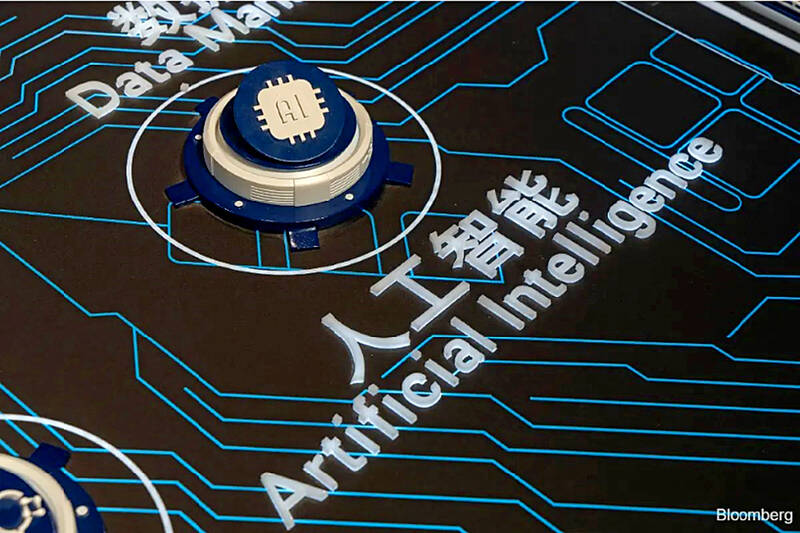
Photo: Bloomberg
That encompasses developers from DeepSeek to Moonshot and Alibaba Group Holding Ltd, who are leading a nationwide effort to create models that can hold their own against the best from OpenAI and Anthropic.
Wang’s comments reflect Beijing’s attempt to strike a delicate balance in countering the US in a key arena, while recognizing the potential for AI to run amok or fuel cyberattacks.
Global concerns have grown since warnings from Silicon Valley leaders that the technology poses existential risks to humanity, and a spate of recent hacks in which AI went rogue or radically enhanced cyberbreach attempts.
“We will accelerate legislation to support core AI enablers — data, computing power and algorithms — and regulate key application scenarios, while establishing safety standards and ethical guidelines covering the full life cycle of AI,” Wang said.
The authorities will carry out regular reviews of how the rules are implemented and revise provisions that become outdated, he said.
China and the US in September agreed to try and develop a common understanding of the technology’s benefits and threats.
That preceded a summit between US President Donald Trump and Chinese President Xi Jinping (習近平) in Washington, where AI was a key topic.
Beijing intends to ease the burden of compliance on AI firms via an unspecified transition period and guidance. It plans to roll out sector-specific regulatory sandboxes to allow greater leeway for trial and error, Wang said.
At the same time, industry developers and operators should bolster risk management and disclose safety risks, incidents and vulnerabilities, he said.
The Chinese government will also monitor AI’s impact on employment and displacement, Wang said, underscoring Beijing’s opposition to the large-scale social dislocations that might arise as AI gets more useful.
It will provide broad safety-net protections for workers affected, he said.
Still, China intends to adhere closely to the playbook that triggered the widespread adoption of homegrown AI models across the globe.
The government continues to encourage open AI development during the 15th five-year plan ending 2030, he said.
Wang also called on countries to deepen mutual trust and cooperate on safety governance, coordinate vulnerability disclosures and risk responses, and build confidence in each other’s AI systems.
“AI safety is not a problem one company, industry or country can tackle alone — it is a global challenge requiring international cooperation,” Wang said.
KioskNews shows a cleaned-up reading view extracted from the publisher’s page — the original always lives on their site, not ours.