Yemen violence deepens concerns over child hunger crisis
- More than one in four screened children are acutely malnourished
- Around 200 children screened have severe acute malnutrition
- At least 15 children have been killed since 3 September
Of nearly 2,900 children screened in areas where there is safe humanitarian access, the UN Children’s Fund (UNICEF) said that more than one in four was acutely malnourished, while around 200 were sick with severe acute malnutrition.
“This is only a glimpse of how devastating the situation is across Yemen; every day we are seeing more and more cases,” said Akhil Iyer, the agency’s top official in the country.
Testimonies from some of the approximately 130,000 people who have fled clashes in the southwest illustrate how civilians have been severely impacted by the fighting in recent weeks, after years of food and nutrition crises.
“We spoke to Haifa, a young mother who fled Yemen's west coast as well, and she told us that the sounds of gunfire were closing in on her house, as her house was shaking. She told us that she didn't have time to think, she just knew that she had to run and run quickly with her family,” the UNICEF official said.
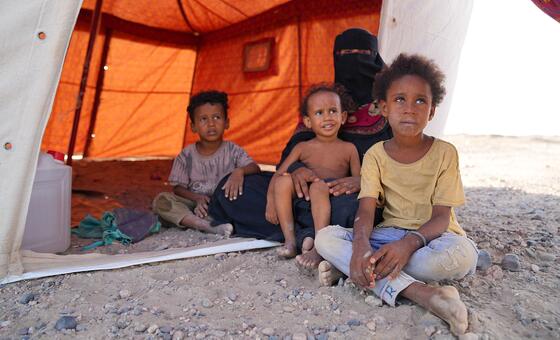
Today, Haifa and her family “live in extreme heat, in [one] a side of a tent”, in AlFirdos displacement camp near Aden. They have no way of earning money and they struggle to find food and medicine, Mr. Iyer explained.
“She pointed out to us that displacement has stripped them of their dignity. This is in fact what displacement does.”
Most vulnerable at highest risk
Briefing journalists from Aden, Mr. Iyer also described the plight of four-year-old Taha, who he found receiving treatment at a UNICEF-supported mobile clinic.
“His family had just fled violence in Mokha district, some 200 kilometres (124 miles) away, leaving behind their home and belongings. His mother told us, ‘We escaped with nothing. My only fear was that I would lose my son before finding help.’ Taha’s story is sadly not unique.”
Over the past three weeks, nearly 130,000 people in Yemen have been forced from their homes. That number includes an estimated 71,000 children. The majority have been uprooted in southwestern Taiz governorate where they are unable to move to safer areas “because of fighting, blocked roads, or lack of transportation”, Mr. Iyer continued.
Since 3 September, UNICEF has verified that at least 15 children have been killed and 14 injured, primarily by shelling attacks. Three more youngsters are still missing. “Behind every one of those children is a parent living through the unimaginable – grief, fear, or the agony of not knowing,” Mr. Iyer stressed.
Before the latest uptick in fighting, more than 2.2 million children under five in Yemen were projected to be acutely malnourished this year, with more than half a million suffering from severe acute malnutrition.
Access dangers
Providing healthcare for all those exhausted by repeated displacement is vitally important, particularly amid a spread of preventable diseases, including measles, acute respiratory infections, diarrhoea and cholera. But reaching communities with the highest health needs is becoming “increasingly difficult”, according to the UN World Health Organization (WHO).
In 90 of the 105 health-cluster priority districts in northern Yemen, “UN operations have been suspended”, explained the agency’s Amna Smailbegović. “The disruption has a direct impact on essential services, including outpatient consultation, skilled deliveries and child health services.”
For its part, UNICEF and other aid agencies do not have safe and unimpeded humanitarian access to between 65-70 per cent of children because the areas where they live are controlled by Houthi opposition forces.
KioskNews shows a cleaned-up reading view extracted from the publisher’s page — the original always lives on their site, not ours.