PHIVOLCS: Gas vent blockage observed at Mayon Volcano before eruption
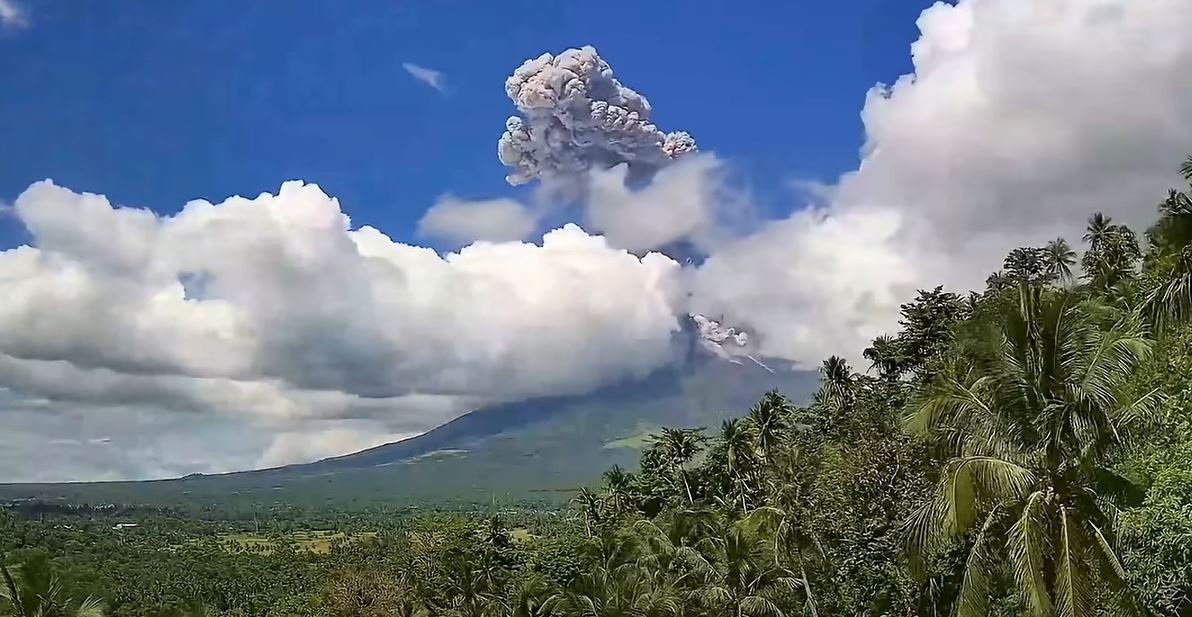
A blockage in a volcanic gas vent was observed overnight before the eruption of Mayon Volcano, the Philippine Institute of Volcanology and Seismology (PHIVOLCS) said Friday.
In an interview on Super Radyo dzBB, PHIVOLCS said the blockage led to a pressure buildup, which triggered Mayon Volcano’s explosion.
“Kasi ang nangyari po dito sa Mayon ay overnight po nagkaroon po ng bara ‘yung nilalagusan po ng mataas na volcanic gas emission nito at nagkaroon po ng pag-ipon ng pressure kaya po ito biglang nag-explode,” Volcano Monitoring and Eruption Prediction Division Chief Mariton Bornas said.
(What happened here at Mayon was that there was a blockage in the vent of its high volcanic gas emissions overnight, causing a pressure buildup that led to this explosion.)
“Ito pong prosesong ito ay medyo shallow. Hindi na po ito nahahagip ng ating network dahil ang lapit na po sa crater ng Mayon ang source ng explosion na ito… Kung mas malalim po ‘yan, mas made-detect po ‘yan ng ating network—’yung pag-buildup po ng… gas pressure,” she added.
(This process is relatively shallow. It is no longer being picked up by our monitoring network because the source of this explosion is already so close to Mayon's crater... If it were deeper, our network would have detected the buildup of gas pressure better.)
Before Mayon Volcano’s eruption on Friday morning, PHIVOLCS said it recorded 100 volcanic earthquakes in the 24 hours preceding the explosion, which caused the spurt of volcanic gas.
However, despite recording small volcanic earthquakes, there was no distinct sign that it would erupt, according to Bornas.
“So ‘yung kanina pong pagputok, ito po ay wala po siyang distinct na sign na mangyayari bagama’t nagkaroon po tayo ng pagdami ng maliliit na volcanic earthquakes related to volcanic gas,” Bornas said.
(So with earlier's eruption, there was no distinct sign that it would happen, although we had an increase in small volcanic earthquakes related to volcanic gas.)
“Pero in the medium term po, naka-Alert Level 2 po tayo at lagi po tayong magbababala na hindi pa po bumababa ang unrest bagkus meron pa pong tsansa na magkakaroon pa po tayong activity,” she added.
(But in the medium term, we were under Alert Level 2 and we constantly warned that the unrest had not abated, but rather there was still a chance of further activity.)
Danger around Mayon Volcano
Following its eruption, Mayon Volcano was placed under Alert Level 3.
Bornas said raising the status to Alert Level 3 indicates an anticipation of another eruption that could be stronger and could last longer than the recent explosion.
Comparing its observations at the start of the year, PHIVOLCS said there were changes in the acidity of Mayon today.
“Noong January to August ay, noon po ‘yung umpisa ng taon, ito po ay nagluluwa lamang ng lusaw na lava so lahat po ng ating volcanic hazards ay nasa isolated lang po na area kung saan lang po may lava flow,” Bornas said.
(From January to August, at the start of the year, it was merely effusing molten lava, so all our volcanic hazards were isolated strictly to the area with the lava flow.)
“Ngayon po, medyo may kakaiba pong ugali ang Mayon. Bigla po tayong merong explosive na activity matapos po ng mahabang lava effusion, at saka ito pong explosive activity ang major difference po ay lumilikha po ito ng vertical eruption column,” she added.
(Now, Mayon is exhibiting somewhat unusual behavior. We suddenly have explosive activity following a long period of lava effusion, and the major difference with this explosive activity is that it generates a vertical eruption column.)
Bornas explained that an eruption column can collapse, generating "uson" or pyroclastic density currents.
Unlike before, when the hazard was confined to areas along the path of lava flow, a vertical eruption column means hazards could sweep across all areas surrounding the volcano.
“Hindi po sa isang side lang, katulad po nung kapag lava flow lang po ang pinanggagalingan. The danger is all around the volcano,” Bornas said.
(Not just on one side, unlike when it originates purely from a lava flow. The danger is all around the volcano.)
According to Bornas, PHIVOLCS currently sees no signs of a major eruption following the recent activity, but state volcanologists are not ruling out its possibility. –NB, GMA News
KioskNews shows a cleaned-up reading view extracted from the publisher’s page — the original always lives on their site, not ours.