Trump’s ‘golden age’ push hands top science honours to big tech. Will it work?
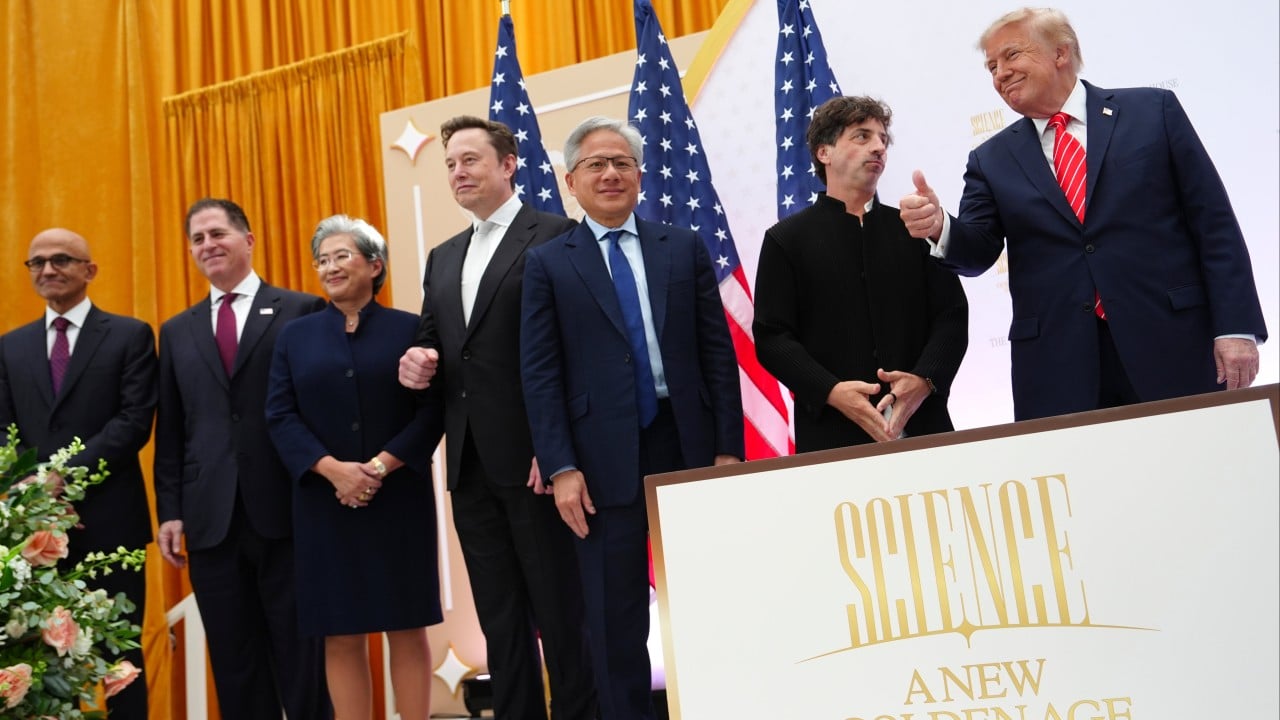
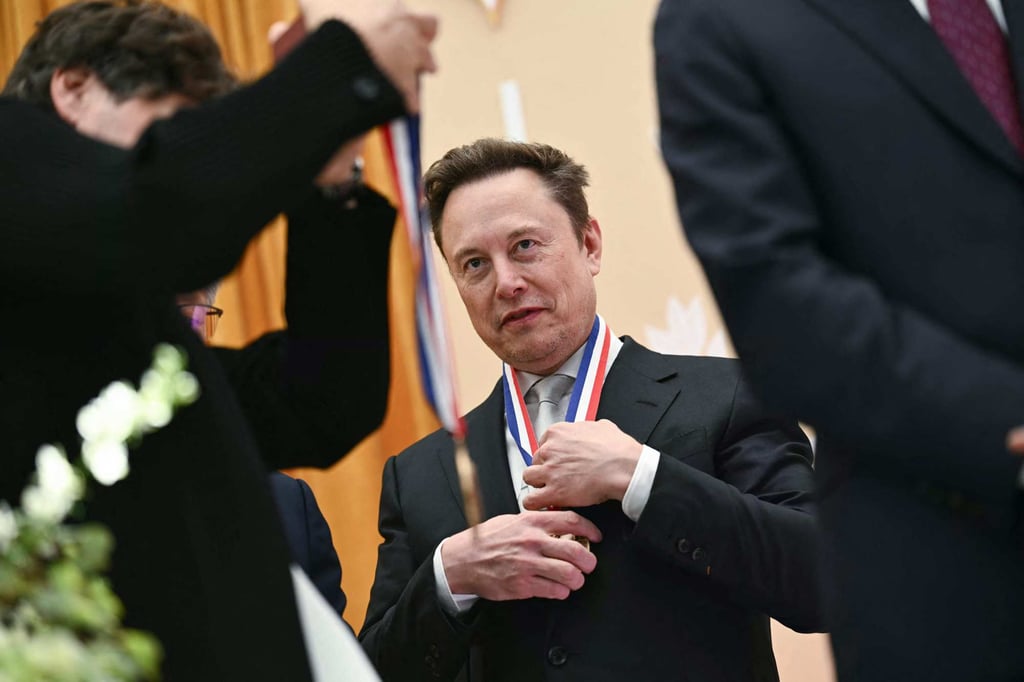
Personal computer tycoon Michael Dell and Microsoft CEO Satya Nadella received the National Medal of Technology and Innovation, the US’ most prestigious award for the category.
While entrepreneurs have previously won these awards, observers noted that it was unprecedented for tech executives to be honoured on such a scale – particularly given that the National Medal of Science had long prioritised scientists and researchers.
The award was established by Congress in 1959, while the technology medal was introduced in 1980.
All of this year’s recipients have close ties with the White House. Musk is widely considered a Trump ally despite their months-long public feud last year, while Huang, Su, Brin and Dell are all members of the President’s Council of Advisers on Science and Technology.
The companies they lead have also deepened their commercial ties with the Pentagon to varying degrees.
With artificial intelligence (AI) emerging as a major arena of the China-US tech rivalry, those enterprises are also critical players in the supply chain. At Trump’s state dinner last month for Chinese President Xi Jinping, Musk, Huang and Su were seated at the same table as the two leaders.
WATCH: US President Donald Trump hosts state dinner for Chinese President Xi Jinping
Sun Zhanqing, a special researcher at the South China University of Technology’s Institute of Public Policy, said the line-up of awardees showed that a “new type of power relationship” was taking shape in the US.
SCMP Plus is a new premium news platform that gives you an
all-inclusive edge to stay ahead on China news.
To access our exclusive content you’ll need to subscribe.
Already a subscriber?
LOG IN
“Tech entrepreneurs’ standing in [shaping] resource allocation, technological road maps and the national science narrative is rising,” Sun wrote in a note on the think tank’s social media channel on Friday.
Still, he cautioned against conflating US tech executives’ growing influence over scientific research with scientists’ actual “capacity to create knowledge”.
“The Trump administration’s science awards may create a cycle that warrants vigilance,” warned Sun, who is also deputy director of the government-affiliated Guangzhou Academy of Social Sciences’ Urban Culture Research Institute.
Tech bosses’ resource advantages yielded more visible results, he said, earning them higher honours that in turn could reinforce their policy influence and ability to secure more resources.
“Ultimately, people may attribute the advantages created by this cycle to the idea that a certain group of people is inherently more creative,” he warned.
“A golden age of science cannot be judged solely by how glamorous the people standing on the podium are.”
An analysis by Xinzhi Observatory, a technology-focused channel owned by Shanghai-based news portal Guancha, also struck a sceptical note on last week’s US science summit.
Even as the Trump White House continued to cut routine federal funding for basic science, it was trying to tap the massive computing power and capital of private giants to rebuild US global leadership in research through so-called superintelligence, the piece noted, using Trump’s new preferred moniker for AI.
With entrepreneurs increasingly steering research, the purity of scientific inquiry and the public interest could face an “unprecedented test,” it cautioned. “Whether reliance on the patronage of tech oligarchs can truly open a new, enduring golden age of science remains a highly contested unknown.”
However, China could ill afford to let its guard down, the observers cautioned.
“The award ceremony was not merely a ‘symbolic arrangement’,” Sun said. “Big tech companies are taking part in national tech competition as technology developers.”
He cited the more than US$6 billion in science and technology investments announced by the Trump administration at Thursday’s event. This includes US$2.4 billion in contributions from 11 companies, including Nvidia, AMD, OpenAI, Anthropic and Google, to provide AI “science tools and compute credits” for researchers.
Xinzhi Observatory said the investment plans announced at the summit might reveal a blueprint for “stockpiling talent reserves for future industrial competition” – by pushing advanced computing capacity directly to the local level to spur broader basic innovation.
Thursday’s event built on “Science: A New Golden Age”, a report by White House Office of Science and Technology Policy director Michael Kratsios released in July.
It outlines a major overhaul of the framework for American science, whose foundations were laid by the 1945 report “Science, the Endless Frontier”, written by Vannevar Bush, director of the US Office of Scientific Research and Development during the second world war, while positioning itself as the 21st century successor to it.
Kratsios’ report argues that the post-war “linear model” of technological progress – flowing in sequence from university-based basic research funded through slow, consensus-driven peer review, to applied research, then to technological development and industry – no longer held in many fields.
It said US private companies dominated research spending, bureaucratic and funding structures were burdening scientists, and the fruits of American science often ended up helping rivals build their advantage due to decades of industrial offshoring.
It proposed prioritising funding for risk-taking individual scientists over “legacy institutions” and expanding the Genesis Mission – launched by the Trump administration in November to use AI to accelerate scientific discovery.
However, Kratsios’ report has drawn criticism at home, including over its ostensible aim to shift vast resources away from traditional academia towards big tech, effectively turning national research into a venture-capital model.
But Chinese observers say it could pose a challenge to Beijing, by shifting the gravity of US-China tech competition away from individual breakthroughs to how well each side governs its innovation system.
The report identified China as the first “peer-level competitor” to the US in research and development spending – driven by Beijing’s “all-of-society approach” to partnerships across sectors.
02:12
Chinese robots square off in unique human-controlled humanoid fighting tournament in Singapore
Strategically, the White House report was a “direct response” to China’s whole-of-nation approach to scientific research, said Zhu Yanmei, dean’s adviser at the Shenzhen Loop Area Institute.
She warned in a July post that regardless of future administrative shifts, its core propositions – that science must serve national competitiveness, that federal funding must pursue quantifiable gains in technological sovereignty, and that AI must be treated as national infrastructure – had probably become consensus in US strategic circles.
She also cautioned that the problems highlighted in the US report – bureaucracy, conservatism and inefficiency – mirrored chronic flaws in China’s own research system.
“What China needs is not simple benchmarking or a reflexive response but a profound reflection on its innovation paradigm. In criticising America’s own ailments, the report has inadvertently held up a mirror for China,” she wrote.
“For China, the report’s biggest takeaway may be this: a true science and innovation power is measured not by the number of papers or the scale of funding but by whether its institutions can keep generating ‘crazy ideas’ and turn them into ‘world-changing forces’.”
Beijing is also moving to streamline its research system.
Guidelines issued last Friday on developing new productive forces called for boosting the role of companies as the main force in scientific and technological innovation, and for supporting capable private firms to lead major national technology projects.
In April, Xi called for an open, inclusive innovation environment that tolerated failure and placed greater weight on AI-enabled basic research.
KioskNews shows a cleaned-up reading view extracted from the publisher’s page — the original always lives on their site, not ours.