Delhi air pollution today more than 10 times WHO guideline: AQI at Baljit Nagar records 797 on November 29
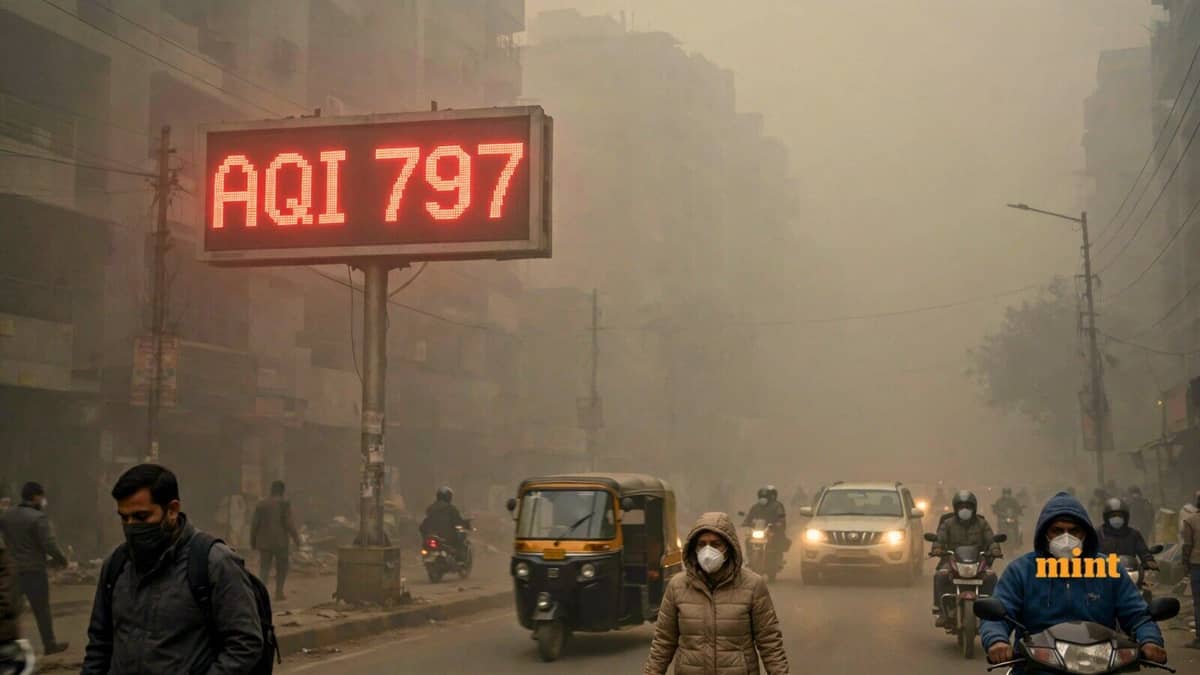
Delhi’s air quality reached hazardous levels Sunday morning, with a citywide AQI of 522. Baljit Nagar recorded 797, the highest neighbourhood reading.
Delhi’s air quality was hazardous on Sunday morning, with a live AQI of 522. AQI.in recorded that citywide reading on November 29 at 8:01 AM. New Delhi ranked 12th among the world’s most polluted cities at the time, with Baljit Nagar recording 797.
Railway Colony recorded an AQI of 745. Punjabi Bagh Cooperative Housing Society followed at 719 while Than Singh Nagar recorded 635. These neighbourhood readings fell in the hazardous category, which starts at 301 on this scale. Even Than Singh Nagar’s reading was 113 points above the citywide figure.
The neighbourhoods saw air pollution fall on Saturday before rising again overnight. Baljit Nagar’s AQI dipped below 300 before climbing back towards 800 by Sunday morning. Railway Colony’s reading fell close to 200 before rebounding above 700.
Than Singh Nagar also dropped close to 200 before returning above 600. Punjabi Bagh saw a similar fall below 300 before climbing back above 700.
Delhi’s citywide PM2.5 level stood at 336 micrograms per cubic metre. The PM10 reading was higher at 471 micrograms per cubic metre. AQI.in put that PM10 level at more than 10 times the World Health Organization’s guideline. The guideline cited was 45 micrograms per cubic metre.
Baljit Nagar also had the highest readings for both particles among the four neighbourhoods. Its PM2.5 level reached 474 micrograms per cubic metre, and PM10 reached 664. Railway Colony recorded 449 for PM2.5 and 628 for PM10. Punjabi Bagh recorded 435 and 610, respectively, while Than Singh Nagar recorded 393 and 551.
Saturday’s daily AQI was 378, up 128 points from Friday’s 250. Delhi recorded 235 on Tuesday, 226 on Wednesday and 240 on Thursday. November 9 had the highest daily reading through November 28, at 666.
Delhi most polluted
Delhi had the highest AQI among the Indian metros listed by AQI.in. Pune came next at 197, followed by Hyderabad at 182 and Bengaluru at 173. Mumbai stood at 172, Chennai at 171 and Kolkata at 162. Ahmedabad had the lowest reading among the eight cities, at 152.
At the time, Delhi was sunny, with a temperature of 25°C. The citywide update put wind speed at just 3.6 km/h. AQI.in estimated that continuous exposure over 24 hours was comparable to smoking 12.6 cigarettes.
The comparison used the average PM2.5 level over those 24 hours. AQI.in credits Berkeley Earth for the comparison.
About the Author
Sounak Mukhopadhyay covers trending news, sports and entertainment for LiveMint. His reporting focuses on fast-moving stories, box office performance, digital culture and major cricket developments. He combines real-time updates with clear context for everyday readers. <br><br> Sounak brings newsroom experience across breaking news, explainers and long-form features. He has a strong emphasis on accuracy, verification and responsible storytelling. His work tracks audience behaviour, celebrity influence and the business of sport and cinema. He helps readers understand why a story matters beyond the headline. <br><br> Sounak has contributed to widely read digital publications. He continues to build a body of journalism shaped by consistency, speed and editorial clarity. He is particularly interested in the intersection of media, popular culture and public conversation in contemporary India. <br><br> At LiveMint, he writes daily coverage as well as analytical pieces that interpret numbers, trends and cultural moments in accessible language. His approach prioritises factual depth, balanced framing and reader trust. The reporting aligns with modern newsroom standards of transparency and credibility. <br><br> Outside daily reporting, he explores storytelling across formats including podcasts, filmmaking and narrative non-fiction. Through his journalism, Sounak aims to document the rhythms of modern entertainment and sports while maintaining rigorous editorial integrity. <br><br> Sounak continues to develop audience-focused journalism that connects speed with substance in a rapidly-changing information environment. His work seeks clarity, trust and lasting public value in every story he reports.
KioskNews shows a cleaned-up reading view extracted from the publisher’s page — the original always lives on their site, not ours.