Singapore launches Asia-Pacific initiative to earlier identify next big infectious disease threat
SINGAPORE – An Asia-Pacific initiative was launched in Singapore on Nov 3 to identify emerging infectious disease threats through predictive modelling for earlier intervention.
The Asia Pacific One Health Initiative (APOHI), based in Singapore, will bring together regional partners, experts and institutions across human, wildlife and environmental health to build a more integrated approach to detecting early signs of such threats.
This is especially important in Asia-Pacific, where dense populations and rich biodiversity heighten the risk of emerging zoonotic disease threats or animal-to-human spillovers.
Leo Yee-Sin, an infectious diseases specialist and APOHI co-lead, said: “It is about time Singapore steps up after learning from our past experiences, and be able to connect better with the region when it comes to existing and emerging infectious disease threats.
Leo, who is senior advisor and senior consultant at Temasek Life Sciences Laboratory, had led teams through multiple outbreaks in Singapore, including SARS in 2003 and Covid-19 from 2020 to 2022.
Pointing out the limitations in communication between countries, institutions and experts during the SARS outbreak, she said she was fortunate to have connected with Joseph Sung, who was then the chairman of the Department of Medicine and Therapeutics at the Prince of Wales Hospital in Hong Kong, where the outbreak hit severely.
“When it came to Covid-19 pandemic, the world was so much more connected and the networks were already there... There was a lot of opportunities to share what was happening in Singapore, the region and the world. It made it critical for us to get information and to be able to put our focus in areas such as research, as it was a brand new pathogen,” Leo said.
While emerging infectious disease threats are increasingly shaped by interactions between humans, animals, and the environment, the surveillance systems still tended to operate in silos, with information fragmented across institutions and borders, making it difficult to identify emerging risks and act early.
APOHI, supported by Temasek Foundation, Gates Foundation and the Health for Human Potential Community by the Philanthropy Asia Alliance (PAA), was launched to bridge the gaps through a “one health” approach, which Leo said is “easy to understand but not easy to act upon”.
Ng Boon Heong, executive director and chief executive officer of Temasek Foundation, said: “Today, we still tend to learn of an emerging disease from its first human patients, because the warning signs in animals and the environment are seldom brought together. Through APOHI, we can build a platform for partners to connect these signals and give the region an earlier warning capability.”
Ian Cheong, senior principal investigator at Temasek Life Sciences Laboratory, said the main challenges in the ‘one health’ approach are those of coordination when it came to using human, animal and environmental data.
“When we think of ‘one health’, we would be working backwards to collect these data temporaneously and have them correlated in ways where we see patterns between these data when they are ‘unsiloed’. So, that’s key in getting things to happen. It would take relationships, the willingness of parties across borders and disciplines to work together,” said Cheong, another co-lead of APOHI.
Over the next 10 years, APOHI aims to advance integrated surveillance, predictive intelligence, and cross-border scientific research to strengthen preparedness against emerging infectious disease threats.
First regional programme: Monkey malaria in Borneo
For APOHI’s first programme, a research team led by spatial epidemiologist Kimberly Fornace is working to identify potential macaque monkey hotspots where a malaria-causing parasite carried by monkeys could spread to humans.
Malaria can be passed from monkeys to humans when a mosquito feeds on a parasite-infected macaque and then bites a person.
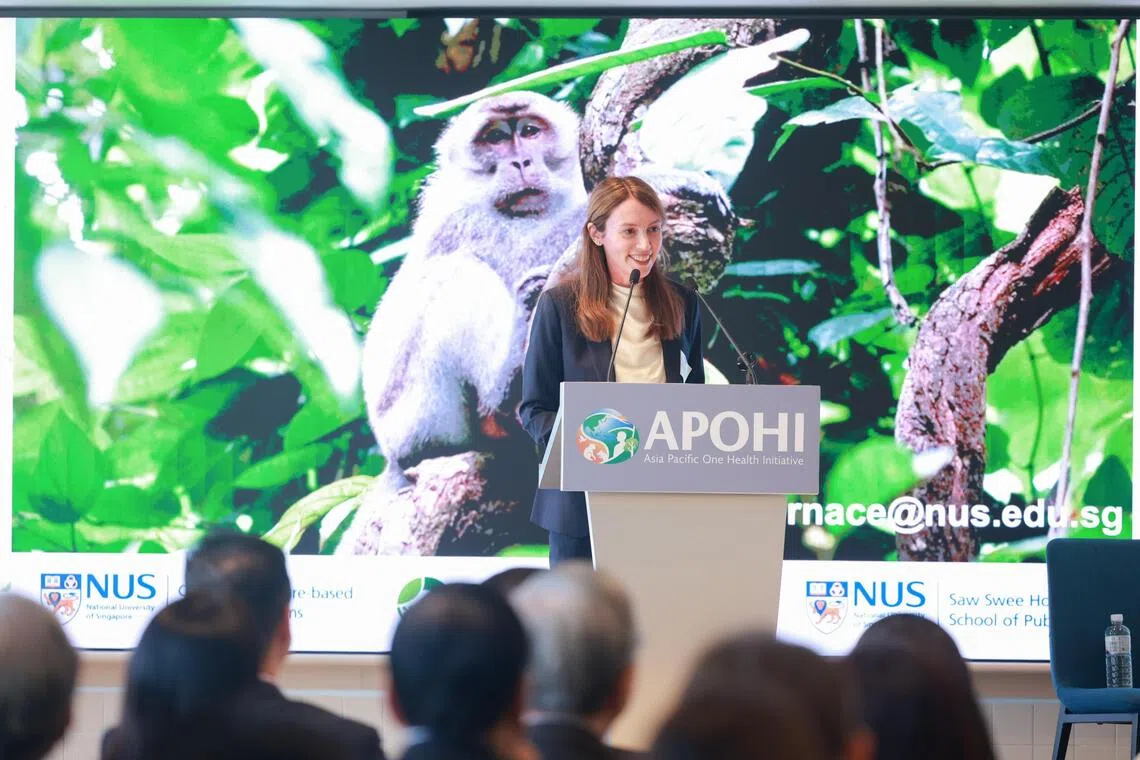
Spatial epidemiologist Kimberly Fornace leads the first regional research under the Asia Pacific One Health Initiative on monkey malaria and its potential spread to humans in the region.
ST PHOTO: JASON QUAH
The project, bringing together researchers and institutions across Singapore, Malaysia, Indonesia, and Brunei, would show how integrated surveillance and predictive modelling can strengthen understanding of disease transmission risks.
It also serves as a platform to develop and test cross-border data sharing, joint analysis, and coordinated action. Lessons learnt from the project will inform future efforts to address other emerging infectious disease threats, in line with participating countries’ priorities.
Fornace said Borneo’s changing forest and land-use patterns affect interactions between humans, wildlife, and mosquitoes, potentially influencing the risk of zoonotic or monkey malaria transmission.
While there is a reduction in human cases when there are extreme haze events during El Nino, the fires that cause the haze result in burnt landscapes often create new habitats for mosquitoes, she added.
“So when we have more rain in these new habitats a year later, we see some of the perfect habitats for this type of mosquito, (resulting in) much higher cases of malaria. These factors all combine to really drive risks,” Fornace said.
“One of the things that we consistently found was these forest edges which are close to human settlements have these mosquito breeding sites. They are also where macaques live and where people move to and are typically where we see spillover risks,” she said.
“Any time we have a kind of big change, where we see roads expanding, settlements extending, we often see an increase in these interfaces. So we have been working very closely with partners in Indonesia to work at developing surveillance, and understanding the risks.”
KioskNews shows a cleaned-up reading view extracted from the publisher’s page — the original always lives on their site, not ours.