Manufacturing PMI rises to five-year high
By Crystal Hsu / Staff reporter


Taiwan’s manufacturing sector expanded at its fastest pace in more than five years last month, as robust demand for artificial intelligence (AI) hardware continued to drive growth, despite easing new orders and mounting supply and cost pressures, the Chung-Hua Institution for Economic Research (CIER, 中華經濟研究院) said yesterday.
The manufacturing purchasing managers’ index (PMI) climbed to 63.4 from 61.7 in August, its highest level since August 2021, with all six major industries reporting improved business conditions, the institute said.
A reading above 50 indicates expansion.
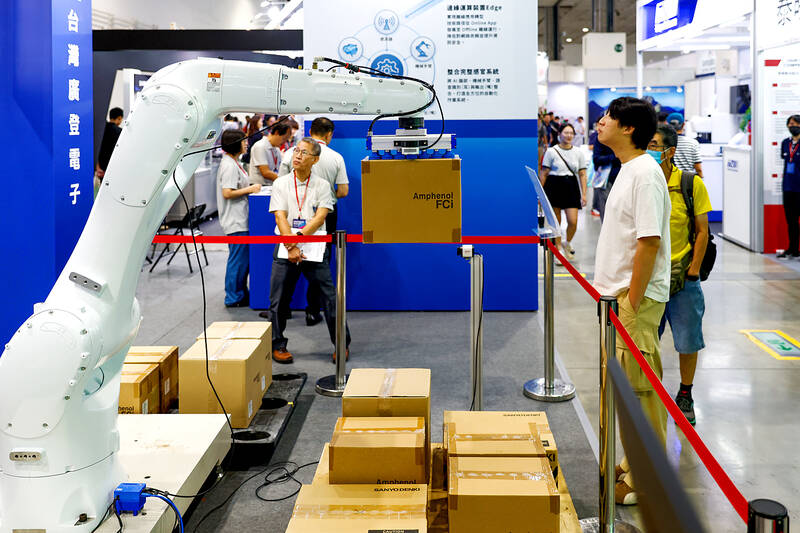
People observe a programable robotic arm in action during the Automation Taipei Expo in Taipei on Aug. 20.
Photo: Ritchie B. Tongo, EPA
“AI demand continues to drive manufacturing growth, with the benefits gradually extending to nonmanufacturing sectors,” CIER president Lien Hsien-ming (連賢明) told a news conference in Taipei.
The expansion remained particularly strong in technology-related industries, although its pace moderated somewhat, Lien said.
The new orders index, a leading indicator of future activity, fell 2.9 points to 63.6. Manufacturers reported shortages of some materials, excess inventories of others and longer delivery times, all of which were complicating production schedules, the institute said.
The combination suggests manufacturers are shifting some focus from expanding output to managing inventory and supply-chain pressures, it said.
AI-related demand remains the main support for manufacturing, while rising energy costs amid heightened tensions in the Middle East have sharply increased raw material prices and prompted companies to reallocate orders, Supply Management Institute in Taiwan (中華採購與供應管理協會) adviser Jerry Pai (白宗城) said.
Petrochemical producers are facing higher raw material and transportation costs, while demand remains relatively firm for advanced semiconductor materials, specialty chemicals and materials used in precision medical products, Pai said.
Manufacturers are also reviewing products and production plans for next year, while new product trials and testing are competing for capacity already strained by long lead times, potentially weighing on some short-term PMI readings, he said.
Still, the six-month business outlook remained firmly in expansion territory at 59.5 last month, the highest reading since May 2024, with all six major industries expecting growth, the institute said.
Meanwhile, the nonmanufacturing index rose for a 19th consecutive month to 56.9, indicating that the manufacturing boom is gradually extending into services, including stock-related and tourism businesses, the CIER said.
Service sector companies also became more optimistic about fourth-quarter activity, although persistent cost and delivery pressures remained a concern, it said.
Lien cautioned that the expansion remains uneven, with a pronounced gap between technology and non-technology industries.
“We hope other industries can gradually catch up as the tech sector expands, narrowing the gap across the economy, but so far, the tech sector remains exceptionally strong,” Lien said.
KioskNews shows a cleaned-up reading view extracted from the publisher’s page — the original always lives on their site, not ours.