FSC announces measures after stock market losses
VOLATILITY: The decline in Taiwan’s stock market largely mirrored global markets, and there are no problems with the nation’s economy, the Ministry of Finance said
The Financial Supervisory Commission (FSC) yesterday announced that it had further tightened short-selling restrictions after the country’s stock market suffered heavy losses in recent sessions amid global volatility in artificial intelligence (AI)-related stocks.
In a statement, the FSC said it had prohibited short-selling of stocks whose prices fell in the previous trading session, marking the first time since 2015 that the commission had imposed such a blanket restriction.
The latest measure tightens a restriction announced on Thursday that prohibited short-selling of stocks that had fallen 3.5 percent or more in the previous trading session.
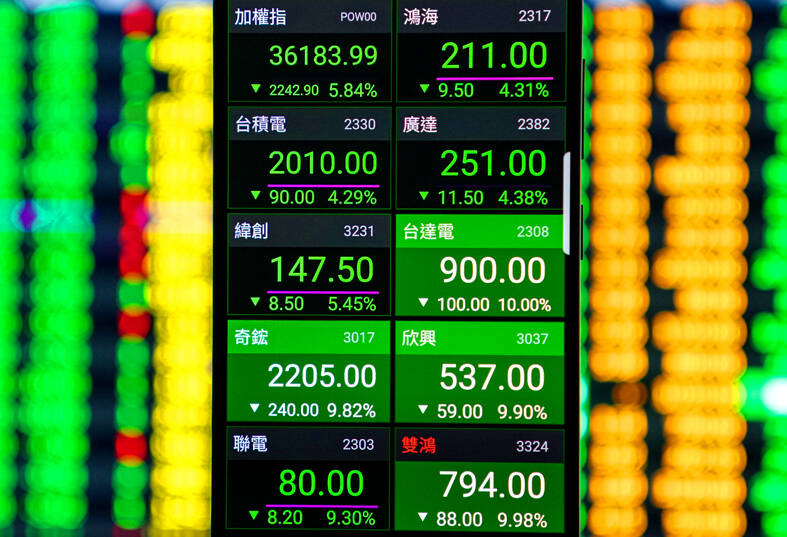
Stock prices are displayed in Taipei on Friday.
Photo: CNA
The new rule is aimed at maintaining orderly trading and market stability, the FSC said.
The commission also raised the minimum margin requirement for short-selling from 130 percent to 150 percent, requiring investors to provide more collateral.
The new rules are to take effect tomorrow, the FSC said.
The latest restrictions came after the TAIEX, the Taiwan Stock Exchange’s benchmark index, on Friday plunged 2,393.60 points, or 6.23 percent, to close at 36,033.29, its lowest closing level in about seven months. It was the third-largest single-session point loss on record.
From an intraday record high of 49,968.92 points on Oct. 6, the TAIEX had fallen 14,230.24 points, or 28.48 percent, to an intraday low of 35,738.68 on Friday amid growing concerns about the outlook for the global AI industry.
The FSC announced the measures after Premier Cho Jung-tai (卓榮泰) met with heads of economic and financial agencies, including the commission, yesterday morning and instructed them to devise measures to stabilize the market.
The FSC also decided to suspend acceptance of applications from securities firms seeking to issue put warrants for listing on the Taiwan Stock Exchange and the Taipei Exchange, which operates the over-the-counter market.
The commission said it would continue to encourage listed companies to buy back their own shares.
It also called on financial institutions and other lenders to suspend securities lending and, for shares already lent out, to recall the shares early or refrain from renewing the loans when they mature.
The FSC said it would closely monitor rapidly changing global financial markets and local market conditions and adjust its stabilization measures accordingly.
The management committee of the NT$500 billion (US$15.18 billion) National Financial Stabilization Fund has been authorized to intervene in the market since Nov. 6, while the FSC has gradually introduced measures to curb short-selling since then.
Meanwhile, in a statement issued by the Executive Yuan after Cho met with heads of economic and financial agencies, Cabinet spokeswoman Michelle Lee (李慧芝) cited the Ministry of Finance (MOF) as saying that the sharp decline in Taiwan’s stock market largely mirrored heavy losses in global markets and that there were no underlying structural problems with the nation’s economy.
Lee also cited the Ministry of Economic Affairs (MOEA) as saying that the long-term trend of investment in AI infrastructure remained strong and that the fundamentals of Taiwan’s technology and semiconductor industries remained sound.
Combined revenue at electronics distributors listed on the main board and over-the-counter market surged 92.2 percent from a year earlier in October, the MOEA said.
Revenue at computer and computer peripheral suppliers, semiconductor companies and electronics component manufacturers also jumped 75.6 percent, 63.6 percent and 41.2 percent year-on-year respectively.
Lee also pointed to Taiwan’s export performance as evidence of its economic strength. Exports exceeded US$750 billion in the first 10 months of this year on robust global demand for AI-related products. Exports for this year are forecast to surpass US$900 billion.
Taiwan’s economy grew 14.22 percent in the first three quarters of this year, and strong export performance is expected to lift full-year economic growth to 12 percent, up from the 11.05 percent forecast made in August, she said.
Despite the strong economic outlook, Cho instructed government agencies to closely monitor stock market movements and rapidly changing global economic conditions, Lee said.
Cho called on the stabilization fund to increase its market intervention efforts and instructed the MOF to provide more financing and credit guarantees to businesses, while the FSC was asked to devise additional measures to ease market volatility, she said.
The premier also asked the MOEA to continue helping companies expand their presence in global markets and instructed the central bank to closely monitor movements in the local foreign exchange market and the New Taiwan dollar’s exchange rate, Lee said.
Cho pledged to maintain stability in the local capital market and bolster investor confidence in Taiwan’s economy, she added.
KioskNews shows a cleaned-up reading view extracted from the publisher’s page — the original always lives on their site, not ours.