5 Essential Jurassic Park Games, Ranked

Sign in to your Collider account
Jurassic Park has always looked like it should produce incredible video games. Dinosaurs already provide enemies, spectacle, exploration, survival, and the constant possibility that a routine objective will become a terrible idea within seconds. The challenge has been finding developers who understood that the fantasy involves more than shooting velociraptors.
These five games represent very different answers. One turned Isla Nublar into an ambitious 16-bit adventure. Another delivered pure arcade panic. But there’s more to them that makes them essential to what we have as games in Jurassic Park world. Scroll down slowly and find out.
5 'Jurassic Park (SNES)' (1993)

The Super Nintendo version of Jurassic Park puts Dr. Alan Grant back on Isla Nublar and asks him to restore security systems, recover dinosaur eggs, and survive long enough to escape the island. Rather than simply recreating scenes from the 1993 film, the game turns Jurassic Park into a large interconnected environment. Outdoor areas use a top-down perspective, while entering buildings suddenly switches the action into first-person corridors filled with raptors and other threats. For a licensed console game released in 1993, that combination was remarkably ambitious.
Its age is also impossible to ignore. There was no battery save system, so finishing the game demanded a long uninterrupted session and a strong memory for the island layout. Objectives could be vague, interior navigation was easy to lose track of, and Grant spent an impressive amount of time collecting access cards for someone whose original vacation had already gone badly enough. Still, the game captured something many later adaptations missed. Isla Nublar felt like a place to explore rather than a collection of movie scenes. That sense of freedom earns it a permanent spot in Jurassic Park gaming history.
4 'The Lost World: Jurassic Park (Arcade)' (1997)

If the SNES game tried to make players explore Jurassic Park, The Lost World: Jurassic Park arcade game wanted them to survive it at full volume. Sega’s light-gun shooter loosely follows the second movie and sends players through Isla Sorna while dinosaurs attack from forests, research facilities, caves, and every other location that looks suspiciously capable of hiding a raptor. Two players can fight together, which turns the experience into exactly the kind of frantic dinosaur attraction an arcade cabinet should provide.
The game understands that an arcade machine has very little time to earn another coin. Encounters arrive quickly, dinosaurs charge directly toward the screen, and larger creatures turn set pieces into shooting galleries without asking players to study complicated systems first. The cabinet itself was part of the appeal, especially when found in a crowded arcade where the sound, oversized guns, and approaching Tyrannosaurus could attract spectators before anyone even started playing. It lacks the depth of the games ranked above it, but depth was never really the assignment. This was Jurassic Park as an amusement-park ride, and it embraced that job beautifully.
3 'Trespasser' (1998)

Trespasser begins after the events of The Lost World, with Anne crash-landing on Isla Sorna and attempting to cross the abandoned dinosaur research site while searching for a way home. On paper, the idea was years ahead of its time. The island was designed as a large continuous environment with physics-based interaction, limited interface elements, dinosaur behavior systems, and a story connected to John Hammond’s memories of InGen and Site B. The game wanted the player to feel physically present in Jurassic Park rather than simply moving through conventional shooter levels.
That ambition became the reason Trespasser is still discussed. Its controls were notoriously awkward, the physics frequently produced comedy where tension was intended, and the technical demands exceeded what most computers of 1998 could comfortably handle. Yet many of its ideas eventually became normal in immersive first-person games. Anne could manipulate objects directly with her arm, weapons existed physically in the environment, and the island tried to operate as a believable space rather than a carefully disguised corridor. Trespasser is deeply flawed, but it is the fascinating kind of flawed. Anyone interested in Jurassic Park games or the history of ambitious PC design should experience at least a little of it.
Collider Exclusive · Sci-Fi Survival Quiz Which Sci-Fi World Would You Survive? The Matrix · Mad Max · Blade Runner · Dune · Star Wars
Five universes. Five completely different ways the future went wrong — or sideways, or up in flames. Only one of them is the world your instincts were built for. Eight questions will figure out which dystopia, galaxy, or desert wasteland you'd actually make it out of alive.
💊The Matrix
🔥Mad Max
🌧️Blade Runner
🏜️Dune
🚀Star Wars
01
You sense something is deeply wrong with the world around you. What do you do? The first instinct is often the truest one.
02
In a world of scarcity, what resource do you guard most fiercely? What we protect reveals what we believe survival actually requires.
03
What kind of threat keeps you up at night? Fear is useful data — if you're honest about what you're actually afraid of.
04
How do you deal with authority you don't trust? Every dystopia has a power structure. Your approach to it determines everything.
05
Which environment could you actually endure long-term? Survival isn't just tactical — it's physical, psychological, and very much about where you are.
06
Who do you want in your corner when things fall apart? The company you keep is the clearest signal of who you actually are.
07
Where do you draw the line — if you draw one at all? Every survivor eventually faces a moment that tests what they're actually made of.
08
What would actually make survival worth it? Staying alive is one thing. Having a reason to is another.
Your Fate Has Been Calculated You'd Survive In…
Your answers point to the world your instincts were built for. This is the universe your temperament, your survival instincts, and your particular brand of stubbornness were made for.
The Matrix
You took the red pill a long time ago — probably before anyone offered it to you. You're a systems thinker who can't help but notice the seams in things.
- You're drawn to understanding how the system works before figuring out how to break it.
- You'd find the Resistance, or it would find you — your instinct for spotting constructed realities is the machines' worst nightmare.
- You function best when you have access to information and the freedom to act on it.
- The Matrix built an airtight prison. You'd be the one probing the walls for the door.
Mad Max
The wasteland doesn't reward the clever or the well-connected — it rewards those who are hard to kill and harder to break. That's you.
- You don't need comfort, community, or a cause larger than the next horizon.
- You need a vehicle, a clear threat, and enough fuel to outrun it — and you're good at all three.
- You are unsentimental enough to survive that world, and decent enough — just barely — to be something more than another raider.
- In the wasteland, that distinction is everything.
Blade Runner
You'd survive here because you know how to exist in moral grey areas without losing yourself completely.
- You read people accurately, keep your circle small, and ask the questions others prefer not to answer.
- In a city where humanity is a legal designation rather than a feeling, you hold onto something that keeps you functional.
- You're not a hero. But you're not lost, either.
- In Blade Runner's world, that distinction is everything.
Dune
Arrakis is the most hostile environment in the known universe — and you are precisely the kind of person it rewards.
- Patience, discipline, and political awareness are your core strengths — and on Arrakis, they're survival tools.
- You understand that the long game matters more than any single victory.
- Others come to Dune and are consumed by it. You'd learn its logic and earn its respect.
- In time, you wouldn't just survive Arrakis — you'd begin to reshape it.
Star Wars
The galaxy far, far away is vast, loud, and in a constant state of violent political upheaval — and you wouldn't have it any other way.
- You find meaning in being part of something larger than yourself — a cause, a crew, a rebellion.
- You'd gravitate toward the Rebellion, or the fringes, or whatever pocket of the galaxy still believes the Empire's grip can be broken.
- You fight — not because you have to, but because standing aside isn't something you're capable of.
- In Star Wars, that willingness is what makes all the difference.
2 'Jurassic Park: Operation Genesis' (2003)

For years, Jurassic Park: Operation Genesis was the game fans pointed to when explaining what a proper Jurassic Park experience should be. Instead of surviving someone else’s failed attraction, players build their own park from the ground up. Fossil expeditions provide DNA, laboratories create dinosaurs, guests need facilities and viewing areas, and every successful enclosure increases the possibility that one broken fence will suddenly become everybody’s problem.
The management systems are approachable enough to make dinosaur creation immediately satisfying, but the real charm comes from watching the park function. Visitors react to the animals, predators hunt, herbivores move through enclosures, storms create emergencies, and the player can leave the management interface to drive vehicles or observe dinosaurs more directly. The campaign also includes missions that move beyond ordinary park construction. Later management games have far more systems, but Operation Genesis established the fantasy with remarkable clarity. Build the park, open the gates, admire the Tyrannosaurus, and then remember that electrical infrastructure deserves your full attention.
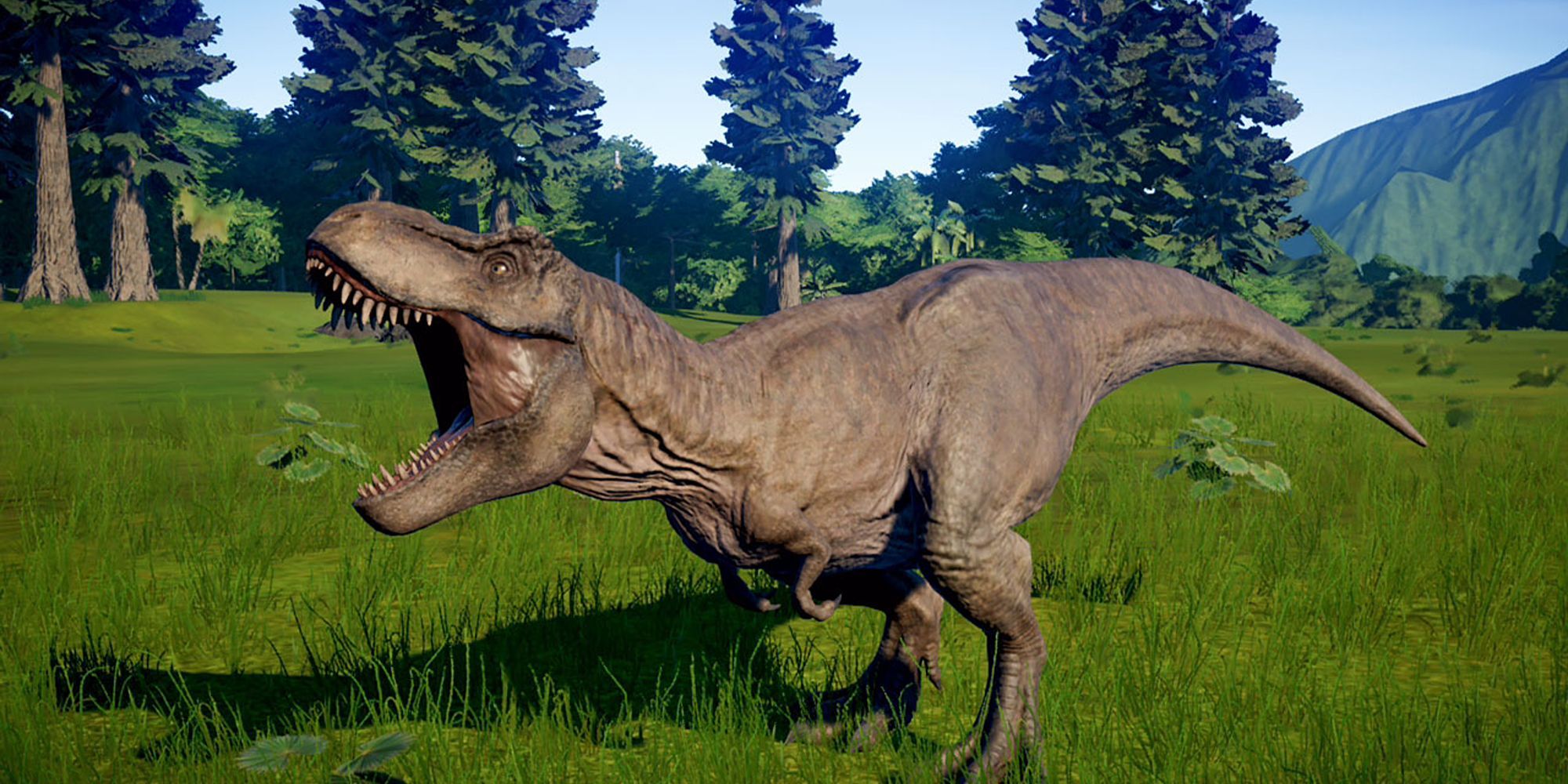
1 'Jurassic World Evolution' (2018)

Jurassic World Evolution finally gave the modern franchise a management game with the scale fans had been imagining since Operation Genesis. Players develop parks across the Muertes Archipelago, send expeditions for fossils, extract dinosaur DNA, manage guest needs, construct enclosures, and balance competing demands from science, entertainment, and security divisions. Familiar characters from the films appear throughout, while the dinosaur roster and visual presentation make the parks feel much closer to the modern Jurassic World fantasy.
Frontier Developments understood that the dinosaurs themselves had to remain the center of the experience. They socialize, fight, hunt, panic, escape, and react to enclosure conditions in ways that make park management feel connected to living animals rather than decorative attractions. Watching a newly created species walk out of the Hammond Creation Lab never really gets old, especially once the park starts filling with dozens of different dinosaurs. Later expansions and the sequel added more complexity, but the 2018 game deserves credit for bringing Jurassic park-building back in such a polished form. It gave longtime fans the control room, the laboratories, and the keys to every enclosure. Whether giving us those keys was responsible is another question entirely.

Jurassic World Evolution
- Released
- June 12, 2018
- ESRB
- t
- Developer(s)
- Frontier Developments
- Publisher(s)
- Frontier Developments
- Engine
- COBRA
- Franchise
- Jurassic World Evolution
KioskNews shows a cleaned-up reading view extracted from the publisher’s page — the original always lives on their site, not ours.