Lai outlines climate resilience plans
TWO-FOLD: The strategies of expanding urban forests and greener transportation networks complement each other in addressing people’s everyday needs, Lai said
By Chen Yun and Jake Chung / Staff reporter, with staff writer


President William Lai (賴清德) yesterday outlined two strategies to prepare Taiwan for a forecasted “super El Nino” later this year and the growing threat of extreme weather.
The first strategy focuses on expanding urban forests to reduce heat and strengthen the nation’s ability to adapt to climate change, while the second aims to improve the resilience of transportation networks by accelerating the transition to greener transport, Lai told the ninth meeting of the National Climate Change Committee.
The government has held more than 30 public information sessions nationwide, drawing more than 4,000 participants, Lai said, adding that the government plans to incorporate the suggestions into a national urban forest plan, which it aims to submit for approval by the end of the year.
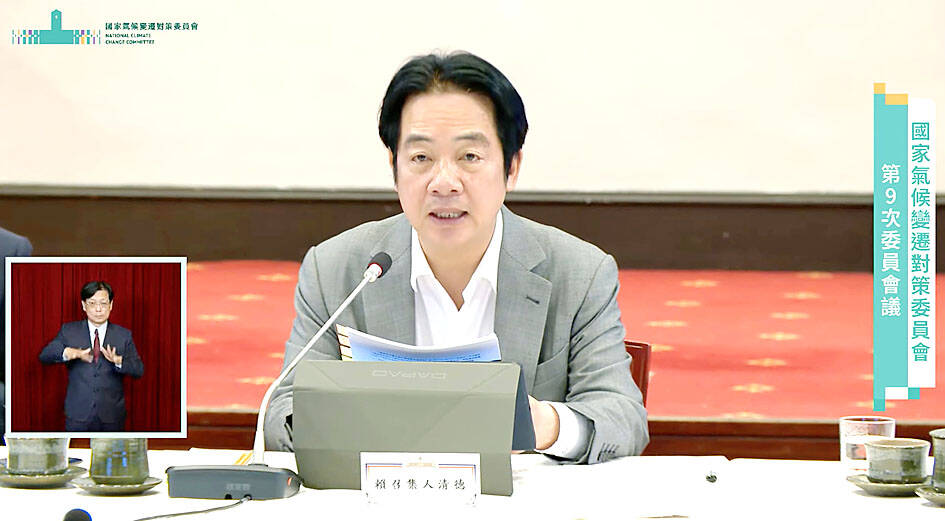
President William Lai addresses the ninth meeting of the National Climate Change Committee in Taipei yesterday.
Photo from the Presidential Office YouTube
Vice Premier Cheng Li-chiun (鄭麗君) is overseeing efforts to draft special legislation for the initiative, he said.
Urban forests can reduce heat and provide shade, absorb air pollution, store carbon and reduce surface runoff, while also providing habitats for wildlife, improving urban landscapes and supporting public health, he said.
The initiative builds on a climate-adaptation plan to expand tree cover proposed in April.
The government aims to connect urban green spaces, community tree belts and natural forests to create a broader network that bolsters the nation’s resilience to climate change.
Promoting urban forests is about protecting human life, as trees serve as an important defense against extreme heat, Lai said.
Taiwan is an island nation with a high concentration of people and industries, making it essential to strengthen the resilience of critical infrastructure, as well as improve system integration to ensure emergency rescue operations, essential supplies and key supply chains remain functional when disaster strikes, he said.
Regarding the second strategy, electric buses account for more than 40 percent of buses operating in urban areas, he said.
The government will encourage private investment in green transportation infrastructure and create an environment conducive to vehicle electrification, Lai said.
The next step is to better integrate urban cooling measures with transport networks to create routes that offer shade, comfort and safety, encouraging people to walk, cycle or use public transportation, he added.
The government will also continue developing sustainable aviation fuel and green ports to help related industries align with international standards and seize opportunities arising from the transition to net zero emissions, he said.
The two strategies complement each other by addressing people’s everyday needs while supporting the nation’s broader economic and transportation goals, Lai said.
Climate governance requires cooperation among central and local governments and the private sector to ensure that Taiwan remains safe, resilient and competitive as it pursues a sustainable future, he added.
KioskNews shows a cleaned-up reading view extracted from the publisher’s page — the original always lives on their site, not ours.