Nothing but highlights: is Power Slap the sport we deserve?
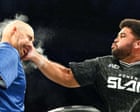
In the days before Power Slap 22, in Belgrade, Serbia, in late July, the organisers of the world’s newest combat sport were taking no chances. At the Crowne Plaza hotel, where competitors were booked to stay, those facing off had been separated by floor, lest any unauthorised violence took place.
It turned out there was little need. The night before the main event, contestants mingled amiably in the lobby and bar. The atmosphere was more specialist sales conference than brewing barroom brawl. In the lobby, I joined Louis “Razor” Robinson, and Ryan “the Punisher” Kenny. “We’re all friends in slap,” Robinson said, earnestly, by way of a greeting. Robinson, a Brit from Stalybridge, Greater Manchester, is 30, stout, intense. Kenny, a Canadian, is 34, lofty, laid back.
The two had become fast friends since they met at Power Slap 17, which took place last October in Saudi Arabia. They host a podcast together, called The Slappy Hour (sample chat: “I had questions for his chin … but the chin question’s gone”). “As the sport’s so new, it’s great to have someone to bounce ideas off,” said Robinson. It’s not uncommon for competitors to destroy each other on stage, then later compare notes. When I spoke to Damien “the Bell” Dibbell, an affable 24-year-old American heavyweight whom many consider the greatest slap-fighter alive, he mentioned that he met his best friend, Duane “the Iron Giant” Crespo, after knocking him unconscious in the second round.
In the Crowne Plaza, conversation veered from recent rule changes – beards were now limited to a few millimetres, much glorious facial hair had been lost – to a controversial incident in Power Slap 21 when Anthony “Kiing” DeFrank had refused to alter his stance after being accused of “turtling”, breaking the rules by tucking his chin flush into his neck to receive the slap. Despite his protests, he was disqualified. Word was he’d never slap again.
Seen from a certain perspective, Power Slap is less a sport in its own right than one whittled down from other sports: think football reduced to penalties or rugby with just conversions. Like boxing, it is a combat sport, separated by gender and weight divisions (from flyweight to super-heavyweight). Unlike boxing, competitors are forbidden from dodging or blocking the blows. Like darts, Power Slap is turn-based. Unlike darts, contestants effectively take turns at being the board.
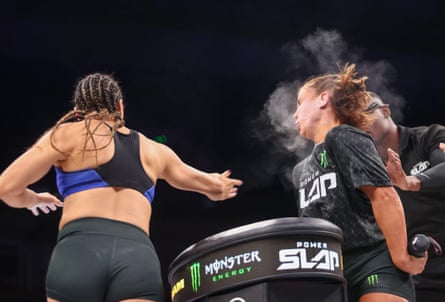
The rules are straightforward. Competitors stand either side of a central podium. In each round, they are permitted to strike their opponent – open-handed, ungloved, cheek only – a single time. After one minute of recovery time, they must allow themselves to be struck back. Bouts range between three and five rounds. Victory can be earned on points – the three judges look for clean technique and the impact a strike makes – but about half are won via knockout. The podium is padded, as the competitors sometimes collide with it on the way down. Behind each competitor stand two catchers to grab them as they fall. When Power Slap introduced a super-heavyweight division, where contestants can weigh the same as an upright piano, they hired professional strongmen for the job.
This is a sport precision-made for our moment. It is designed to be viewed on TikTok and YouTube Shorts and Instagram Reels, one thumb-swipe at a time. Power Slap’s CEO, Frank Lamicella, a former corporate lawyer from New York, will happily admit it was created with short attention spans in mind. The only real buildup comes in the contestants’ walk to the stage and the brief seconds they spend rehearsing their slap before striking, like snooker players feathering a cue. A round lasts a couple of minutes; titles can be decided in seconds. As every action is a potential knockout, the highlights come pre-packaged. It is nothing but highlights.
Since its launch in November 2022, Power Slap has gained 4 million YouTube subscribers. On TikTok it has more than 9 million. Perhaps even more importantly – though admittedly unverifiably – Power Slap claims that clips of the sport have racked up 25bn total views across all online platforms. Its live events are now held almost every month, in locations from Las Vegas to Abu Dhabi.
The founder of Power Slap is Dana White, the man behind the Ultimate Fighting Championship (UFC), whose accomplishments include organising a cage fight on the White House lawn to celebrate the 250th anniversary of the Declaration of Independence. Donald Trump is such a fan of White that he recently asked him to be his press secretary. (He later claimed he was just kidding.)
White expects Power Slap to be the biggest sport in the world soon. In explaining its appeal, he likes to invoke the school playground: no matter what kids are up to, when a fight breaks out, everyone watches. Violence is a universal language. Or, as he told a podcast last year, “everyone understands a slap”. He sells “holy shit moments”, he said, and Power Slap has more than most.
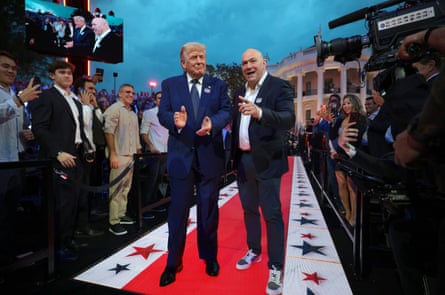
According to White, Power Slap has secured more sponsorship revenue in its first two years than UFC did in its first decade. The companies lining up to plaster their name over Power Slap include energy drink suppliers such as Monster Energy and cryptocurrency platforms such as VeChain. Erectile dysfunction drug company Rugiet recently sponsored Power Slap’s action replay.
Power Slap is not without its detractors, many of whom deem it less a sport than violence for the hell of it. The Brain Injury Association of America has demanded its immediate end. Chris Nowinski, CEO of the Concussion Legacy Foundation, has wondered: “What’s next, ‘who can survive a stabbing?’” Even podcaster Joe Rogan, a noted proponent of UFC – itself criticised for brutality – has called Power Slap “free brain damage”.
In Belgrade, Robinson was confident but apprehensive. Power Slap 22 marked the first time the competition had been held in Europe. It was only his second Power Slap, having risen through the less glamorous UK scene where they slap over a barrel. He wanted to do his local scene proud. His opponent the following day was Pavol “Glitch” Horelican, an undefeated Slovakian. Yet his long-term goal was taking down Dibbell, the Apollo Creed to his Rocky. “He’s an ungodly genetic freak,” Robinson told me. “He’s probably the perfect slap-fighter.” In Serbia, the two went out for dinner, though they were careful not to talk tactics.
Both Robinson and Kenny had been at the hotel for the best part of a week, fulfilling various media duties. One of the challenges, it turns out, for a sport that is both ultra-collegial and ultra-violent, is ramping up aggression when required. For his pre-fight face-off with Horelican earlier that day, Robinson did his best with the required pantomime smack-talk, but his heart wasn’t in it. He’d taken him out to dinner, too, and even taught him how he tenses his muscles to prepare for a slap. (Kenny was aghast: “What the fuck you doing?”)
In the hours before the fight, Robinson told me, he planned to work himself into a state of frenzy by imagining Horelican responsible for the death of his entire family, a sort of John Wick-plus. Kenny, the Canadian, said he would be aiming for a Zen state, through meditation.
Roughly speaking, the history of sport is a story of compression and contraction, or at least the growing understanding that we all have homes to go to. Many events began as endurance contests: boxing matches went on until one person could no longer stand; Test cricket could span weeks. (One match, between England and South Africa, lasted 12 days and was eventually abandoned as England had a ship to catch.) Before the modern marathon, the Victorians followed “pedestrianism”, six-day walking races during which competitors steadily consumed beef tea. By the dawn of the TV age, most competitive sports required only small tweaks, rather than total reinventions, to accommodate themselves to the new medium. Football kick-off times changed, table-tennis balls were very slightly enlarged. Now that we have arrived at the viral clip stage of human culture, we have new requirements. Hence Power Slap.
The first professional slap, as far as anyone can tell, took place a little over a decade ago. A Californian man called Raymond Hernandez ran a touring expo called The Ink Masters Tattoo Show and wanted some non-tattoo-based entertainment. He had recently toured Japan, and remembered a segment from a gameshow that made him laugh: five men in a circle, each taking turns to slap the man to his right – last man standing wins. Hernandez decided two men were enough. Stripping an activity down to its studs was in slap-fighting’s DNA from the start. At an expo in Lubbock, Texas, in early 2015, Hernandez placed the competitors either side of a folding table and explained the entire rulebook. Slap.
The first man slapped the other across the table without much impact; the second slapped back and knocked his opponent out. Hernandez hadn’t arranged for anyone to catch the falling fighter. “We never thought you could get knocked out by a slap,” he has said. The footage, recorded on a smartphone, went viral. ESPN and Jimmy Kimmel got in touch. Slap fighting was born.
It wasn’t until 2017 that Dana White first became aware of slap fighting. Sitting in a meeting room at UFC’s head office in Las Vegas, White, as CEO, was supposed to be discussing matchups and pay-per-view deals, yet his attention was elsewhere: specifically, on a social media video of two large Russian men taking turns to slap each other. The production value was not high – to White it looked like it had been filmed in a barn – yet it had racked up almost 400m views. At the time, those were Justin Bieber numbers.
At UFC, White had built a reputation on turning violence into entertainment. UFC is a very-few-holds-barred cage-fighting contest that combines kickboxing and wrestling undertaken with minimally padded gloves. In 1995, the senator John McCain labelled it “human cockfighting”. By 2001, UFC was on the verge of bankruptcy when White, along with Vegas casino magnates Frank and Lorenzo Fertitta, bought it for $2m. They codified the rules, received athletic commission approval, and self-funded a reality TV show to promote it. It became a juggernaut. In July 2016, the trio had sold UFC for $4bn, though White stayed on as CEO. Not long after seeing the video of the Russian men slugging each other in a weirdly compelling ritual, White called the Fertitta brothers and asked: “Wanna do it again?” It was a historic moment. “I don’t know another example where this has happened, where you take one YouTube video and you build an entire sport around it,” Lamicella told me.
Owing to the pandemic, it wasn’t until March 2022 that they put together a closed-doors pilot in Las Vegas. It consisted of 25 bouts involving more than 40 fighters over two days, and its aim was, among other things, to firm up the rules. By then, other slap-fighting competitions, with varying standards of safety and showmanship, had formed in Poland, South Africa and the UK. There was even an American upstart called SlapFight Championship. Power Slap, with more buying power, snapped up the best fighters.
The rules boiled down to three main fouls. No stepping – meaning no heel lift, feet square, to reduce a strike’s power. No clubbing – meaning no striking with the heel of the palm and no contact anywhere but the cheek. And no flinching. They also limited the number of rounds. At SlapFight Championship, they initially went on until someone won, which usually meant a knockout. One fight lasted 27 rounds before doctors stopped it. One man’s eye had swollen shut.
For Lamicella, the pilot event in Vegas brought home one major realisation: they were going to need a hell of a lot of cameras. More than 30, he reckoned, to capture the full majesty of the sport. “You have the shot, the slow-mo, the super slow-mo, the aerial shot, the shot of the feet, every which angle,” he told me. “It looks simple, but the production budget is huge.”
White followed the same formula as UFC. After obtaining regulatory approval from the Nevada State Athletic Commission, he launched a reality TV show to promote it, Power Slap: Road to the Title, to air on basic cable network TBS. The show did not last long once footage emerged of White, in an irony that was lost on no one, slapping his wife in a nightclub. TBS cancelled the show after the first season.
There is no typical route into “slap”, as those in the sport call it. Robinson, who had never previously competed professionally in any combat sport, discovered it online during lockdown. Then and there, he decided, for reasons he finds hard to fully articulate, to become the best slap fighter in the world. His podcast co-host, Kenny, had been making $30 a match in Canadian wrestling when a recruiter asked him: “You wanna get slapped?” After asking how much it paid – $5,000 with another five if he won – it turned out that, yes, in fact, he did.
Some journeys are more colourful. Peter “the Alligator All G” Truchlik, a former international arm-wrestling champion, was talent-spotted by Power Slap promoters who came across YouTube videos of him bending nails, tearing books and slapping watermelons into oblivion. Vasilii “Dumpling” Kamotskii, who competes in the super-heavyweight division, found the sport by chance. At a strongman festival years before, the Siberian farmer had entered both a slap-fighting and a dumpling-eating contest, won both, and got a new side-hustle and a new nickname to go with it. His first Power Slap paycheque was $25,000 and three goats.
No one I spoke to slapped full-time. Even reigning heavyweight champion Dibbell, who sells slap-based merch (phone cases, hoodies, T-shirts) on the side, has a day job as an air-conditioning repairman. Robinson is a lift engineer by trade. He enjoys the work. It teaches him a lot about people. Surprisingly often, he says, he’ll attend a broken lift only to find those stuck inside have ended up fighting, breaking it further still. “A different type of cage match,” he laughs.
Robinson is short and sturdy, with a trim beard and a seriousness only punctuated by a laugh that seems to arrive by accident, as if he’s been caught off guard. He is a man easily obsessed, and his obsessions make him easy to like. Before slap fighting, his passions flared and burned out. As a younger man, he compulsively collected things such as coins and cards, before moving on to driving simulators, buying everything from the chair to the steering wheel to the gearstick. By his mid-20s, he was on to chess, setting up two monitors at work, one permanently on chess.com, playing four or five hours a day (he has since left that job), before moving on to darts, joining leagues, spending hundreds on the exact type of board and arrow, “trying to work my way up”.
Each time, what ended the obsession was the dispiriting realisation he would never be the best. Chess came to an abrupt halt when he realised he was 20 years late, having failed to start aged five.
His gift for Power Slap had been staring him in the face the whole time. He grew up on a rough estate in Stalybridge, was punched and slapped his fair share, yet he never so much as bruised. His party trick as a teen: to let people punch him as hard as they could. This was not his proudest hour, yet he eventually realised it was his superpower. When he saw slap fighting on YouTube in lockdown, he thought: where can I do this?
He contacted Josh Skeete, who by 2022 was just getting a UK slap-fighting scene, which would later be called BritSlap, off the ground in Liverpool. Skeete had encountered his fair share of resistance. At first, the fighters and wrestlers he contacted to take part told him to get lost; slap fighting wasn’t a sport. Others seemed interested. He hired refs – who could ensure the fighters’ feet didn’t move and the striker’s aim for the cheek was true – and a medical team, yet soon realised he needed to hire catchers, too. At early events, fighters brought along a friend for the job, but they would often get so wrapped up in the action, they’d forget to actually catch the falling fighters.
For his first slap fight, at BritSlap 3 in early 2024, filmed without an audience in a TV studio in Liverpool, Robinson competed in jeans. Looking back, he reckons his technique was all over the place, his body motion all wrong. Still, by the judge’s decision, he won. He was hooked. “I was all in. I was addicted. That was it for me. I thought: now I’m gonna conquer the world.”
He had only told his partner, Shannon Hilton, that he was taking part a few hours before. She spent the intervening time watching YouTube videos, becoming ever-more horrified. “She was livid,” Robinson told me. When he returned and told her he’d won, she had been so angry, she’d already decided to deny him victory, and had told everyone he had lost.
Slap fighting is so new that nearly every aspect of training and technique must be invented. Prior to his second BritSlap fight, in October 2024, Robinson prepared mostly with regular gym work, while also honing his technique by slapping pads held by a friend. He got some odd looks in a PureGym while those around him did pilates. He won his fight, knocking his opponent out with the very first slap. But to become the best in the world, he needed more.
The demands on the slap fighter are particular. Unlike boxing, the rules dictate that competitors cannot place one foot behind the other to help generate force. So Robinson sought out a sport in which competitors throw while seated, and found one: Paralympic discus. He found a Paralympic discus trainer who taught him how to generate torque from his hips. The motion suited him: unlike taller US slap fighters, who prefer horizontal bear-claw swipes, Robinson, at 5ft 7in, is mostly slapping upwards.
His feet weren’t allowed to lift – but what, he wondered, if they could roll? Other slap fighters wore cowboy boots to aid this. Power Slap has no rules regarding footwear. Under the guidance of his personal trainer, James Reed, Robinson began studying the heel-to-toe rolling techniques that surfers use to change direction. He realised the tendon in his slapping arm, his right, was more important than the muscles. In his van, any time he was parked, Robinson pumped a hand-grip with his right. To strengthen that hand, he looked to rock climbers, who do finger exercises with their hands submerged in uncooked rice. “The burn you get off that is insane,” says Robinson, who mostly does it while watching Netflix. When he saw an actor deliver a slap on screen, he’d think: amateur.
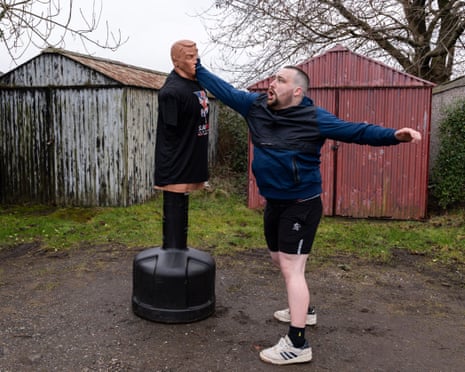
At the gym, he’d slap a punching bag. At night, in his garden, he’d practice by slapping the head of a boxing mannequin. At first, his neighbours thought the sound was gunfire. By BritSlap 5, in May last year, now at Boxpark in Liverpool with a crowd of more than 1,000, Robinson knocked another opponent out with his first slap. Power Slap soon came calling. Skeete became his manager.
To fully appreciate the power of a well-honed slap, I attended the Resilience Training Centre in Stalybridge, a small gym in a former factory that recently became the first in the UK to offer dedicated slap-fight training. I held a pad at head height as a slender young man, who was competing in a forthcoming BritSlap, practised his slaps. With each, my arm was almost wrenched from the socket. I declined Robinson’s kind offer to receive his slaps next, but I can confirm: Robinson’s slaps do sound like gunfire.
When it comes to brain injuries, just how dire is Power Slap? The bad news is that participation virtually guarantees head trauma. But its defenders note that this trauma comes in limited portions: five scheduled blows for title fights. Robinson points out that he might take more than 100 blows in a boxing match. In Power Slap, the most common injuries happen to the slapper – pulled biceps, fractured wrists, even broken arms, because, unlike boxing, where your gloves cushion the blow, the combatant is putting all their force into connecting with a solid object.
Still, the solid object in question happens to be the opponent’s face, and the unabashed aim is to render that opponent unconscious. It is this that drives online views. Power Slap offers $10,000 bonuses for knockouts, typically doubling a fighter’s purse. Robinson has honed his technique to this end. He slaps upwards, making the head move quicker, the brain deforming inside the skull. “The science of knocking someone out isn’t how hard you hit them,” he told me. “It’s how fast you can make that brain accelerate.” Robinson has yet to be knocked out, but notes the “flashes” of white light he gets each time he is struck.
after newsletter promotion
Sometimes, after a knockout, competitors have to be reminded what happened. At Power Slap’s test event, a competitor named Chris Kennedy was knocked unconscious by the first slap he took, and asked, upon waking, “Got knocked out doing what?” After being knocked out in Power Slap 6, in Las Vegas, Sheena “the Hungarian Hurricane” Bathory woke up in an ambulance. She had to be informed why she was in Las Vegas, and that she had won (her opponent had committed a clubbing foul). Slap fighting’s one fatality occurred in 2021, at PunchDown 5 in Poland, when Artur “Waluś” Walczak suffered a brain bleed and died several weeks later. It was his third slap fight of the evening. (“In any combat sport, fighting more than once in an evening is insane,” says Robinson.)
When I asked Lamicella about the dangers, he noted the comprehensive medical tests, including brain scans, that every fighter must pass before each fight. He also compared Power Slap, favourably, to both boxing and UFC. “If our doctor was on the phone, he would tell you the big issues in boxing are not the big knockouts. It’s all the little jabs, the continuous punches, the sparring. That’s where the people really get hurt with things like brain bleeds,” he said. He added that their “hospital transport number” was “a lot lower than UFC”.
One of the few medical studies of Power Slap was carried out by Raj Lavadi, a neurosurgeon at Indiana University School of Medicine, who studied footage of 333 strikes across 78 matches and found 79% of fighters showed an observable sign of concussion. “The frequency with which you observe these signs is shocking,” Lavadi told me.
Lavadi also pointed out the brain scans don’t count for much. “A brain scan is great for certain things,” he said. “But I don’t know if it really protects the fighter. Like, is that it?” Crucially, while a brain scan can pick up conditions ranging from blood vessel abnormalities to fractures, it would not pick up the onset of chronic traumatic encephalopathy (CTE), a degenerative brain disease most likely caused by repeated blows to the head, which is linked to symptoms ranging from memory loss to dementia. “You can really only diagnose that in autopsy,” he said.
At the event in Belgrade, participants spoke about the fighters who could take a slap without much reaction and who could not – who could “eat it”, in slap parlance. They also spoke about a “chin-meter” – like a battery bar they think of depleting with each knockout, making the next knockout more likely. Both Robinson and Kenny mentioned light heavyweight Ron “the Wolverine” Bata. It was time for him to retire, they felt. “He doesn’t look the same, he looks like he gets hurt more and more now,” said Kenny.
When I mentioned the undetectable onset of CTE to Robinson, he said he’d already given himself a knockout limit. Twice and he was out. He understood the long-term impact multiple knockouts could have. He was a father of three, with a fourth on the way. He mentioned a quote from Dibbell, the reigning champion he hoped to topple. “He said, ‘If you’ve been knocked out before, I’m not the man to fight’, and that’s the truth.”
Every Power Slap clip is its own microdrama. Each has suspense and violence, triumph and disaster. It doesn’t much matter if you watch in horror or with glee: the algorithm will note that you watched and will suggest you watch more.
Nearly all begin with a closeup on the face of someone waiting patiently to be struck, and you realise how strange this is. It is not like watching a live execution, but it’s also not like watching penalties. The closest analogue is probably corporal punishment. As they wait, slap fighters grimace manically, looking terrified. This grimacing is often used for the thumbnail images on social media, but it is not just a product of fear. Forming this expression engages their trapezius muscles, or traps, bracing the neck and upper back, aiming to spread the impact of the blow to come. You feel their pain before they do.
The striker will first place their hand on their opponent’s cheek, in a way that almost seems tender, to get their measure before they swing. They will do wind-ups, slowly motioning the real strike, and must declare beforehand when it comes – on one, two or three.
For a sport that doesn’t allow flinching, let alone blocking, slap fighters put just as much training into defence as they do attack. What exactly works seems woolly. Most agree having strong neck and jaw muscles helps, though most don’t copy Hayden “the Cowboy” Johnson, who lifts kettlebells with his teeth. Robinson uses a jaw exerciser. He’s managed to develop bulging temples (“a right meathead,” he laughs).
The hardest part, most will tell you, is training yourself not to flinch, especially for those with a combat background, who’ve spent their lives learning how to dodge. The penalties for flinching are serious. After a flinch, the striker is allowed to slap again. Three flinches in the same round, or four overall, means disqualification. Light heavyweight Logan “Kill Shot” Greenhalgh once lost a title fight to a flinch. Some use the Muay Thai technique of punching water in a barrel, keeping their eyes open through the splashes. It’s perhaps only Aaron “Colossus” Turner who trains with snakes, putting his face to the glass and trying to stay still when they strike. (It didn’t work – Turner was disqualified in his last match for flinching.) Most, including Robinson, just get someone to slap them with foam pool noodles.
Yet even here, Robinson has innovated. What if, he wondered, he could take the impact out of a slap by moving his face, rolling with it, at the exact moment of contact? Could it be done? In that fraction of a fraction of a fraction of a second? He looked towards Formula One, where drivers train their reactions with a multicoloured three-pronged spinning device – they must grab the colour of the prong their coach calls out while it spins in mid-air. “We’ve spent hours doing that,” laughs Reed, his trainer. In real time, as he is struck, it seems as if Robinson is flinching. YouTube commentators always claim it. It’s only in slow motion you realise he isn’t. He moves at the millisecond a blow arrives. Robinson now proudly calls this his signature move.
The most-watched Power Slap clip is an 18sec YouTube short, with almost half a billion views. It is not a knockdown. It is called “Eviahn ATE this slap with ease!” Eviahn “the Waterboy” Scott takes a blow, and celebrates wildly, like a goalkeeper who’s just pulled off a fingertip save to preserve a precious lead. The camera cuts to a giggling Dana White, looking like a child who’s seen an adult almost slip over. Then it’s time for the replay. In Power Slap, the slow-motion replays almost always focus on the exact motion of impact, the flesh on the face not so much absorbing the blow as spreading it, rippling from it, like a sheet caught by a breeze.
The second-most-watched clip is a knockdown. It has been viewed 371m times, this time on TikTok. It is called, “Jewel Scott #knockouts hit different #powerslap #slap”, and sees Scott’s opponent, Anthony Green, drop to the ground like a ragdoll.
We think of dopamine as a pleasure chemical, yet neuroscientists will tell you it is not. It is, instead, the molecule of desire and anticipation. It makes us watch to the end, it makes us flick to the next, but it does not bring joy. It is also why they compare social media’s infinite scroll to slot machines.
At the Belgrade Arena, on 30 July, several thousand spectators filed in for PowerSlap 22. The sport is still new in Europe. In Las Vegas, I’m told, the vibe is a cross between British darts and American wrestling, the ramp-up between each slap eliciting hollers and cheers and boos. In Belgrade, the mood was one of amused interest.
Before it began, young fans flooded to the front to beg autographs from a couple of fighters walking the floor. Once the lights went down, it took on an air closer to a Vegas magic show than a prize fight. A light show strobed, a black stage without borders in the arena’s centre was lit up by neon podiums at either end – Power Slap’s equivalent of a fighter’s corner, where each competitor would retreat for one minute to recover after each blow – and in the centre, a glowing podium rose from the ground to a height of around 3ft, the padded plinth over which all slaps would take place.
A sharply suited MC kicked things off by introducing the sponsors. The night’s “monster knockouts”, we were told, were brought to us by Monster Energy (“unleash the beast!”). VeChain was the crypto token partner – and also the medium in which the $10,000 knockout bonuses would be paid. The night’s prediction odds were brought to us by Polymarket.
The first fight was both the most thrilling and disturbing, as Darren “the Tarantula” Godfrey, bearded and liberally tattooed, took on the fresh-faced Daniyar “Shreder” Toktarov in the middleweight division. Both wore trainers, Power Slap-branded tracksuit bottoms, and Power Slap-branded T-shirts. Godfrey was knocked down in both the first and second rounds, something most fighters don’t recover from. On the second occasion, Godfrey stayed down until the referee counted to eight. He retreated to his corner, then returned to the podium. On Godfrey’s second slap, he knocked Tokarov out, his head connecting sickeningly with the central podium as he dropped. It was replayed in slow, then super slow, motion on the arena’s screens. No one in the audience appeared to wince. Most clapped and cheered.
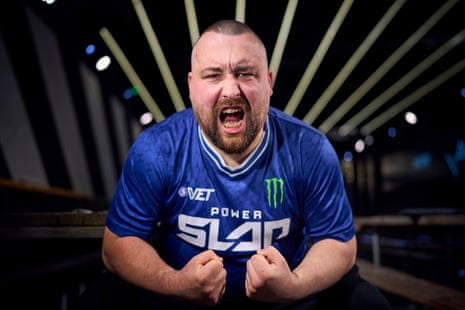
When Robinson entered the arena, he set about stirring up the crowd, whipping both arms upwards. The lights strobed, La Roux’s In for the Kill vibrated from the speakers. The arena’s screens listed the circumference of the competitors’ necks (19in for Robinson, 20in for Horelican) and the size of their hands, measured thumb to pinky (8in to 9.5in). Horelican, who had won the coin toss, slapped first, but to little effect. The strike wasn’t clean, hitting Robinson on the neck: a clubbing foul, a point deduction.
Before his strike, Robinson rubbed his hands in chalk. He gave Horelican a mirthless wink. And then, drawing on all his 6am starts, his hours of studying footage, his months of tendon training, his garden slapping, he put it all into a single motion that lasted milliseconds, a sharp twist of torso, a brutal whipping blow upwards.
Horelican went down, blood gushing from his mouth. Robinson raised both palms, the universal symbol of: are you not entertained? Robinson had burst a blood vessel in his opponent’s mouth – remarkably, a Power Slap first. Medical staff wiped the blood from his chin, but they couldn’t stem the bleeding. Horelican didn’t seem dazed, but a replay showed his eyes rolling back, sickeningly, as he fell. He couldn’t carry on.
For several minutes after Horelican left the stage, Power Slap staff half-heartedly mopped the blood from the arena’s floor by pushing towels with their feet. Robinson had won, one slap closer to the title. Not long after, he called Shannon, as he always does post-fight, to let her know he was OK.
When I spoke to Robinson recently, he was one step closer still, having recently competed in Power Slap 25 in Abu Dhabi, beating Jujhar “Tiger” Singh in the second round. Though he wouldn’t get a $10,000 knockout bonus – his first slap failed to knock his opponent down and Singh was disqualified in the second round after consecutive clubbing fouls – he had moved up two places in heavyweight rankings, to six. His partner was still coming around, he said, slowly but surely. This time, she’d even allowed a viewing party at their home. Though he added: “I was told she was basically peeking from behind the door in the kitchen on the first slap.”
Her view of the sport likely wasn’t helped by another serious injury a month before. At Power Slap 23 in Texas, Jake “Rock Hard” Hager was left with one eyeball ruptured and a retina detached. His team stated that, after two surgeries, he retained some sight in the eye. Dana White described it as one of the most severe injuries in the sport he had seen.
Not long ago, I spoke to Shannon. She still remembers her first reaction to the sport: “How can someone stand there and take a blow?” Before every fight, she says, an entire week of dread, a 50/50 chance that her partner gets hurt. But she remembers, too, his early determination. Even back when Robinson was in BritSlap, “he’d watch Power Slap and say: ‘I’ll be there one day.’ I said there’s no way you’re going there! It looks brutal.” But, so far, he’s proved he can do it. “I’ve never had a reason to doubt him. I think that’s what changed my opinion.”
Still, at the recent watch party, she couldn’t stand to watch him be hit. She turned her back to the screen, and asked those around her: “Is he still standing? Is he still standing up?” She is yet to see him compete in the flesh. But if Power Slap was held in London, she allows that she might. Their eldest daughter, who’s 11, has become quite the fan. “She loves it,” says Robinson. “She thinks I’m some kind of local celebrity. You know: my dad’s on Google!” It sounded almost quaint.

The Long Read magazine crime issue: out now
A special true-crime edition of the Long Read magazine brings together 10 of our most gripping tales from the past decade. To celebrate its launch, join us for an evening with contributors Imogen West-Knights and Samira Shackle at Funny Weather Books in north London on 25 November.
KioskNews shows a cleaned-up reading view extracted from the publisher’s page — the original always lives on their site, not ours.