Kevin Paquette: The PQ wants a referendum? Quebec barely functions as a province
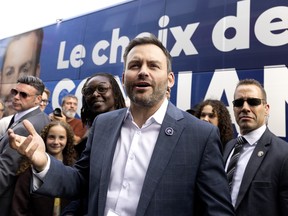
Today, Quebecers will be called to the polls to elect their next government. If trends hold, the Parti Québécois should, by all indications, win this election, with some recent polls even placing it within reach of a majority.
Sign In or Create an Account
This has been a rather strange election campaign. The Parti Québécois, which has been leading in the polls for nearly three years, has not faced the barrage of attacks one might have expected. Its proposal to hold a referendum on Quebec independence during a first term has failed to stir much passion, and the issue does not seem to have mobilized federalist voters as much as many observers might have expected.
The story of the campaign has been the Quebec electorate’s desire for change. Tired of the Coalition Avenir Québec’s broken promises, Quebecers were desperately looking for a credible alternative to Premier Christine Fréchette’s party.

Columnist Jesse Kline keeps you up to date with what’s happening in Israel and the effects of antisemitism on life here in Canada. Friday mornings.
By signing up you consent to receive the above newsletter from Postmedia Network Inc.
A welcome email is on its way. If you don't see it, please check your junk folder.
The next issue of Channel Israel will soon be in your inbox.
We encountered an issue signing you up. Please try again
It’s a distinction political observers need to understand. A victory on Monday, even a majority, should not be confused with strong support for the referendum process. Quebecers may be preparing to give PQ leader Paul St-Pierre Plamondon a mandate to govern, but that does not mean they are giving him a mandate for independence.
The modern Quebec voter is extremely cynical about politicians and about the government’s ability to deliver on what it promises. Before being convinced that Quebec is ready to take its destiny into its own hands, voters will want their government to prove that it can first get itself back in order.
There is nothing particularly encouraging about Quebec’s ability to govern itself when we look at the state of public services and the province’s chronic inability to deliver major projects, whether in infrastructure, technology or elsewhere. For all the talk about Quebec’s political future, the most immediate problem for most voters is that they have lost confidence in the government they already have.
The mandate given to the Parti Québécois on Monday will first and foremost be one to clean things up and restore confidence in Quebec’s ability to provide quality public services. It means that, before asking Quebecers to believe that their government can take on the responsibilities of an independent country, the PQ will have to show that it can properly handle the responsibilities Quebec already has.
That is the main priority the PQ will have to tackle if it wins government. And that is ultimately what voters will judge it on.
Paul St-Pierre Plamondon’s path to the premier’s office has not been without setbacks. We have to remember that when he took over the PQ leadership in 2020, people were already writing his party’s obituary, expecting it to be nearly wiped off the electoral map in 2022.
But against all odds, PSPP held the fort. He stood his ground and owned his ideas, even the most unpopular ones, such as holding a referendum during a first term. That is a large part of what appealed to many voters disappointed with the CAQ. These are voters who had been promised the world and who felt the government never kept its commitments.
In that context, PSPP gives the impression of being guided by a real compass and of not being the type to govern by polls. That image has served him really well in opposition. But governing will test him. We will see whether the same political courage applies when the difficult choices involve spending, bureaucracy, public-sector unions and the very Quebec model that needs to be changed.
It’s clear that, for the PQ, the hardest part is still ahead. St-Pierre Plamondon will have to turn the desire for change into real results. And he’ll need to respond concretely to the frustration of taxpayers, who feel they are not getting enough for their money.
All of this will happen in an extremely complicated context for the PQ leader. Public finances need to be restored. Spending cuts will be necessary to return to a balanced budget, especially if the PQ wants to present independence as an economically credible project.
The trade war with the United States will also add another layer of difficulty. Quebecers have been strong supporters of Ottawa’s response to Donald Trump’s tariffs, and they remain deeply hostile toward the U.S. president. That puts PSPP in an awkward position. Any Quebec premier has an interest in building relationships with international partners, which will be truer with a sovereigntist leader preparing for a referendum. But in the current climate, even the appearance of getting closer to the Trump administration can come at a political cost.
We saw how sensitive that can become this weekend when Martin Patriquin reported in the Montreal Gazette on leaked text messages indicating that a meeting involving St-Pierre Plamondon at the U.S. State Department had been scheduled before being cancelled. The PQ has disputed the interpretation surrounding that meeting but the reaction to the story showed how hard it will be for PSPP to keep a working relationship with Quebec’s largest trading partner while dealing with an electorate that wants its government to stand up to Trump.
He will also find himself, in 2028, at the bargaining table with Quebec public-sector unions, one year before the target year of 2029 for holding the referendum, when Donald Trump leaves the U.S. presidency. Unions have generally been natural allies of the PQ and an important mobilizing force in the YES camp.
It will be an important balancing act for the PQ to negotiate an agreement that respects the Quebec government’s ability to pay while also keeping progressive sovereigntist forces united. The political interests of the government he will be leading and those of the referendum coalition he will eventually need will not always point in the same direction.
So there will be a great deal of work to be done. The problems are numerous and expectations will be high. PSPP has no room for mistakes.
The greatest strength of St-Pierre Plamondon’s political rise has been that he could present himself as the politician who held his ground and said what he believed even when it was unpopular. As premier, he’ll need to govern by the same standards.
He won’t be able to settle for being a government like any other. And the PQ won’t deliver better results simply because the person at the head of government has changed. They’ll need to change the way things are done.
And if the PQ ends up with a majority, there will be very few people left to blame if it doesn’t work.
Kevin Paquette is a consultant at Crestview Strategy. He was a political advisor to Quebec’s Minister of Public Security and president of the Coalition Avenir Québec’s youth wing.
Join the Conversation
This website uses cookies to personalize your content (including ads), and allows us to analyze our traffic. Read more about cookies here. By continuing to use our site, you agree to our Terms of Use and Privacy Policy.
KioskNews shows a cleaned-up reading view extracted from the publisher’s page — the original always lives on their site, not ours.