US bit barn boom sees energy needs grow 10x as fast as grid capacity
Operators face longer connection waits and a growing need to bring their own electricity
Datacenter power consumption in the US is growing roughly ten times faster than grid capacity, meaning facilities may soon need to find a large chunk of their own electricity from other sources.
Surging demand for AI infrastructure is driving a wave of new server farms across America, but it is exposing long-term underinvestment in the grid networks required to deliver power where it's needed.
Insurance broker Howden calculates that datacenters would need to source up to 58 percent of their power off the grid by 2030 just to keep their share of grid capacity from growing.
REG AD
Gartner warned in June that the energy consumed by AI datacenters is on track to grow 26 percent this year, and grid supply may be unable to keep pace with demand by the end of this decade.
REG AD
Howden's analysis of data from the US Energy Information Administration (EIA) and S&P Global found that since the year 2000, power being fed to data campuses has risen 19 percent a year on average, while the electricity grid expanded capacity by just 2 percent per annum over the same period.
Datacenters' share of US grid capacity was circa five percent in 2025, up from 0.1 percent in 2000 – a 50-fold increase.
Management consultancy Bain & Company issued a report two years ago warning that energy companies must switch gear and invest in building out grid capacity faster, as energy draw by server farms is expected to more than double by 2030.
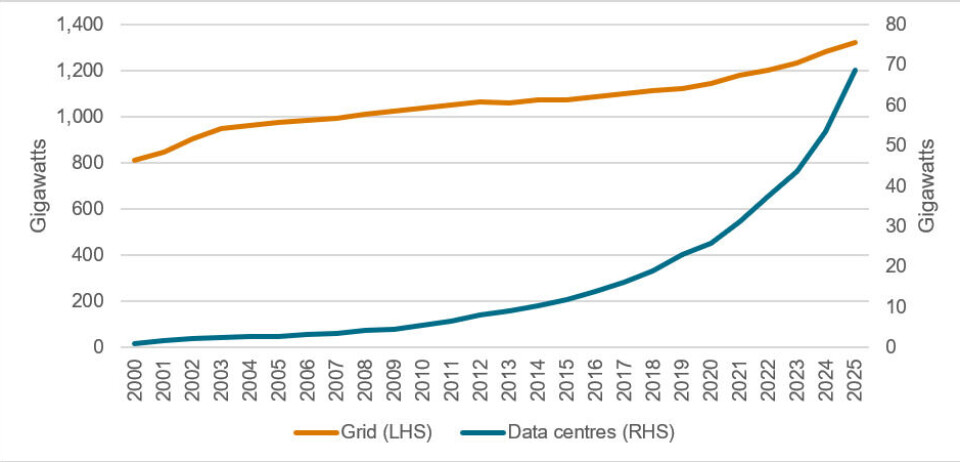
This doesn't mean that datacenters are in danger of eating all of America's electricity, at least not in the immediate future. The graph makes it appear that the two lines are about to cross, but the chart uses different scales: 1,400 gigawatts on the left axis for grid capacity, versus just 80 on the right for datacenters.
Keeping datacenters at five percent of grid capacity requires 110 gigawatts of behind-the-meter capacity by 2030, Howden estimates – an expansion it considers unlikely. Instead, it expects a combination of greater reliance on the grid, slower development at power-constrained sites, and alternative supplies.
For the largest, most power-constrained projects, Howden warns that grid delays of two to six years could mean $800 million to $2.4 billion in forgone revenue.
"Power availability is becoming one of the defining challenges of the datacenter boom," says Howden head of Natural Resources Stuart Adam.
"As demand for AI infrastructure accelerates, developers are increasingly looking beyond traditional grid connections to secure the electricity they need."
REG AD
Howden's business is insurance, and so Adam also notes that on-site generation introduces new operational and financial exposures, as operators take greater responsibility for their power infrastructure. ®
KioskNews shows a cleaned-up reading view extracted from the publisher’s page — the original always lives on their site, not ours.