Why a Pune family of lawyers spends months turning paper into Ganesh idols
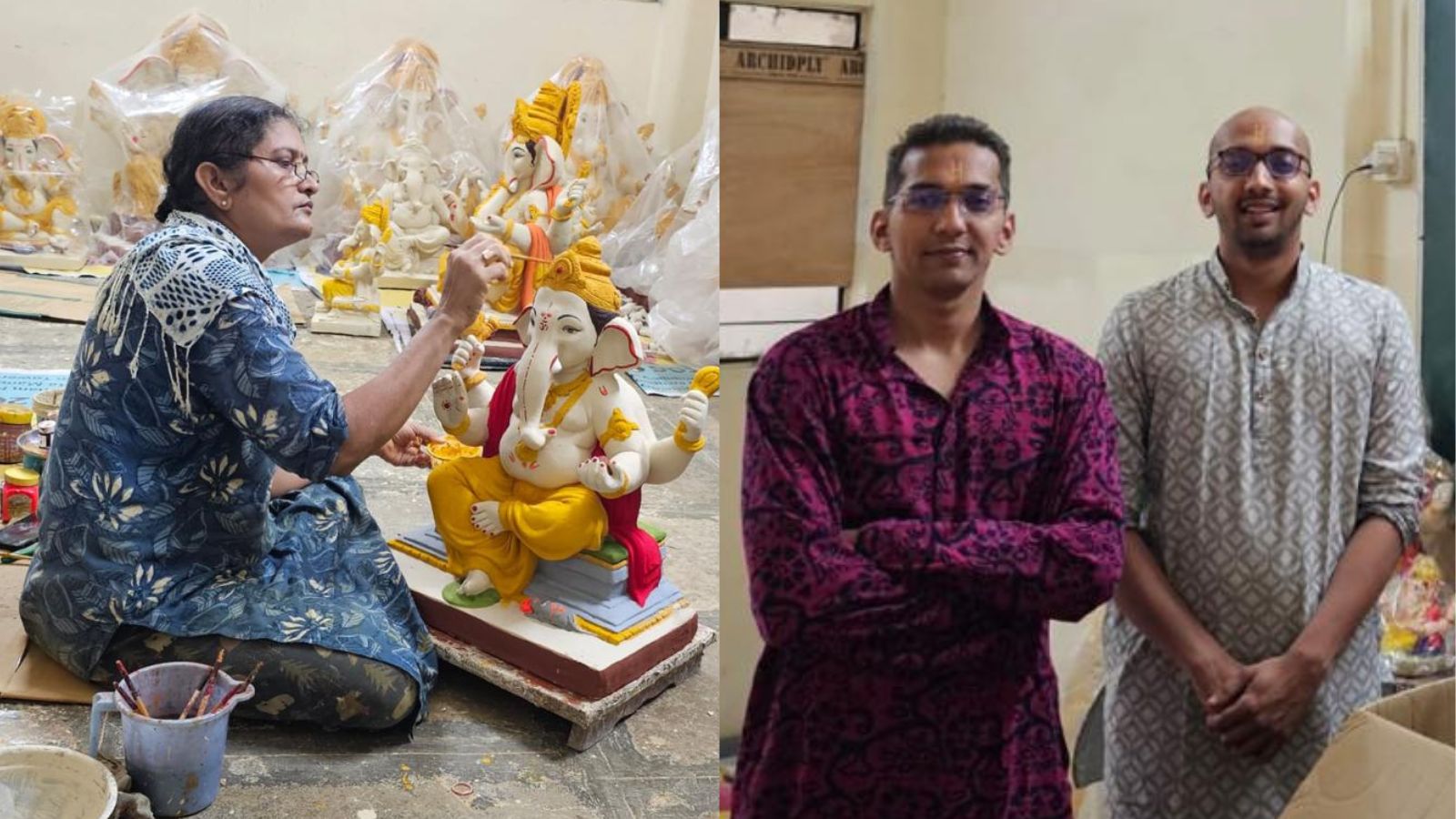
Surekha Agarkar and her sons, Ashish and Adesh—all lawyers—have been making eco-friendly Ganesh idols entirely by hand. (Photo: Special arrangement)
In a small workshop on Pune’s Prabhat Road, opposite Deccan Gymkhana, a family of practising lawyers spends months each year doing something far removed from courtrooms and case files—hand-moulding paper mache Ganpati idols that dissolve completely in water within minutes.
Surekha Agarkar, 54, and her sons, Ashish, 36, and Adesh, 31—all lawyers—have been making eco-friendly Ganesh idols together since 2004, entirely by hand, with no outside help. Surekha’s husband, Pramod Agarkar, 60, a goldsmith, and her 78-year-old mother, Vijaya Gade, contribute equally.
The idea grew out of the family’s spiritual alignment with their guru, who has long championed environmental causes. “POP [Plaster of Paris] idols that do not dissolve in water are really detrimental to the environment,” says Ashish, who runs a legal practice along with his younger brother. “We had a brainstorming session and our guru, who heads the Anirudha Upasana Foundation, guided us on how to make Ganesh idols of paper mâché.”
Paper became the first choice of material because, explains Surekha, scores of devotees use it to write the name of God as jap, leading to the accumulation of reams of paper. “It was decided to recycle this paper for the idols,” she says.
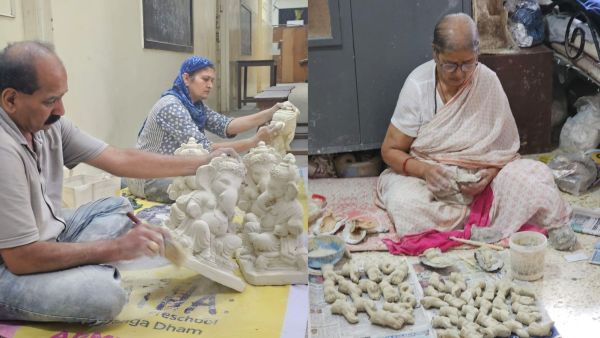 Surekha Agarkar’s husband, Pramod, a goldsmith, and her 78-year-old mother, Vijaya Gade, also help make the paper mache Ganesh idols. (Photo: Special arrangement)
From seva to a family mission
What began as a small community seva, with believers gathering to make idols for each other, gradually expanded to serve people beyond their immediate circle. Surekha and her family decided to make this effort a dedicated family cause.
Early idols, Ashish admits, were rough by market standards. “The paper mache idol was quite rudimentary compared to shadu mati (natural clay) or POP. Initially, when we started in 2004, people found it difficult to take to that idol even though it was eco-friendly,” he recalls. Now, after over 20 years of refinement, the family produces idols ranging from seven inches to five feet tall.
The process stretches across nearly a year: it begins post-Diwali with soaking paper and deliberating on new designs, picks up pace by January-February with mould-making, a task Surekha personally oversees, followed by casting, sanding, attaching separately moulded hands, and finally, painting.
Story continues below this ad
The material used is sustainable: no chemical colours, only natural pigments like Multani Mitti, gheru (red ochre), and haldi (turmeric), along with paper and organic glue. “The idol is dissolved in 15 minutes, maximum,” says Ashish.
Selling sustainability
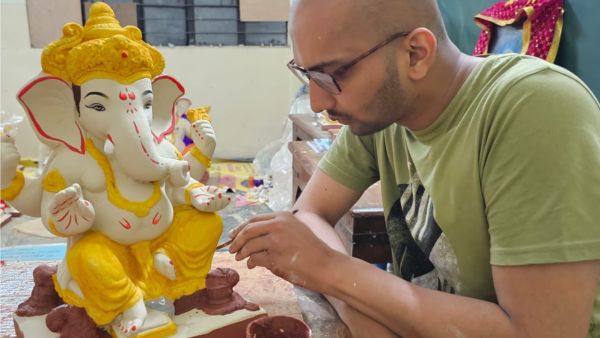 Only sustainable materials are used to make the Ganesh idols: Just natural pigments like Multani Mitti, gheru (red ochre), and haldi (turmeric), along with paper and organic glue. (Photo: Special arrangement)
The family makes around 150 to 200 idols annually, almost all of which find buyers, entirely through word of mouth, without any social media presence or formal marketing. Many are sold through Eco-Exist, an environmental organisation the family has been associated with since 2014.
Profit, Ashish says, was never really the point. “It’s a very informal arrangement…we don’t really account for profit,” he says, noting the family has yet to formalise pricing structures, largely because commercialising the process too conventionally risks diluting its real purpose. “This message of sustainability, we feel, might get lost,” he says, if the focus shifts purely to selling idols.
A law degree in her 40s
Incidentally, Surekha earned a law degree in 2019, long after her two sons had graduated from law college, to further her passion for sustainability. “I have always been very motivated when it came to education. I got married after my 12th and then went on to complete my BCom, followed by MCom, BA, MA, and then law. The last was to learn about environmental rules and regulations and the roles of authorities and politicians in their implementation. I feel this knowledge is very important for anyone who wants to pursue environmental causes,” she explains.
KioskNews shows a cleaned-up reading view extracted from the publisher’s page — the original always lives on their site, not ours.