S’pore makes $118m push to manufacture materials from living organisms under bioeconomy initiative
SINGAPORE - Singapore wants to harness nature’s living “factories” to produce enzymes, chemicals and materials - some of which can replace fossil fuels - and is making a $118 million push to grow its bioeconomy sector.
Examples of these products include sustainable aviation fuel, which can replace petroleum-based jet fuel. Polymers made from castor oil can be a substitute for plastics made from crude oil, while the use of biomethane for energy can reduce the need to burn fossil-based natural gas.
The Bioeconomy Funding Initiative was announced on Oct 5 by Education Minister Desmond Lee at the launch of the National Centre for Engineering Biology.
The effort is driven by the Economic Development Board (EDB) and A*STAR. Its launch comes amid projections for how the global market for such materials and chemicals could exceed US$200 billion by 2030.
This initiative is Singapore’s largest funding tranche for developing the bioeconomy sector in Singapore, according to the government agencies.
The initiative joins existing funding of about $82 million, and contributes to a total commitment of some S$200 million for bioeconomy-related projects over the next five years.
EDB’s managing director Jermaine Loy said at the launch event at the National University of Singapore (NUS) that the promising outlook for the bioeconomy is driven in part by the rollout of regulation spurring firms to look for alternatives that replace raw materials dependent on fossil fuels.
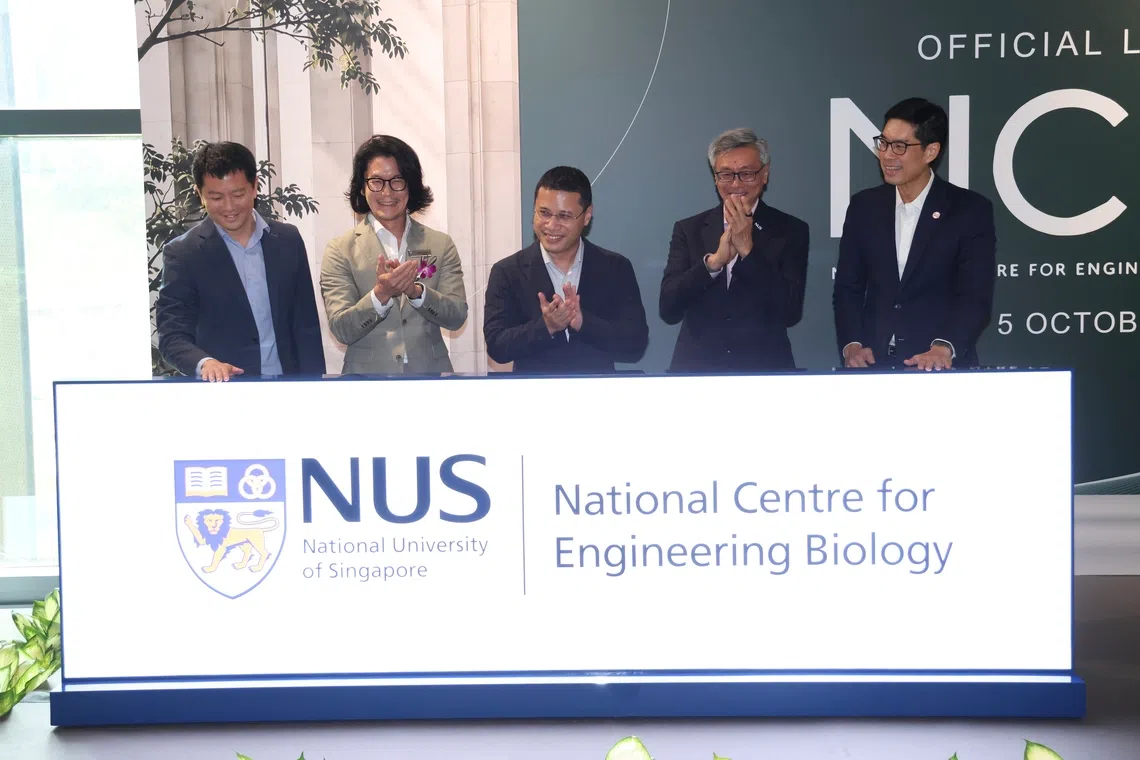
(From left) Tan Wee Chee, Deputy Chief Executive of the National Research Foundation; Zhang Xu, Executive Director of the Centre for Synthetic Biology and Director of the Synthetic Biology R&D Programme at NUS; Desmond Lee, Minister for Education; Tan Eng Chye, President of NUS; and Beh Swan Gin, Chairman of EDB, at the launch of the National Centre for Engineering Biology.
PHOTO: LIANHE ZAOBAO
Biology has also increasingly been used to make products that perform better than existing products, in areas such as agricultural crop protection, and consumer care, he added.
Against this backdrop, the fund will build research capabilities in areas where Singapore has an advantage in to tackle challenges flagged by local companies, start-ups, and investors. For instance, its position in South-east Asia is also where most of the world’s palm oil is produced.
“Our ambition is for the bioeconomy to become a new source of growth for Singapore,” said Loy.
He said the bioeconomy could create new business opportunities in the development of specialty chemicals and advanced materials,create good jobs and new career pathways for Singaporeans.
EDB said this emerging area could also strengthen Singapore’s energy and chemical sector, which today accounts for about 20 per cent of the country’s total manufacturing output.
EDB vice-president for chemicals and materials Kelly Lai said Singapore’s strong energy and chemicals sector, as well as related expertise in synthetic biology and research and innovation, will enable the country to better tap the opportunities in the bioeconomy.
Said Lai: “Home to a diverse range of companies — from global majors to specialised players — with a long-term presence here to serve demand across Asia, (the sector) has the depth and scale to pursue new growth pathways.
“The bioeconomy gives these companies new tools to diversify raw material sources, develop novel high-value products, and produce more sustainable chemicals and materials, supporting Singapore’s broader push into specialty chemicals and advanced materials.”
For instance, researchers at the existing HH@NUS SINERGY Laboratory - a partnership between the NUS and industrial polymer firm Huahao Chemical - have found a way to use living cells as factories to make building blocks for a polymer in fibres and fabrics.
The initiative will focus on four areas.
The first aims to transform underused agricultural waste from producing biodegradable fuels, such as as crude glycerol from palm residues, into cheaper, sustainable raw materials.
The second seeks to engineer microbes and enzymes by using advanced tools including artificial intelligence.
The third looks at improving industrial-scale processes using smart monitoring and digital technologies to reduce waste and lower costs.
The last area will find the most effective ways to produce commercially-relevant products such as high-grade synthetic rubbers and cosmetic ingredients.
Projects under the initiative will be managed by the new Bioeconomy Innovation Office in A*STAR, which will help promising innovations reach adoption and commercialisation.
A*STAR’s interim programme director for the Bioeconomy Innovation Office Wong Min Hao said the fund will also help boost the resilience of supply chains by finding materials that can reduce a heavy reliance on petrochemicals.
He cited the region’s unique waste streams of palm oil, cassava, tapioca and rice, as areas Singapore could look into. If successful, this could mean that chemicals used to dye items could use such ingredients instead of petrochemicals, he added.
Ultimately, the fund aims to push for more commercial outcomes at the end of five years, said Wong.
New centre for engineering biology
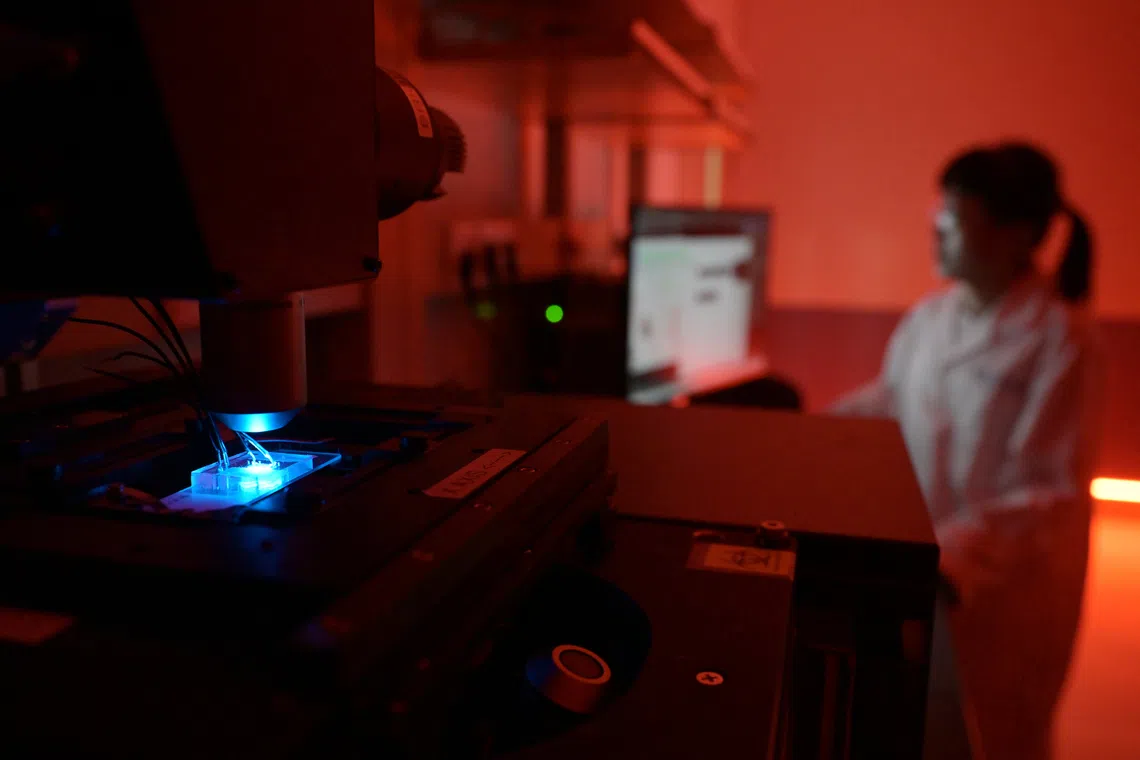
The National Centre for Engineering Biology will develop knowledge and technologies in engineering biology for AI-guided sustainable biomanufacturing of chemicals and materials.
ST PHOTO: NG SOR LUAN
Meanwhile, the National Centre for Engineering Biology – hosted at NUS – will nurture scientists and innovators that will shape the future of the field that programmes and harnesses living cells, said Lee.
He was speaking at the opening of the inaugural Singapore Engineering Biology Week that brings together those in the field.
He added: “Students and researchers will work across disciplines and institutions, and engage industry on real-world needs.
“In doing so, they will deepen their expertise and make an impact.”
Officially opened on Oct 5, the centre is supported by a National Research Foundation grant of nearly $50 million, awarded over seven years starting in 2023.
It brings together Singapore’s institutes of higher learning, including NUS, Nanyang Technological University, and the Singapore Institute of Technology.
The centre will focus on building knowledge and technologies in engineering biology for the sustainable biomanufacturing of specialty chemicals such as flavour and fragrance compounds.
Its ongoing flagship project, led by NUS, focuses on AI-guided engineering biology for sustainable specialty chemicals, with the aim of engineering microbes and enzymes which can convert renewable feedstocks – organic materials used to create fuels and other chemicals – into specialty chemicals.
Said the centre’s executive Matthew Chang: “Our goal is to enable more sustainable ways of making products that society depends on, using renewable feedstocks and cleaner manufacturing processes.”
More than 150 researchers, students, and professional staff involved contribute to the centre’s work across partner institutions.
Recruitment is ongoing for about 50 more roles, the centre’s institutes of higher learning said in a statement.
These roles span principal investigators, postdoctoral researchers, and graduate students, alongside technical, engineering, laboratory support, and centre management staff.
KioskNews shows a cleaned-up reading view extracted from the publisher’s page — the original always lives on their site, not ours.