Amid Record Turnout In Israel, A Look At Past Performance Of Arab Parties
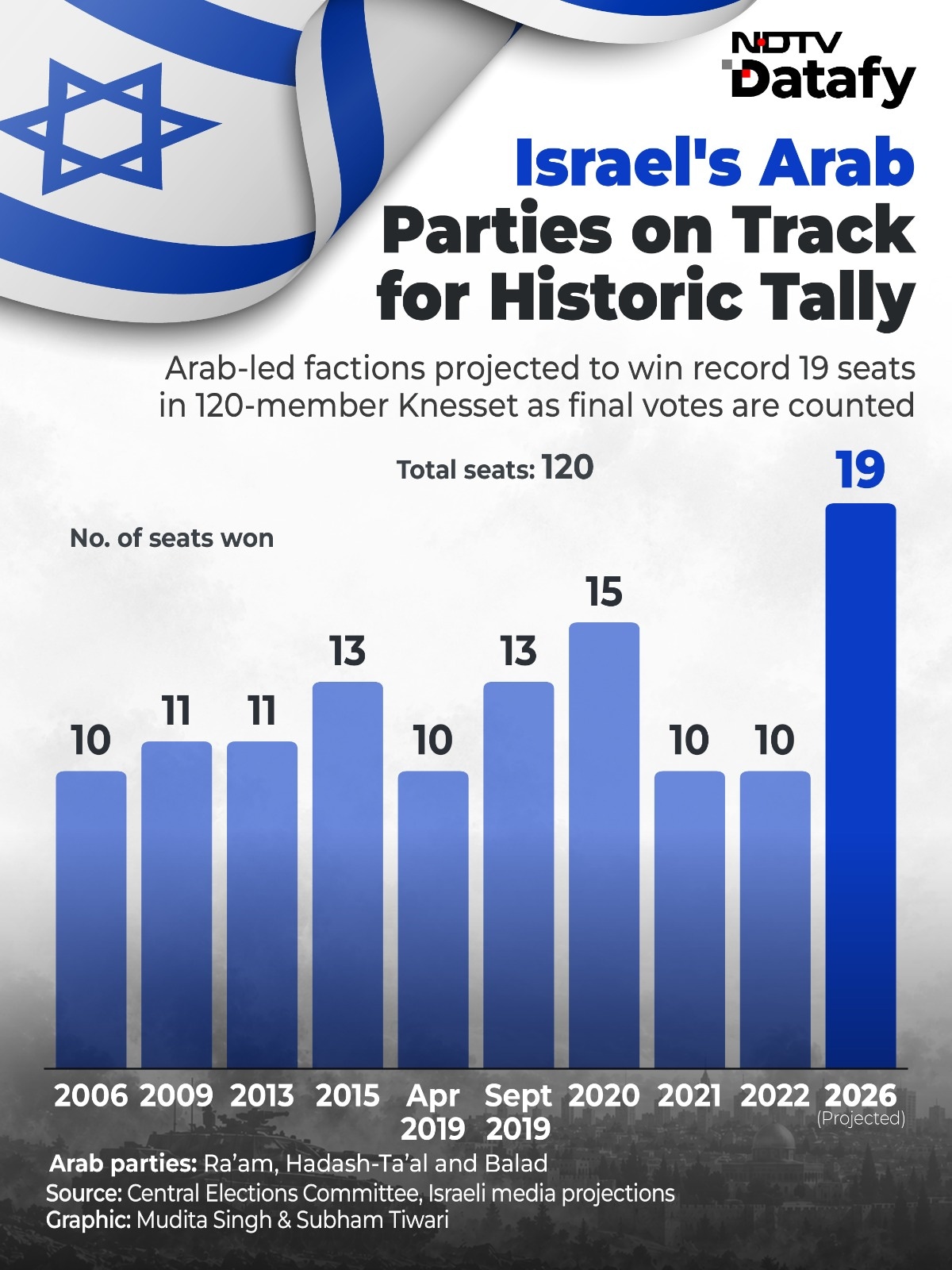
Israel's Arab parties are projected to win a historic 19 seats in the 120-member Israeli parliament as Arab citizens voted in record numbers to express their opposition to Prime Minister Benjamin Netanyahu's government.
Arab citizens make up roughly 21 per cent of Israel's 10.24 million population. They include Muslim, Christian and Druze communities.
READ | From 'Intifada' To Kingmaker: Israel's Arab Parties' Momentum Post Hamas Attack
Final results are yet to be announced. After nearly 90 per cent of votes were counted, two predominantly Arab parties were poised to win a record 19 seats. The left-wing Joint List was projected to win 12 seats, and the socially conservative United Arab List, or Ra'am, could win seven seats, putting them in a kingmaker's position in forming the next government.
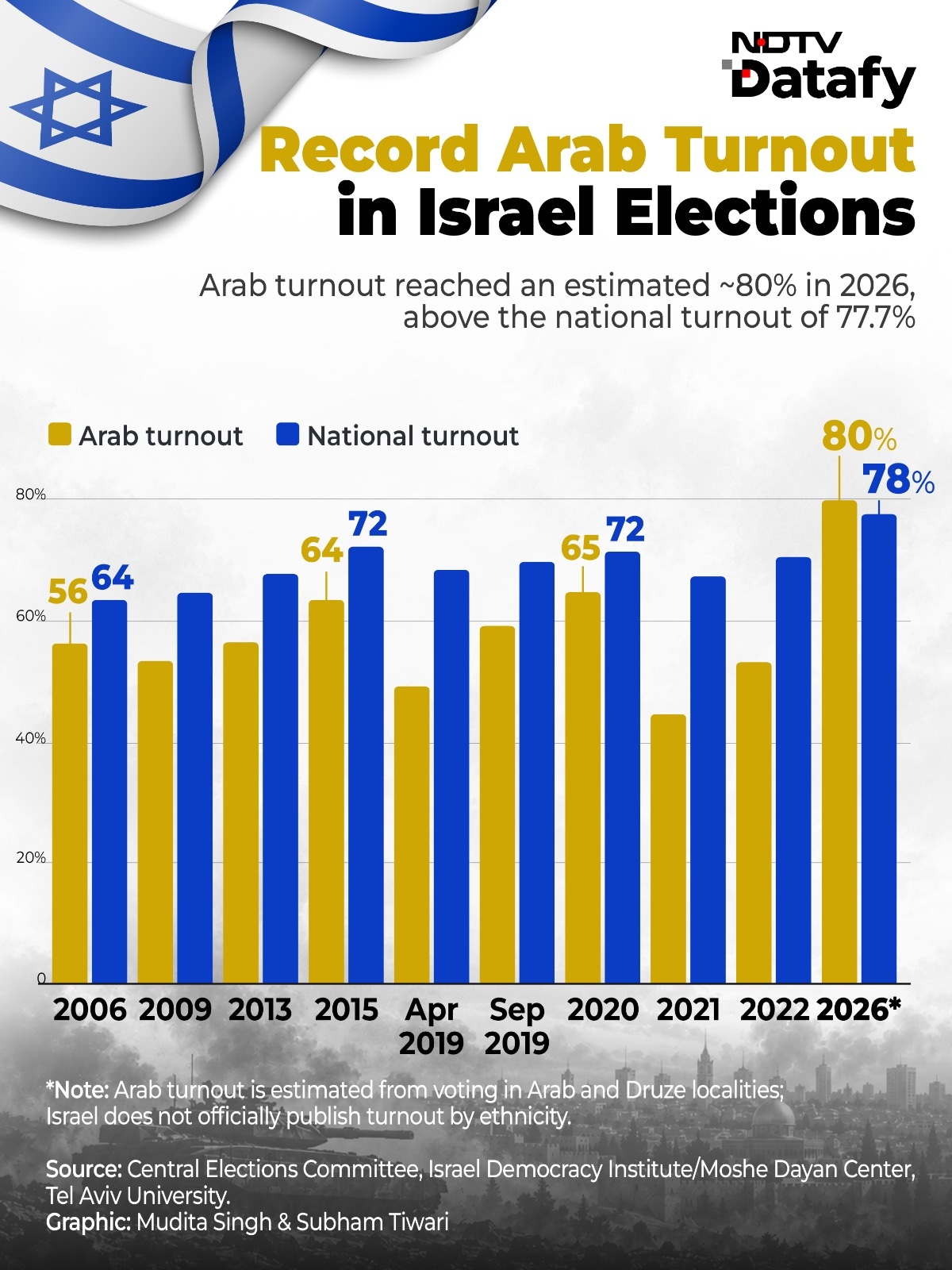
Israel's Channel 12 estimated that turnout among Arab voters was around 80 per cent in the October 27 elections. The national voter turnout was pegged at 77.7 per cent, the highest since 1999.
As per the Jerusalem Post, many Arab-dominated cities and towns recorded turnout higher than in the last parliamentary elections.
Arab citizens of Israel are predominantly the descendants of Palestinians who remained within the country during the 1948 Arab-Israeli war. They largely live in separate towns and neighbourhoods from Jewish Israelis and have long complained of discrimination.
Historically, many Arab voters have avoided participating in the electoral process due to several disagreements, including Israel's nature as a Jewish state, reports the New York Times.
Despite their strong showing, Arab parties have no clear partner. Netanyahu can't risk his far-right coalition by aligning with Arab leaders, and his opponent Gadi Eisenkot, whose bloc appears to have won 48 seats, has not committed to aligning with them either. The majority mark is 61.
Israel's parliamentary elections come three years after the deadly October 7 attack by Hamas that triggered a years-long war, flattened much of the Gaza Strip, and divided Israeli society further along ideological lines.
Israel's electoral system treats the entire country as a single constituency. Voters do not choose individual candidates or local representatives; instead, they cast a ballot for a party, and each party that crosses the electoral threshold of 3.25 per cent of valid votes wins seats in proportion to its national vote share.
Members of Knesset (MKs) are then drawn in order from each party's pre-published, ranked list of candidates, so a party that wins 10 seats sends its top 10 names to parliament. There are no geographic constituencies and no seats reserved for minorities.
This makes two factors decisive for Arab representation: turnout and unity. When Arab voters stay home, their parties shrink; when Arab parties split, some risk falling below the threshold, wasting votes, as happened to Balad in 2022 when it won 2.9 per cent and no seats.
KioskNews shows a cleaned-up reading view extracted from the publisher’s page — the original always lives on their site, not ours.